

Residents in South Korea’s Andong city told to evacuate as wildfires spread
Advertisement
Read this article for free:
or
Already have an account? Log in here »
To continue reading, please subscribe:
Monthly Digital Subscription
$1 per week for 24 weeks*
- Enjoy unlimited reading on winnipegfreepress.com
- Read the E-Edition, our digital replica newspaper
- Access News Break, our award-winning app
- Play interactive puzzles
*Billed as $4.00 plus GST every four weeks. After 24 weeks, price increases to the regular rate of $19.95 plus GST every four weeks. Offer available to new and qualified returning subscribers only. Cancel any time.
Monthly Digital Subscription
$4.99/week*
- Enjoy unlimited reading on winnipegfreepress.com
- Read the E-Edition, our digital replica newspaper
- Access News Break, our award-winning app
- Play interactive puzzles
*Billed as $19.95 plus GST every four weeks. Cancel any time.
To continue reading, please subscribe:
Add Free Press access to your Brandon Sun subscription for only an additional
$1 for the first 4 weeks*
*Your next subscription payment will increase by $1.00 and you will be charged $16.99 plus GST for four weeks. After four weeks, your payment will increase to $23.99 plus GST every four weeks.
Read unlimited articles for free today:
or
Already have an account? Log in here »
Hey there, time traveller!
This article was published 24/03/2025 (372 days ago), so information in it may no longer be current.
SEOUL, South Korea (AP) — Officials in the South Korean city of Andong on Tuesday alerted residents to evacuate to safe areas as firefighters struggled to contain wildfires that have ravaged southern regions since last week, forcing thousands to flee and destroying likely hundreds of structures, including a 1,300-year-old Buddhist temple.
Thousands of firefighters in South Korea were battling at least nine wildfires across the country as of Tuesday afternoon, after the blazes fueled by dry winds burned more than 36,300 acres of land in the past five days.
Officials in Andong, a city in the country’s southeast, and the nearby town of Uiseong ordered residents in several villages and those near Andong University to evacuate to safe locations or temporary shelters — including schools and indoor gyms — as a fire that started in Uiseong continued to spread due to strong winds. The fire in Andong was also reaching the village of Pungcheon, home to the Hahoe folk village, a UNESCO World Heritage site founded around the 14-15th centuries.

The blaze in Uiseong destroyed Gounsa, a Buddhist temple built in the 7th century, according to officials from the Korea Heritage Service. There were no immediate reports of injuries, and some of the temple’s national treasures, including a stone Buddha statue, were evacuated before the fire reached the wooden buildings.
The fire was also spreading to the nearby coastal town of Yeongdeok, where officials shut down roads and ordered residents of at least four villages to evacuate. The Justice Ministry did not immediately confirm local reports that it had begun relocating some 2,600 inmates from a prison in Cheongsong county, near Uiseong.
More than 3,700 firefighters, along with 76 helicopters and 530 vehicles, were deployed to battle the fires in the Uiseong and Andong areas, which were nearly 70% contained as of Tuesday evening, according to the Korea Forest Service.
The service raised its wildfire warning to the highest “serious” level nationwide, requiring local governments to allocate a larger work force for emergency response, tighten entry restrictions for forests and parks, and recommend that military units withhold live-fire exercises.

South Korean officials said earlier on Tuesday that firefighters had extinguished most of the flames from the largest wildfires in the country’s southern regions, including Uiseong, the neighboring town of Sancheong, and Ulsan city. However, the ongoing dry and windy weather now appears to be causing setbacks.
Four firefighters and government workers were killed in Sancheong on Saturday after being trapped by fast-moving flames driven by strong winds. At least 11 other people have been injured by wildfires around the country since last Friday, according to the Ministry of the Interior and Safety.
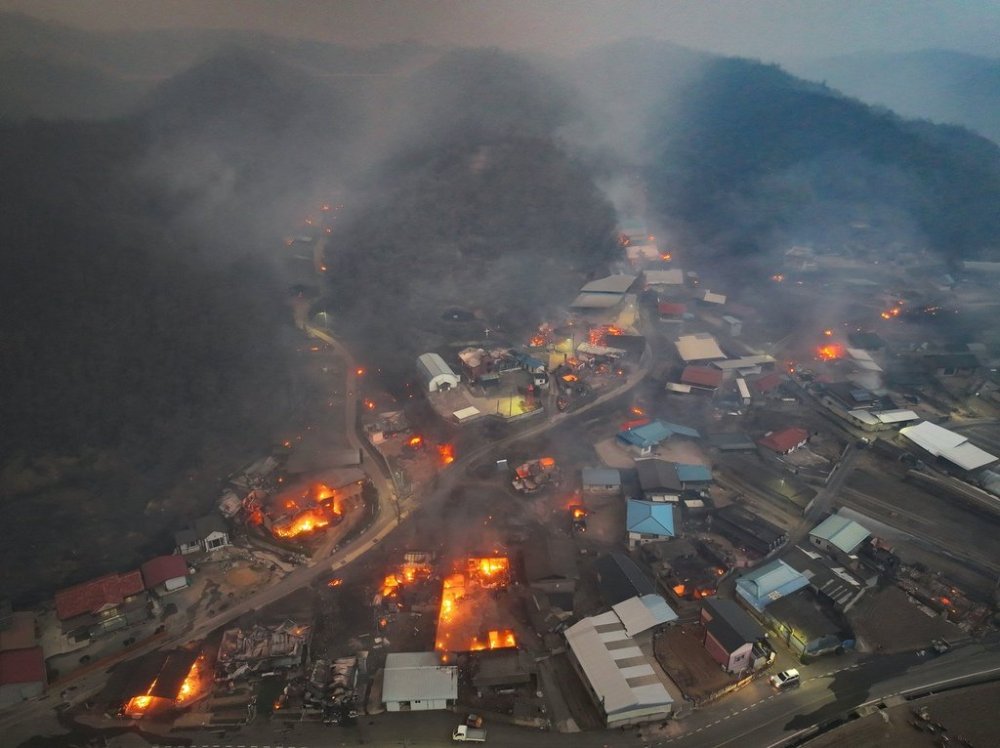
The national government designated the hardest-hit southeastern regions as disaster zones to focus resources and accelerate recovery efforts.
Prime Minister Han Duck-soo, serving as the country’s acting leader following President Yoon Suk Yeol’s impeachment over a December martial law decree, vowed an all-out effort to contain the wildfires during a government meeting on Tuesday. He also urged public vigilance as dry spring weather persists.
Government officials suspect that several of the recent wildfires, including those in Uiseong and Ulsan, were caused by human error, possibly due to the use of fire while clearing overgrown grass in family tombs or sparks from welding work.
Related Articles
South Korea's centuries-old Gounsa temple is left in ruins by unprecedented wildfires
Advertisement Advertise With Us
Advertisement Advertise With Us