At least 24 dead as wildfires ravage southern South Korea and force thousands to evacuate

Advertisement

Advertise with us

SEOUL, South Korea (AP) — Wind-driven wildfires that were among South Korea’s worst ever have ravaged the country’s southern regions, killing 24 people, destroying more than 300 structures and forcing 28,800 residents to evacuate, officials said Wednesday.

Read this article for free:


or

Already have an account? Log in here »

To continue reading, please subscribe:

Subscribe and receive a limited-edition Free Press branded hat or tote.

Digital Subscription

One year of digital access for only $205*

  • Enjoy unlimited reading on winnipegfreepress.com
  • Read the E-Edition, our digital replica newspaper
  • Access News Break, our award-winning app
  • Play interactive puzzles

*First annual payment billed as $205.00 + GST for one year. This annual subscription will automatically renew at $233.00 + GST every 52 weeks (10% off the regular annual price of $259.35). Offer available to new and qualified returning subscribers only. Cancel any time.

To continue reading, please subscribe:

Add Free Press access to your Brandon Sun subscription for only an additional

$1 for the first 4 weeks*

  • Enjoy unlimited reading on winnipegfreepress.com
  • Read the E-Edition, our digital replica newspaper
  • Access News Break, our award-winning app
  • Play interactive puzzles
Start now

*Your next Brandon Sun subscription payment will increase by $1.00 and you will be charged $17.95 plus GST for four weeks. After four weeks, your payment will increase to $24.95 plus GST every four weeks.

Hey there, time traveller!
This article was published 25/03/2025 (561 days ago), so information in it may no longer be current.

SEOUL, South Korea (AP) — Wind-driven wildfires that were among South Korea’s worst ever have ravaged the country’s southern regions, killing 24 people, destroying more than 300 structures and forcing 28,800 residents to evacuate, officials said Wednesday.

The death toll included a pilot who died after a helicopter crashed during efforts to contain a blaze in the southeastern town of Uiseong, one of the hardest-hit areas. The aircraft had no other crew members. Police said that most of the dead are those in their 60s and 70s.

The National Fire Agency said at least 26 people sustained varying degrees of injuries.

A Korea Forest Service helicopter dumps fire retardant on a wildfire in Uiseong, South Korea, Monday, March 24, 2025. (Yoon Gwan-shick/Yonhap via AP)

An ancient Buddhist temple, houses, factories and vehicles were destroyed in the wildfires that have burned 17,752 hectares (43,866 acres), the government’s emergency response center said.

In a televised address, South Korea’s acting President Han Duck-soo said the wildfires that began last Friday were worse than many previous ones.

“Damages are snowballing,” Han said. “There are concerns that we’ll have wildfire damages that we’ve never experienced, so we have to concentrate all our capabilities to put out the wildfires in the rest of this week.”

Han said crews struggled to extinguish the wildfires because strong winds swept the areas overnight. He also said about 4,650 firefighters, soldiers and other personnel were working Wednesday with the help of about 130 helicopters, adding that “a small amount” of 5-10 millimeters (0.1-0.3 inches) of rain was expected Thursday.

As of Wednesday evening, firefighters were tackling at least six active wildfires, including in the southeastern coastal town of Yeongdeok, which alerted residents of the nearest village to evacuate to an indoor gymnasium.
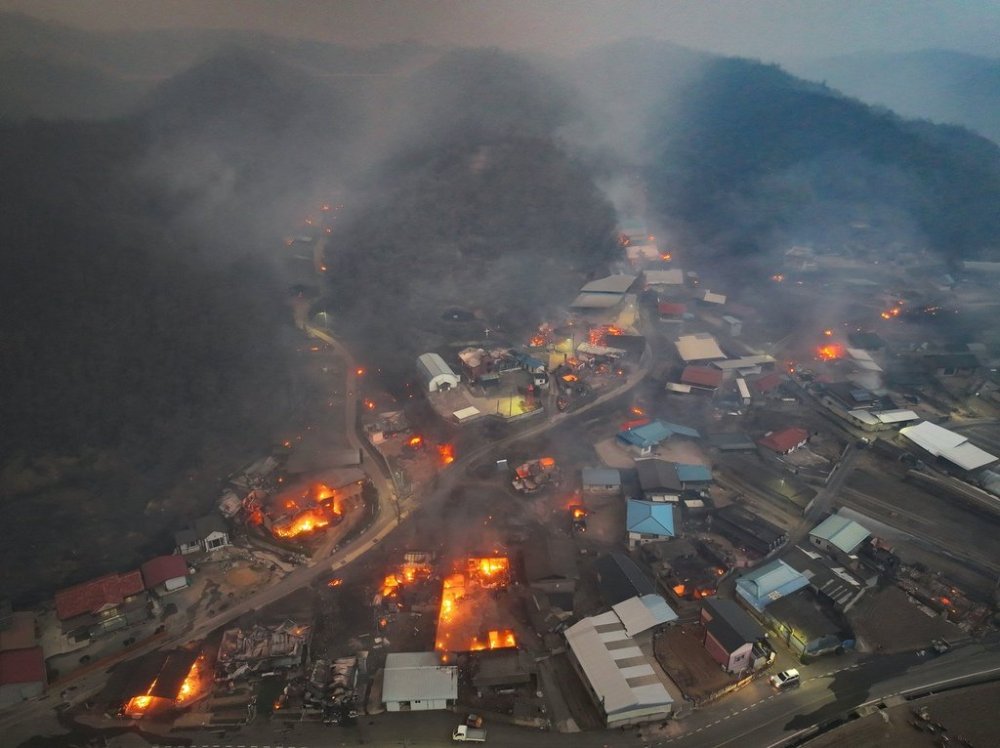
Houses burn in a village after being engulfed by a wildfire fueled by strong winds in Uiseong, South Korea, Tuesday, March 25, 2025. (Yoon Gwan-shick/Yonhap via AP)

Strong winds and smoke-filled skies forced authorities in the southeastern city of Andong to order evacuations in two villages, including Puncheon, home to the Hahoe folk village — a UNESCO World Heritage Site founded around the 14th-15th century. Hikers were advised to leave the scenic Jiri Mountain, one of the country’s largest national parks, as another fire spread closer.

Observers say the ongoing wildfires are the third biggest in South Korea’s history in terms of land burned. The largest fires were in Andong, the neighboring counties of Uiseong and Sancheong, and the city of Ulsan.

On Tuesday, officials said firefighters had extinguished most of the flames from the largest wildfires in those areas, but wind and dry conditions allowed them to spread again.

The blaze in Uiseong destroyed about 20 of the 30 buildings and structures at Gounsa, a temple said to be originally built in the 7th century. Among the burned structures were two state-designated “treasures” — a pavilion-shaped building erected overlooking a stream in 1668, and a Joseon dynasty structure built in 1904 to mark the longevity of a king.

Meanwhile, the Justice Ministry said it protectively removed 500 inmates from a detention center in Cheongsong, another southern town, but no damages were reported to the facility.
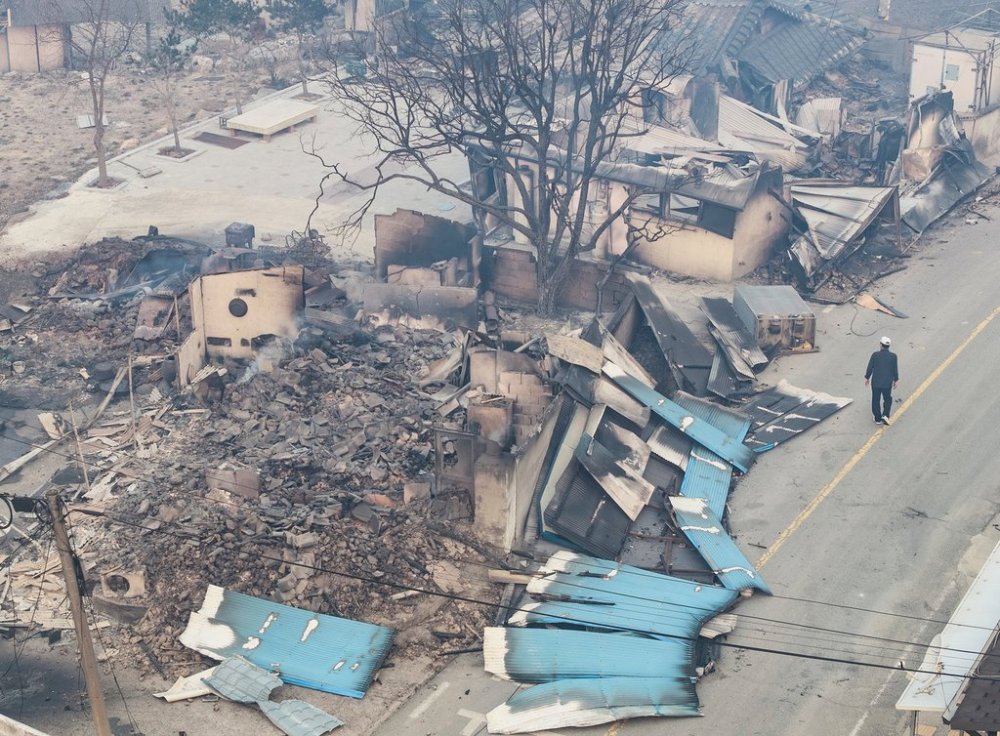
A man walks near a burnt-out house in a damaged village in Yeongyang, South Korea, Wednesday, March 26, 2025. (Yun Kwan-shik/Yonhap via AP)

The Korea Forest Service said it had raised its wildfire warning to the highest level nationwide, requiring local governments to assign more workers to emergency response, tighten entry restrictions for forests and parks, and recommend that military units withhold live-fire exercises.

Among the dead were four firefighters and government workers who died in Sancheong on Saturday after being trapped by fast-moving flames driven by strong winds, according to officials.

Government officials suspect human error caused several of the fires, possibly due to the use of fire while clearing overgrown grass in family tombs or sparks from welding work.
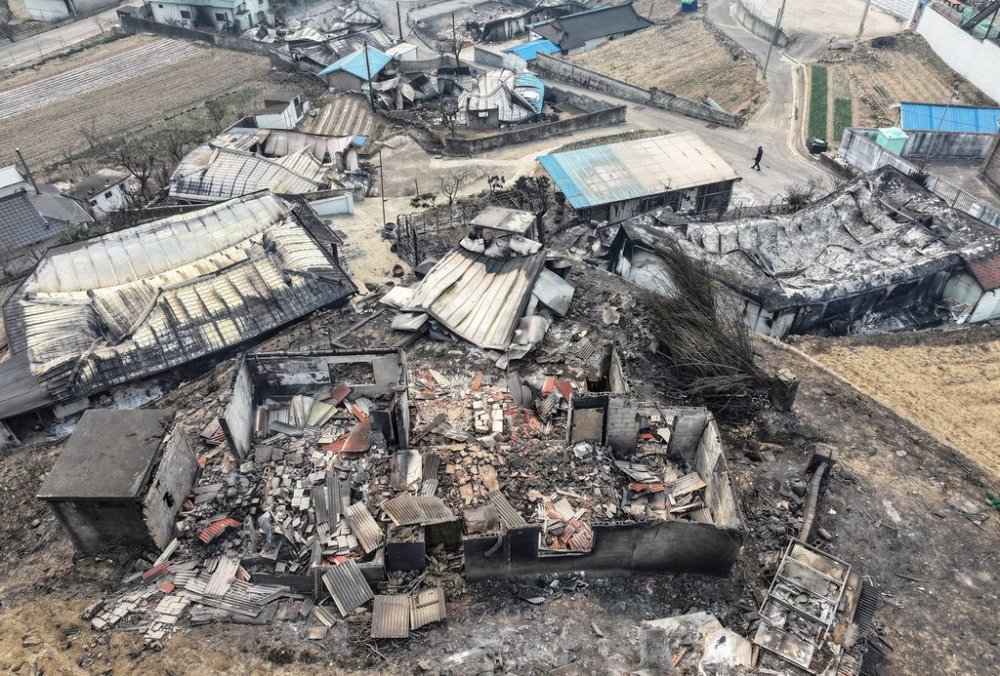
Burnt-out houses are seen at a damaged village due to wildfires in Yeongyang, South Korea, Wednesday, March 26, 2025. (Yun Kwan-shik/Yonhap via AP)
Report Error Submit a Tip

More Stories

Youth centre library cancellation baffles

Editorial 4 minute read Preview

Youth centre library cancellation baffles

Editorial 4 minute read 2:00 AM CDT

It’s difficult to understand why Manitoba Corrections would shut down a library program that cost taxpayers nothing, was popular with young inmates and was designed to help them learn.

Read
2:00 AM CDT

Whistleblower pharmacist fined for misconduct after complaint

Nicole Buffie 5 minute read Preview

Whistleblower pharmacist fined for misconduct after complaint

Nicole Buffie 5 minute read Yesterday at 4:57 PM CDT

A Manitoba pharmacist who made complaints against a colleague that led to sanctions against him has now also been fined due to her own conduct.

Read
Yesterday at 4:57 PM CDT

Corporate declaration of action takes flight

Gabrielle Piché 4 minute read Preview

Corporate declaration of action takes flight

Gabrielle Piché 4 minute read 2:01 AM CDT

Businesses pledging to support reconciliation will meet in Assiniboine Park today as a national project launches.

Read
2:01 AM CDT

AI governance: Canada’s next structural test

Anne Thompson 4 minute read 2:00 AM CDT

Artificial intelligence is accelerating faster than the governance structures meant to contain it. Canada now faces a structural test — whether our institutions can protect autonomy, dignity, and continuity in an era when decision-making is increasingly mediated by systems we did not design, cannot fully audit, and do not yet constitutionally constrain.

This is not a technological problem. It is a governance problem.

AI systems influence how information flows, how institutions behave, and how decisions are made. They shape the conditions under which harm becomes predictable. They amplify both the strengths and weaknesses of the systems into which they are deployed. And they do all of this at a scale and speed that outpaces traditional regulatory tools.

Canada’s current approach to AI governance relies heavily on policy, guidelines, and sector-specific regulation. These are important, but they are not sufficient. What is missing is structural clarity — a constitutional-grade framework that defines authority, responsibility, accountability, and the minimum conditions under which AI systems may operate without undermining human dignity or institutional credibility.

Estate of woman who died from local anesthetic injected into blood vessel sues Morden dentist, his business, clinic

Erik Pindera 4 minute read Preview

Estate of woman who died from local anesthetic injected into blood vessel sues Morden dentist, his business, clinic

Erik Pindera 4 minute read Monday, Oct. 5, 2026

The estate of a 23-year-old woman who died after receiving a local anesthetic during a wisdom tooth extraction at a Morden dental clinic has filed a lawsuit over her death.

Virginia Blatz never returned home after she went to Boundary Trails Dental Centre to have her wisdom teeth removed on Nov. 27, 2024. An autopsy later confirmed she died from local anesthetic systemic toxicity caused by an inadvertent injection into a blood vessel, her family has previously said.

Her father, Dulaney Blatz, filed a lawsuit in the Court of King’s Bench on behalf of her estate late last month, naming Ronald David Janz — the dentist who performed the procedure — his dental corporation and the dental corporation that operates the clinic as defendants.

None of the defendants have filed statements of defence in response to the claim, which has not yet been heard in court.

Read
Monday, Oct. 5, 2026

Don’t let pyjama jibes sour your bedtime bond

Maureen Scurfield 5 minute read 2:01 AM CDT

DEAR MISS LONELYHEARTS: I got married in August and my new husband just bought himself old-man striped flannel pyjamas to wear to bed now that it’s getting colder out. He didn’t do this before we were married. What a turn-off. Should I buy him a nightcap as well?

He used to be a sexy guy who just dumped his clothes on the chair beside the bed and jumped in naked.

But last night I watched him come out of the bathroom in a ratty old robe. I thought, “He looks like my grandfather, not my husband.”

I called out sarcastically, “Hey, gramps, are you lost?” and he said, “Not anymore.” Then he walked into the spare bedroom and slept there all night without me. Help.