

Oh, deer: Riverview resident fears backyard squatters will attract coyotes, spread disease

Advertisement
Read this article for free:
or
Already have an account? Log in here »
To continue reading, please subscribe:

Digital Subscription
One year of digital access for only $205*
- Enjoy unlimited reading on winnipegfreepress.com
- Read the E-Edition, our digital replica newspaper
- Access News Break, our award-winning app
- Play interactive puzzles
*First annual payment billed as $205.00 + GST for one year. This annual subscription will automatically renew at $233.00 + GST every 52 weeks (10% off the regular annual price of $259.35). Offer available to new and qualified returning subscribers only. Cancel any time.
To continue reading, please subscribe:
Add Free Press access to your Brandon Sun subscription for only an additional
$1 for the first 4 weeks*
- Enjoy unlimited reading on winnipegfreepress.com
- Read the E-Edition, our digital replica newspaper
- Access News Break, our award-winning app
- Play interactive puzzles
*Your next Brandon Sun subscription payment will increase by $1.00 and you will be charged $17.95 plus GST for four weeks. After four weeks, your payment will increase to $24.95 plus GST every four weeks.
Read unlimited articles for free today:
or
Already have an account? Log in here »
Hey there, time traveller!
This article was published 26/03/2025 (564 days ago), so information in it may no longer be current.
A RIVERVIEW resident who watched as nine deer settled in her backyard last weekend wasn’t exactly fawning over the close encounter with wildlife.
Eileen Metz, who has lived at her Churchill Drive residence for nearly 50 years, said the deer population has never been as high as it has been recently, and she’s worried it’s attracting coyotes and things such as Lyme disease into the area.
“They’re beautiful, but if they carry disease, if they’re attracting coyotes … they need to be moved out into the forest area,” she said. “It’s a problem. One day, one is going to get killed (by a car). They just run back and forth through the neighbourhood.”
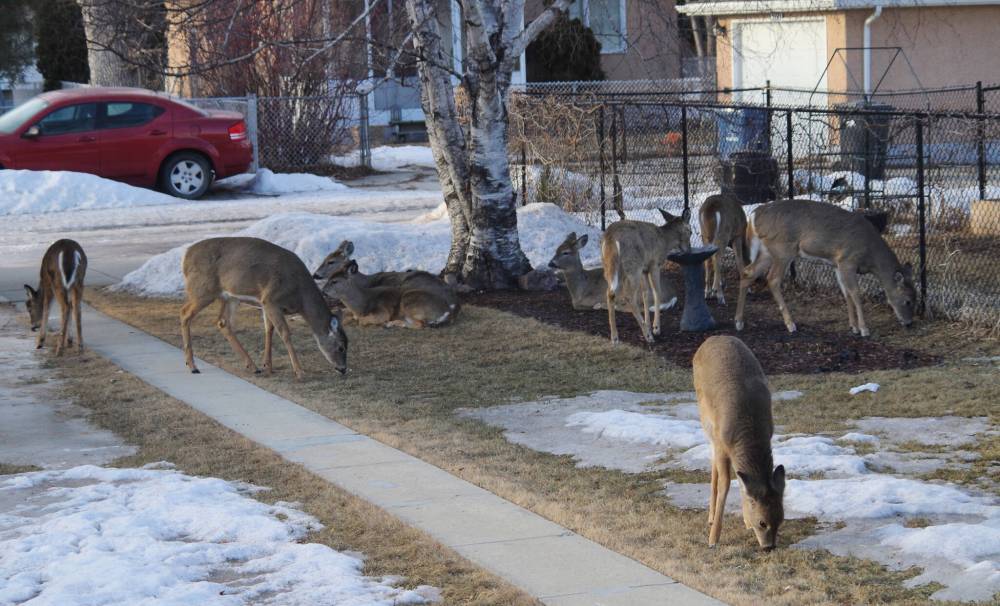
SUPPLIED
A photo showing nine deer on a Churchill Drive home’s property on Saturday. The homeowner is concerned that the high deer population will attract predators and possibly bring disease into the area.
Metz captured photos of two bucks locking antlers last November and a coyote lurking in a nearby park last month. Concerned, she contacted Manitoba Conservation and even visited Premier Wab Kinew’s constituency office Tuesday to voice her concerns.
The conservation officer she spoke with informed her that the deer would not be removed and suggested a homemade water and cayenne pepper solution to keep them away from her plants.
“As far as I’m concerned, that’s not a satisfactory answer,” she said.
But it’s the only answer, according to the province.
“Relocating deer outside of Winnipeg does not address the underlying reasons why deer are in the city and is not an effective long-term strategy,” a government spokesperson said.
The animals are attracted to the city for its abundant food and reduced predation.
Relocation efforts are also not cost-efficient; it is a very expensive process both in terms of financial and human resources needed.
“Relocations often result in high mortality rates for the deer being moved and can also increase the risk of disease transmission when the deer are moved into new areas for release,” the spokesperson said.
Data from the province’s Natural Resources and Indigenous Futures Department shows that there are more than 6,000 known deer-vehicle collisions each year, including about 600 in Winnipeg.
The department also warns against feeding deer, suggesting that supplemental feeding practices are no longer considered sound wildlife management because of associated risks, including transmission of disease and parasites, worsening habitat conditions, increased deer density and an associated rise in predation.
Deer accustomed to humans and attracted to supplemental food sources can cause damage to surrounding vegetation.
Rising urban population has the potential to increase deer reproduction and survival rates, leading to artificially increased numbers that a habitat may not be able to sustain, resulting in long-term damage for both deer and other wildlife.
Wildlife experts, however, say deer and other animals taking up residence in urban areas are a natural occurrence and something city residents must learn to live with.
“Deer herding up like that is extremely common in the wintertime,” said Chris Benson, program and events co-ordinator with the Manitoba Wildlife Federation. “Nine deer isn’t a large number. And the reason why they’re in the city is there’s food.”
Deer are drawn to bird seed left out in the winter and salt used to melt ice on sidewalks and driveways.
Benson said Winnipeg’s Red and Assiniboine rivers serve as natural corridors for deer, allowing them to venture deep into the city, including areas such as Churchill Drive, which winds along the Red.
“And when you have those prey species (deer), it naturally attracts predators (coyotes),” he said.
Soon, fawns will be born, which is what coyotes will be after in a month or two.
“It’s the natural prey-predator cycle,” Benson said, adding people must remember that cities and towns are shared territories on land that was once untouched habitat for deer.
A few doors down from Metz, Peter Scheppit can’t get enough of the wildlife. He said he’s had several deer camping out in his backyard on and off for years.
He’s lived in his home for 25 years and has seen generations of young deer grow.
“It’s nice to have the wildlife; it’s not a problem at all,” he said.
Another nearby neighbour, who wished to remain anonymous, said the wildlife comes with the territory.
“It would be sad if they were removed,” he said, though he has noticed an uptick in the deer population in recent years.
While his wife, an avid gardener, finds it frustrating at times, they’ve adapted by being mindful of what and where they plant.
“I can see that pissing someone off,” he said. “But honestly, they’re really pretty. They’re beautiful.”

His concerns are mainly with the deer getting too comfortable, and he worries that one may get hit by a car.
“I’m surprised there haven’t been more,” he said.
The province said deer populations are stable, although they fluctuate from year to year. Deer appear to be benefiting from an average Manitoba winter.
Residents can take measures to reduce the risk of property damage, including fencing, repellents and scaring devices such as motion-activated lights, water sprayers, noise-makers, radios and scarecrows — although effectiveness can be short-lived, the government spokesperson said.
scott.billeck@freepress.mb.ca
Scott Billeck is a general assignment reporter for the Free Press. A Creative Communications graduate from Red River College, Scott has more than a decade’s worth of experience covering hockey, football and global pandemics. He joined the Free Press in 2024. Read more about Scott.
Every piece of reporting Scott produces is reviewed by an editing team before it is posted online or published in print — part of the Free Press‘s tradition, since 1872, of producing reliable independent journalism. Read more about Free Press’s history and mandate, and learn how our newsroom operates.
Our newsroom depends on a growing audience of readers to power our journalism. If you are not a paid reader, please consider becoming a subscriber.
Our newsroom depends on its audience of readers to power our journalism. Thank you for your support.
Scott Billeck is a general assignment reporter for the Free Press. A Creative Communications graduate from Red River College, Scott has more than a decade’s worth of experience covering hockey, football and global pandemics. He joined the Free Press in 2024. Read more about Scott.
Every piece of reporting Scott produces is reviewed by an editing team before it is posted online or published in print — part of the Free Press‘s tradition, since 1872, of producing reliable independent journalism. Read more about Free Press’s history and mandate, and learn how our newsroom operates.
Our newsroom depends on a growing audience of readers to power our journalism. If you are not a paid reader, please consider becoming a subscriber.
Our newsroom depends on its audience of readers to power our journalism. Thank you for your support.

Advertisement Advertise With Us
Advertisement Advertise With Us