Sewage sludge can find a second life on farm fields. Here’s how it’s made

Advertisement

Advertise with us

What goes down your toilet can end up on farm fields across the United States.

Read this article for free:


or

Already have an account? Log in here »

To continue reading, please subscribe:

Subscribe and receive a limited-edition Free Press branded hat or tote.

Digital Subscription

One year of digital access for only $205*

  • Enjoy unlimited reading on winnipegfreepress.com
  • Read the E-Edition, our digital replica newspaper
  • Access News Break, our award-winning app
  • Play interactive puzzles

*First annual payment billed as $205.00 + GST for one year. This annual subscription will automatically renew at $233.00 + GST every 52 weeks (10% off the regular annual price of $259.35). Offer available to new and qualified returning subscribers only. Cancel any time.

To continue reading, please subscribe:

Add Free Press access to your Brandon Sun subscription for only an additional

$1 for the first 4 weeks*

  • Enjoy unlimited reading on winnipegfreepress.com
  • Read the E-Edition, our digital replica newspaper
  • Access News Break, our award-winning app
  • Play interactive puzzles
Start now

*Your next Brandon Sun subscription payment will increase by $1.00 and you will be charged $17.95 plus GST for four weeks. After four weeks, your payment will increase to $24.95 plus GST every four weeks.

Hey there, time traveller!
This article was published 26/03/2025 (546 days ago), so information in it may no longer be current.

What goes down your toilet can end up on farm fields across the United States.

Biosolids, or sewage sludge, are the solid byproducts of the wastewater treatment process. Rich in nutrients, they can be used as fertilizer on agricultural fields or compost on lawns.

But the process for producing these materials can vary greatly, and some unwanted things can end up in those biosolids. A recent study released by the U.S. Environmental Protection Agency suggested that human health risks associated with toxic per- and polyfluoroalkyl substances (PFAS) were elevated in some places where sludge was applied to farm fields.
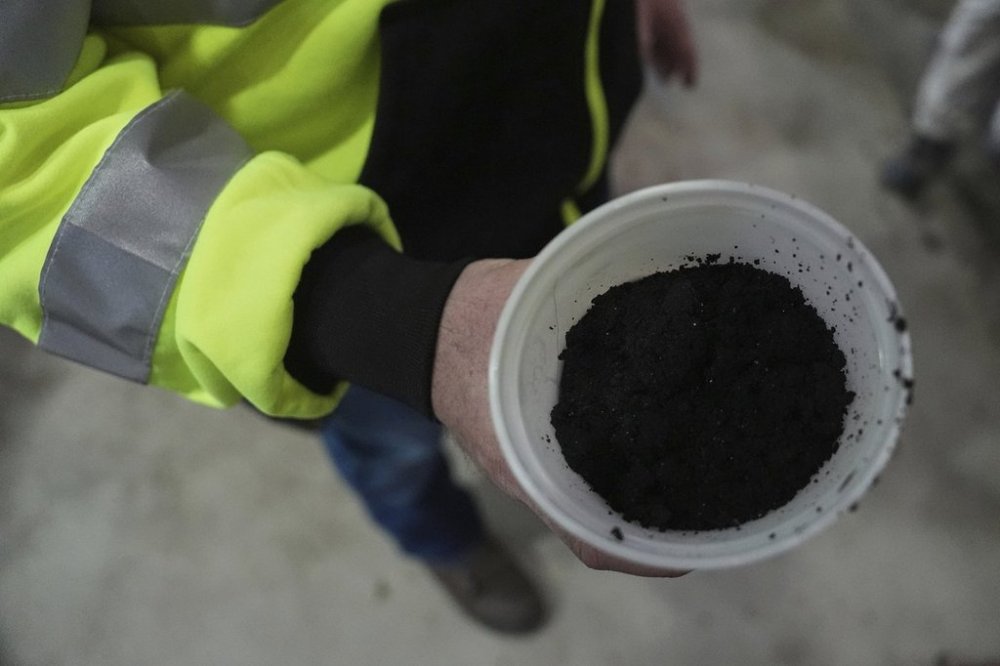
Josh Lutz displays some biosolids, also known as sewage sludge, Friday, March 7, 2025, at a wastewater treatment facility in Lockbourne, Ohio. (AP Photo/Joshua A. Bickel)

The amount of these “forever chemicals” that could end up in biosolids depends on how much were in the water coming into the plant.

“They are very widespread,” said Carsten Prasse, an assistant professor at Johns Hopkins University who studies biosolids. But they’re not in all biosolids and sometimes it’s only in small amounts, he added.

Here’s how they’re made:

At most treatment plants, wastewater is pumped in through large pipes and large debris removal begins immediately. At a facility just outside Columbus, Ohio, a machine screens out large debris such as toilet paper and trash. That debris is collected, compacted and taken to a landfill for disposal.

After large debris is removed, the wastewater flows into a sedimentation tank, a large, open-air and cone-shaped tank where gravity pulls heavier solids to the bottom. A long mechanical arm corrals floating solids into a drain on the top of the tank. A similar arm at the bottom of the tank gathers up the solids there.

The liquid is moved from the sedimentation tanks to an aeration tank where air encourages the growth of microbes that further break down organic particles. The wastewater then gets moved back to another sedimentation tank where more solids are removed.

The solids that are removed at each step of the process are put through thickening centrifuges, then go into these tanks for anaerobic digestion, where microbes continue breaking down organic matter. The tanks are heated to a prescribed temperature for a certain number of days to kill off most pathogens.

After another thickening step, the solids are ready to apply to farm fields based on the U.S. Environmental Protection Agency’s regulations for land-applied biosolids.

“There are values in using biosolids in agriculture because of their high nutrient concentrations,” including nitrogen and phosphorus, Prasse said. They can also help strengthen soil and help with irrigation, he added.

Some treatment facilities further dry out sludge, turning it into a dirt-like material that can emit steam as microbes do their work in decomposition.

The waste that make up biosolids can vary widely depending on what’s in the water. In addition to human waste, biosolids might contain all kinds of everyday household chemicals like beauty products and pharmaceuticals, some of which may contain forever chemicals, Prasse added. At the Columbus facility, the majority of their waste comes from households and businesses.

The Columbus facility tests the final product for metals and nutrients such as phosphorus and nitrogen every month even when they are being stored before land application.

In Columbus, the city takes half of these dirt-like biosolids to a composting facility nearby, where they are mixed with other organic material like trees and leaves and turned into compost after an additional round of heating and aeration to further kill off pathogens. These biosolids are less regulated and can be used on land such as parks or a residential yard.

The Columbus facility, like most such operations, doesn’t test the incoming material for PFAS, an expensive proposition. Dixon said any future testing or treatment of wastewater for PFAS at his facility would depend on future federal regulations.

——

Follow Joshua A. Bickel on Instagram, Bluesky and X @joshuabickel.

——

The Associated Press’ climate and environmental coverage receives financial support from multiple private foundations. AP is solely responsible for all content. Find AP’s standards for working with philanthropies, a list of supporters and funded coverage areas at AP.org.

Report Error Submit a Tip

More Stories

Accept the fact you’re a sensitive soul

Maureen Scurfield 6 minute read Yesterday at 2:00 AM CDT

DEAR MISS LONELYHEARTS: I’m 30, and recently met a girl eight years younger than I am. While we had a great time the first weeks going out for dinners, to the bar and back to my place to make love, she’s now thrown up a big wall!

She left very early in the morning yesterday. I yelled that I wanted to see her again real soon, as she went out the door. But she hasn’t replied to my texts or phone calls since! I’ve reached out, four or five times. I feel like I’m doing something wrong, but I can’t help feeling a lot for her! What should I do?

— Longing for More, River Heights

Dear Longing: Stop trying to reconnect now. By not replying, she’s telling you she’s not interested. You don’t need more of this rejection pain in your life, and you don’t need all this uncertainty and obsessing.

Decorated business vet Spiring announced as NSL Winnipeg president

Grace Anne Paizen 5 minute read Preview

Decorated business vet Spiring announced as NSL Winnipeg president

Grace Anne Paizen 5 minute read Updated: Yesterday at 12:30 PM CDT

Manitoba’s own Dayna Spiring is no stranger to the sports world, but her latest venture into the world of football — this time of the kick-about variety — is a whole new ball game.

“I’m getting up to speed on that as quickly as I can,” Spiring told the Free Press Tuesday, shortly after the accomplished business leader was announced as Northern Super League Winnipeg’s president.

Spiring joins an already stacked roster on the first women’s professional sports team in the Keystone province alongside the likes of NSL Winnipeg’s decorated co-founders Desiree Scott and Rob Gale.

And her own stats sheet is just as historic. Spiring was one of the first women to serve on the CFL’s Board of Governors and was the first woman to serve as chair of the Winnipeg Football Club’s board of directors. She is also the first woman to have her name engraved on the Grey Cup when the Winnipeg Blue Bombers captured back-to-back titles in 2019 and 2021.

Read
Updated: Yesterday at 12:30 PM CDT

Manitoba budget reveals province underspent on crucial departments related to justice, public safety

Carol Sanders 5 minute read Preview

Manitoba budget reveals province underspent on crucial departments related to justice, public safety

Carol Sanders 5 minute read Updated: 8:09 AM CDT

While concerns about homelessness and public safety continue to make headlines in Manitoba, the two government departments mainly responsible for addressing them came in under budget last year.

The 2025-26 public accounts, released Monday, show Housing, Addictions and Homelessness underspent its budget of $869 million by $18 million. Manitoba Justice underspent its budget of $994 million by $34 million.

The 247-page public accounts report attributes the underspending in justice mainly to “reduced impacts of contingency liabilities,” such as a court ruling or legal settlement.

The report did not explain how and why Housing, Addictions and Homelessness underspent its budget last year as the province addresses those critical issues.

Read
Updated: 8:09 AM CDT

U.S. prosecutors and defence counsel for a 32-year-old man accused of sexually exploiting a 10-year-old Manitoba girl online are working to draft a plea deal, a court document shows.

Cortney Arden Wise III, of Wadsworth, Ohio, faces federal charges, including sexual exploitation of children and possession of child pornography.

Court documents allege he posed as a 15-year-old boy when he groomed and convinced the girl to send photos and videos of herself via Snapchat.

Manitoba RCMP were notified in December 2025 after the girl’s grandmother discovered messages. RCMP then contacted the U.S. Department of Homeland Security, whose agents arrested Wise and searched his home Feb. 12.

Manitoba students able to opt out of classes with sensitive lessons on sex, drug use

Maggie Macintosh 6 minute read Preview

Manitoba students able to opt out of classes with sensitive lessons on sex, drug use

Maggie Macintosh 6 minute read Yesterday at 7:08 PM CDT

Manitoba’s premier pledges to continue allowing parents to pull their kids from health class if content — be it related to human sexuality, substance use or otherwise — clashes with personal beliefs.

Wab Kinew said Tuesday the government’s overhaul of phys-ed and health curriculum in Manitoba schools won’t impact the ability for parents to opt-out of a lesson and deliver material as they see fit.

“As a parent, you are your child’s first and most important teacher and that will always be the case,” Kinew said, surrounded by hundreds of teenagers on the football field outside Kelvin High School during an announcement Tuesday.

More than 100 schools are taking part in a voluntary pilot project this fall. It’s the first systematic review of this curriculum in decades. The changes to kindergarten-to-Grade 12 courses will be mandated to all schools in September 2028.

Read
Yesterday at 7:08 PM CDT

Health Canada suspends plasma collection at Grifols Taylor Avenue clinic

Chris Kitching 3 minute read Preview

Health Canada suspends plasma collection at Grifols Taylor Avenue clinic

Chris Kitching 3 minute read 1:59 PM CDT

Health Canada has suspended all plasma collection at Grifols’ Taylor Avenue facility while the private company continues to face scrutiny after two people died following donations at its Winnipeg clinics.

The suspension was issued Wednesday, although Grifols announced Aug. 13 it was pausing plasma collection in Canada a day after the federal department gave the Taylor Avenue site a non-compliant rating.

“Health Canada issued the suspension because Grifols had not effectively implemented some corrective and preventive actions and, overall, it failed to demonstrate that the Taylor Avenue site has implemented an effective quality management system,” the department said in a statement.

The Free Press has contacted Grifols for comment.

Read
1:59 PM CDT