Race against tariffs: consumers, auto industry brace for impact
Read this article for free:
or
Already have an account? Log in here »
To continue reading, please subscribe:

Digital Subscription
One year of digital access for only $205*
- Enjoy unlimited reading on winnipegfreepress.com
- Read the E-Edition, our digital replica newspaper
- Access News Break, our award-winning app
- Play interactive puzzles
*First annual payment billed as $205.00 + GST for one year. This annual subscription will automatically renew at $233.00 + GST every 52 weeks (10% off the regular annual price of $259.35). Offer available to new and qualified returning subscribers only. Cancel any time.
To continue reading, please subscribe:
Add Free Press access to your Brandon Sun subscription for only an additional
$1 for the first 4 weeks*
- Enjoy unlimited reading on winnipegfreepress.com
- Read the E-Edition, our digital replica newspaper
- Access News Break, our award-winning app
- Play interactive puzzles
*Your next Brandon Sun subscription payment will increase by $1.00 and you will be charged $17.95 plus GST for four weeks. After four weeks, your payment will increase to $24.95 plus GST every four weeks.
Read unlimited articles for free today:
or
Already have an account? Log in here »
Hey there, time traveller!
This article was published 03/04/2025 (529 days ago), so information in it may no longer be current.
The new GMC truck that’s parked at Wayne Bartley’s house was driven there, in part, by fresh U.S. tariffs.
American President Donald Trump hadn’t yet placed 25 per cent levies on foreign-made vehicle imports. Prime Minister Mark Carney hadn’t promised to retaliate with taxes that mirror America’s, targeting U.S.-imported autos that don’t comply with the Canada – United States – Mexico Agreement.
The politicians’ decisions took effect March 26 and on Thursday, respectively.
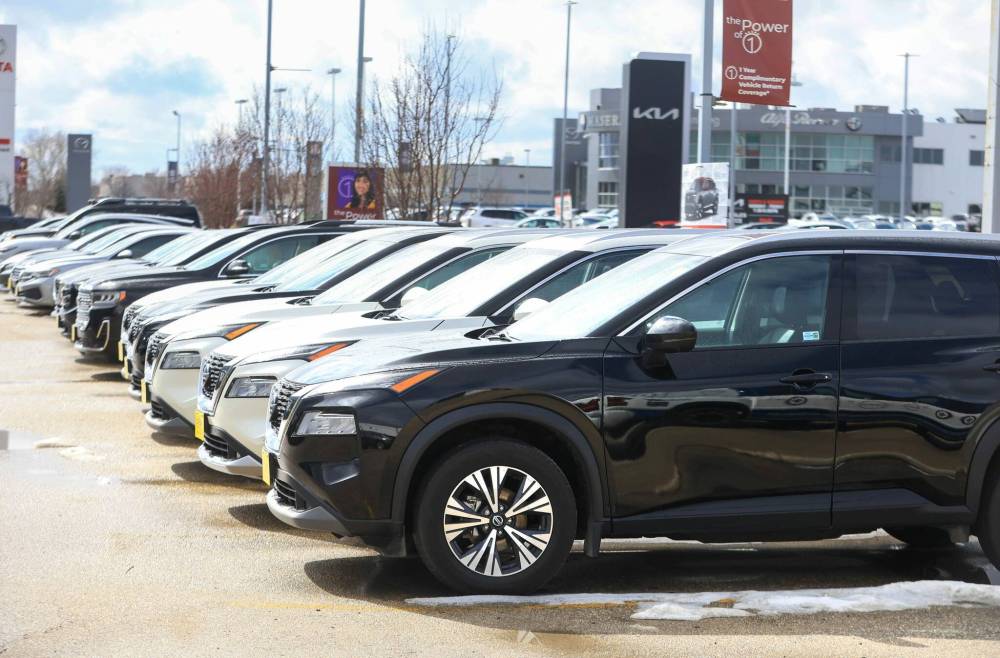
The Crown Auto Group recorded higher sales over the past couple of months.
But last month, tariff threats were being made and Bartley was already considering a new ride.
He researched online to learn how prices could climb if tariffs were imposed. Meanwhile, he was racking up mileage on the truck he wanted to trade in.
“This tariff thing started building and building,” Bartley recalled. “(My wife and I) decided it was probably the best time.”
He joined other Manitobans who raced to buy vehicles and related parts in the weeks leading up to tariff action.
Both the Crown Auto Group and Birchwood Automotive Group, with a collective 31 dealerships locally, recorded higher sales over the past couple of months.
Industry analysts are forecasting inflated vehicle prices and reduced production due to the trade war.
“(This) could have impacts on people’s pocketbooks, the payments they’re making every month,” said Dhiya Dilawri, co-chief executive of Crown Auto Group.
Employees have warned Crown customers of potential price hikes down the road, Dilawri said.
The business has increasingly ordered lower-priced vehicles in anticipation of such hikes and potential buyer demand, she said.
Crown Auto is waiting to hear from manufacturers — Honda, Toyota — about the trickle-down cost of the tariffs.
“There is no such thing as an only-Canadian car, only-American car,” Dilawri said.
“This tariff thing started building and building. (My wife and I) decided it was probably the best time.”–Wayne Bartley
Steve Chipman, president of Birchwood Automotive Group agrees. He gave the example of Ford F-150s: the trucks are made in America, but parts come from both Mexico and Canada.
Canadian tariffs on U.S.-imported vehicles may raise prices at some dealerships. Chipman predicted dealers who sell overseas models, however, could see a spike in customers in upcoming months.
He described the past six months of car sales as “strong.” Tariffs didn’t appear to be the primary reason for purchases, he stated.
“People were holding off buying vehicles because there weren’t vehicles to buy,” Chipman said, recalling the COVID-19 pandemic.
Vehicles were in short supply, and were increasingly expensive, amid supply chain snarls and a shortage of microchips.
Canada’s economy has grown stronger and vehicles are more readily available, Chipman explained.
“This is a COVID-like challenge,” he said about tariffs. “We’ll work through this, and we’ll be better and stronger.”
Used car prices on AutoTrader rose 0.3 per cent month-over-month in March. It’s against seasonal trends, reminding Baris Akyurek of pandemic times.
Akyurek, AutoTrader’s vice-president of insights and intelligence, expects prices to continue to increase if tariffs drag on. People seek used options, which are generally cheaper than new, as costs rise, Akyurek said.
“The used-car supply is already constrained.”
“There is no such thing as an only-Canadian car, only-American car.”–Dhiya Dilawri
Trump maintains his country will regain manufacturing jobs due to auto tariffs.
However, the shift would require the construction of new plants, retooling of current facilities and many millions of dollars and years of change, said Sam Fiorani, vice-president of AutoForecast Solutions, a Pennsylvania company that analyzes the auto industry.
AutoForecast predicts light vehicle sales in the U.S. will decrease 3.2 per cent from last year. It revised its projection from 16.25 million vehicles sold this year to 15.46 million due to the tariff tiff.
New U.S. production is unlikely in both 2025 and 2026, Fiorani predicted. He anticipates production slowdowns on both sides of the border. Meantime, “a couple thousand dollars” could be added to the price of every vehicle hit by tariffs, he said.
“The North American manufacturing machine is designed to have free trade,” Fiorani continued. “It works very efficiently.”
Firms based in the U.S. were stocking up on Canadian-assembled vehicles — such as Toyota Rav4s and Honda CR-Vs — ahead of the tariffs being implemented, Fiorani said. He assumed Canadian firms did the same.
“The border is changing,” he stated. “Everybody had to be prepared for whatever was going to occur in April and May.”
West End Tire bought three months’ worth of inventory from its American supplier to avoid the 25 per cent tax — the Canadian one — earlier this year.
The company doesn’t have any Canadian options for the treads it needs, said chief operating officer Charlie Pantel. Canada’s levy was applied during a round of retaliatory tariffs last month.
“If we want to stay in business, we absolutely have no choice but to keep purchasing from the United States,” Pantel said.
“The border is changing. Everybody had to be prepared for whatever was going to occur in April and May.”–Sam Fiorani
Once the stock runs out, West End Tire will have to raise prices “somewhat” to account for tariffs, Pantel said.
Premier Wab Kinew noted the province has talked with Ottawa about the “remissions process.”
“(It’s), ‘How do we carve out the retaliation so it doesn’t hit Manitoba workers?” he told reporters Thursday, adding the two governments are working together to “address those concerns.”
Carney said Canada’s retaliatory tariff on U.S.-imported vehicles could raise as much as $8 billion before any requests for tariff relief are factored in.
— With files from Carol Sanders and The Canadian Press
gabrielle.piche@winnipegfreepress.com


Gabrielle Piché reports on business for the Free Press. She interned at the Free Press and worked for its sister outlet, Canstar Community News, before entering the business beat in 2021. Read more about Gabrielle.
Every piece of reporting Gabrielle produces is reviewed by an editing team before it is posted online or published in print — part of the Free Press‘s tradition, since 1872, of producing reliable independent journalism. Read more about Free Press’s history and mandate, and learn how our newsroom operates.
Our newsroom depends on a growing audience of readers to power our journalism. If you are not a paid reader, please consider becoming a subscriber.
Our newsroom depends on its audience of readers to power our journalism. Thank you for your support.
Related Articles
Prime Minister Mark Carney says Canada will match U.S. auto tariffs







History
Updated on Thursday, April 3, 2025 7:17 PM CDT: Adds "couple of"