

Menstruation, consent move up in sex-ed lesson plan
More than 100 Manitoba schools participate in new health curriculum pilot

Advertisement
Read this article for free:
or
Already have an account? Log in here »
To continue reading, please subscribe:

Digital Subscription
One year of digital access for only $205*
- Enjoy unlimited reading on winnipegfreepress.com
- Read the E-Edition, our digital replica newspaper
- Access News Break, our award-winning app
- Play interactive puzzles
*First annual payment billed as $205.00 + GST for one year. This annual subscription will automatically renew at $233.00 + GST every 52 weeks (10% off the regular annual price of $259.35). Offer available to new and qualified returning subscribers only. Cancel any time.
To continue reading, please subscribe:
Add Free Press access to your Brandon Sun subscription for only an additional
$1 for the first 4 weeks*
- Enjoy unlimited reading on winnipegfreepress.com
- Read the E-Edition, our digital replica newspaper
- Access News Break, our award-winning app
- Play interactive puzzles
*Your next Brandon Sun subscription payment will increase by $1.00 and you will be charged $17.95 plus GST for four weeks. After four weeks, your payment will increase to $24.95 plus GST every four weeks.
Read unlimited articles for free today:
or
Already have an account? Log in here »
Manitoba’s newest curriculum introduces the menstrual cycle earlier and repeatedly calls for explicit lessons on how students can give, seek, and decline to provide their consent.
The education department has released its sweeping proposal to overhaul how exercise, nutrition and sexuality are taught between kindergarten and Grade 12.
Grade 5 has long served as a key turning point for “the talk,” said J Fiedler, a sexual and reproductive health educator who provided input on the new curriculum.
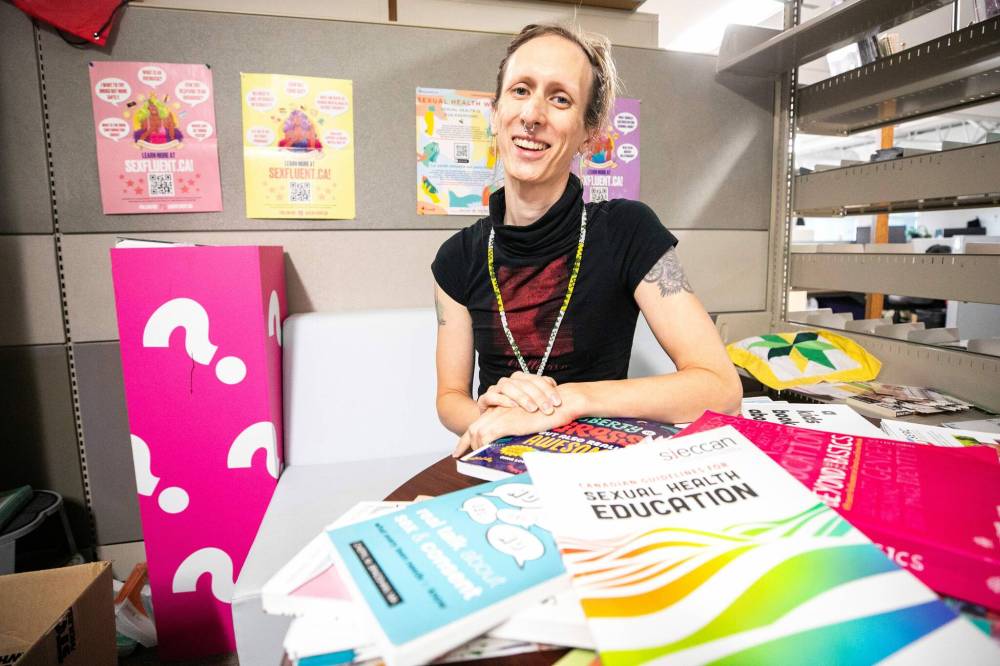
MIKAELA MACKENZIE / FREE PRESS
J Fiedler, a sexual and reproductive health educator, has been working with school divisions to train teachers to confidently deliver age-appropriate lessons.“There’s no ‘the talk’ anymore. Now, there’s continuations of multiple ‘talks,’ which can hopefully reduce stress for students and stigma that people experience talking about sexuality.”
Instead of in-depth human sexuality units in specific grades — the status quo includes kindergarten and grades 2, 5 and 7 — the new curriculum embeds it in all levels.
Setting personal boundaries and the role outside influences play on one’s choices are among many recurring themes.
Grade 4 is now a particularly noteworthy year in which menstruation, ejaculation and physical, emotional and social changes that can happen during puberty are discussed.
One change is the explicit requirement for students to “recognize that menstruation is a normal and natural part of growth and development that should not be treated with secrecy or shame.”
Fiedler, a program co-ordinator at the Sexuality Education Resource Centre, said the changes are more developmentally appropriate and acknowledge the onset of puberty is getting earlier.
The SERC staffer has been working with school divisions to train teachers to get more comfortable with content and confidently deliver age-appropriate lessons for the better part of the last decade.
The new curriculum approaches health as a holistic concept and was designed to be far more simple and accessible than its predecessor, Fiedler said.
There hasn’t been a systemwide overhaul of the phys-ed and health curriculum in more than 25 years.
The existing documents, the last of which was revised in 2008, don’t mention many of the terms that are now mainstream in health education. “Artificial intelligence,” “screengrabs,” and “sextortion” are new additions.
Fiedler said the explicit and repeated inclusion of the word “consent,” a concept that was referenced using different language in the past, is a hugely important change.
The new curriculum explores what asking for consent can look like instead of simply promoting how to refuse unwanted sexual advances, substances and other things.
For instance, Grade 7 students are now studying the conditions, such as “freely given, reversible, informed, enthusiastic, specific,” of sexual consent. They are also required to develop strategies to address conflict and communicate continuously in a variety of sexual situations and relationships.
More than 100 schools have volunteered to start immediately using the new curriculum. A mandatory rollout is scheduled for the 2028-29 school year.
“The level of excitement among phys-ed and health teachers is high,” said Alyson Gysel, co-president of the Physical and Health Educators of Manitoba.
That’s because the new content, including repeated references to self-regulation and anxiety-management, accurately reflects student needs, Gysel said.
Each grade has a list of fitness-related learning outcomes and another with key health lessons that tackle everything from researching recipes to developing “resiliency strategies” to cope with stressful life events.
Gysel said she’s a fan of how much mental health and well-being, Indigenous worldviews and “connection to community” are interwoven throughout the 26 documents.
Students are expected to learn about dance and other forms of movement that reflect First Nations, Inuit and Métis cultures in kindergarten.
By high school, phys-ed must encompass Indigenous teachings and outdoor survival skills in different environments. The final-year framework asks Grade 12 students to specifically reflect on “the spiritual dimension of wellness.”
The province did not make a government staffer available to discuss the wide-ranging contents in the new curriculum.
A spokesperson said in a statement that the changes address how social media can impact user mental health, vape and supplement marketing tactics and the dangers associated with e-scooters.
Grade 1 teachers begin talking about the dangers of excessive screen time, as well as how technology can benefit one’s health.

Students are asked in later levels to identify healthy online and in-person relationships and communication strategies.
All of the document introductions state they were designed to help kids build “physical literacy” and “health literacy.”
The former refers to building understanding about the value of exercise and the confidence and motivation to participate in it throughout one’s lifetime.
The province defines the latter as the knowledge and ability “to value and promote the health and well-being of oneself, others, and the community.”
maggie.macintosh@freepress.mb.ca
Maggie Macintosh
Education reporter
Maggie Macintosh reports on education for the Free Press. Originally from Hamilton, Ont., she first reported for the Free Press in 2017. Read more about Maggie.
Funding for the Free Press education reporter comes from the Government of Canada through the Local Journalism Initiative.
Every piece of reporting Maggie produces is reviewed by an editing team before it is posted online or published in print — part of the Free Press‘s tradition, since 1872, of producing reliable independent journalism. Read more about Free Press’s history and mandate, and learn how our newsroom operates.
Our newsroom depends on a growing audience of readers to power our journalism. If you are not a paid reader, please consider becoming a subscriber.
Our newsroom depends on its audience of readers to power our journalism. Thank you for your support.
Maggie Macintosh
Education reporter
Maggie Macintosh reports on education for the Free Press. Originally from Hamilton, Ont., she first reported for the Free Press in 2017. Read more about Maggie.
Funding for the Free Press education reporter comes from the Government of Canada through the Local Journalism Initiative.
Every piece of reporting Maggie produces is reviewed by an editing team before it is posted online or published in print — part of the Free Press‘s tradition, since 1872, of producing reliable independent journalism. Read more about Free Press’s history and mandate, and learn how our newsroom operates.
Our newsroom depends on a growing audience of readers to power our journalism. If you are not a paid reader, please consider becoming a subscriber.
Our newsroom depends on its audience of readers to power our journalism. Thank you for your support.
Related Articles
Empower youth by giving them tools to stay safe online


Advertisement Advertise With Us
Advertisement Advertise With Us