Schools relying on digital surveillance find security still takes a human touch
Advertisement
Read this article for free:
or
Already have an account? Log in here »
To continue reading, please subscribe:

Digital Subscription
One year of digital access for only $205*
- Enjoy unlimited reading on winnipegfreepress.com
- Read the E-Edition, our digital replica newspaper
- Access News Break, our award-winning app
- Play interactive puzzles
*First annual payment billed as $205.00 + GST for one year. This annual subscription will automatically renew at $233.00 + GST every 52 weeks (10% off the regular annual price of $259.35). Offer available to new and qualified returning subscribers only. Cancel any time.
To continue reading, please subscribe:
Add Free Press access to your Brandon Sun subscription for only an additional
$1 for the first 4 weeks*
- Enjoy unlimited reading on winnipegfreepress.com
- Read the E-Edition, our digital replica newspaper
- Access News Break, our award-winning app
- Play interactive puzzles
*Your next Brandon Sun subscription payment will increase by $1.00 and you will be charged $17.95 plus GST for four weeks. After four weeks, your payment will increase to $24.95 plus GST every four weeks.
Read unlimited articles for free today:
or
Already have an account? Log in here »
Hey there, time traveller!
This article was published 09/04/2025 (502 days ago), so information in it may no longer be current.
Four years ago, a sixth grader in Rigby, Idaho, shot and injured two peers and a custodian at a middle school. The tragedy prompted school officials to reimagine what threat prevention looks like in the district.
Now, student-run Hope Squads uplift peers with homemade cards and assemblies. Volunteer fathers patrol hallways through Dads on Duty. A team of counselors, social workers and probation officers gathers to discuss and support struggling students. Thanks to a new cell phone ban, students are talking to each other more. The positive results of these combined efforts have been measurable.
“We’ve helped change … lives,” said Brianna Vasquez, a Rigby High senior and Hope Squad member. “I’ve had friends who have been pulled out of the hole of depression and suicidal thoughts because of (the Hope Squad).”
___
The Education Reporting Collaborative, a coalition of eight newsrooms, is investigating the unintended consequences of AI-powered surveillance at schools. Members of the Collaborative are AL.com, The Associated Press, The Christian Science Monitor, The Dallas Morning News, The Hechinger Report, Idaho Education News, The Post and Courier in South Carolina, and The Seattle Times.
___
America’s educators are working to prevent harm like Rigby’s shooting. Many U.S. districts have turned to technology — especially digital surveillance — as the antidote. Not everyone is sold on that approach, as there can be issues, including with privacy and security. Without broad agreement on which strategies work best, some districts are trying a combination of technology, on-the-ground threat assessment teams and mental health supports.
Jennifer DePaoli, a senior researcher at the Learning Policy Institute who has studied school safety, said a multi-pronged approach is “very sensible.”
‘People are the solution’
In Rigby, educators lean toward human interaction. Artificial intelligence and digital surveillance systems are perhaps less likely to identify who’s eating alone at lunch or withdrawing from friends.
“It’s all about culture,” said Chad Martin, superintendent of Jefferson County School District in Rigby. “It starts with that – just having a friend, having a group of friends, having a connection somewhere.”
Rigby school leaders use technology to detect threats, including an app, STOPit, which allows students to anonymously report safety concerns, and surveillance software that monitors students’ keystrokes for troubling terms. Martin said those are helpful but must be used in concert with human-led initiatives.
The district’s version of a threat assessment team has been one of the most impactful tools, Martin said. In monthly group conversations, school staff may realize that a student who’s been missing class has a parent who was recently arrested, for example.
“Everybody has a little piece of information,” Martin said. “The goal is to put those people in the same room and be able to paint a picture that can help us support kids.”
Although Idaho doesn’t mandate the use of in-school threat assessment teams, 11 states do. In 2024, the National Center for Education Statistics reported that 71% of U.S. public schools have a threat assessment team.
A leading model, used by thousands of districts, is the Comprehensive School Threat Assessment Guidelines (CSTAG). These were developed by forensic clinical psychologist Dewey Cornell after he spent years studying homicides committed by children or teens, including school shootings. He said digital surveillance technology can offer schools “an illusion of safety and security.”
With CSTAG, teams made up of school staff members use a multi-step process when threats emerge. The group might suspend or relocate a student while conducting mental health screenings, facilitating a law enforcement investigation and developing a safety plan.
If implemented correctly, Cornell said, this approach is less punitive and more rooted in intervention. Cornell co-authored a recent study in Florida, where threat assessment teams are mandatory, finding “low rates of school removal and very low rates of law enforcement actions.”
“If you’re a school counselor and you can work with a troubled kid and help get them on the right track, you’re not just preventing a school shooting, but you’re more likely to be preventing a shooting that would occur somewhere else and maybe years in the future,” he said.
Threat assessment teams aren’t immune from scrutiny. Complaints have emerged about them operating without student or parent knowledge, or without staff members to represent children with special needs, and about discrimination against Black and Hispanic students. The Learning Policy Institute’s DePaoli said more research is needed on whether they successfully identify threats and provide students with appropriate support.
Utah’s Jordan School District uses the CSTAG model. Travis Hamblin, director of student services, credits the “human connection” with strengthening how the district handles threats, boosting student safety and well-being.
Earlier this school year, it received an alert through Bark, a digital monitoring tool that scans students’ school-issued Google suite accounts. It flagged a middle schooler who’d uploaded a hand-drawn picture of a gun.
Through the CSTAG decision-making process, the threat assessment team avoided unnecessarily escalating the situation by determining the student didn’t intend any harm, Hamblin said. They chalked it up to immaturity and asked the student to refrain from such drawings.
The district employs someone — a former administrator and counselor — to field the Bark alerts and communicate with school staff. Administrators from every Jordan school have undergone threat assessment training, along with select staff members.
“A digital tool for us is a tool. It’s not the solution,” Hamblin said. “We believe that people are the solution.”
Student- and parent-led efforts in Idaho
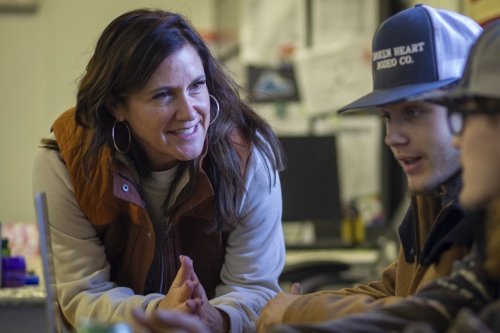
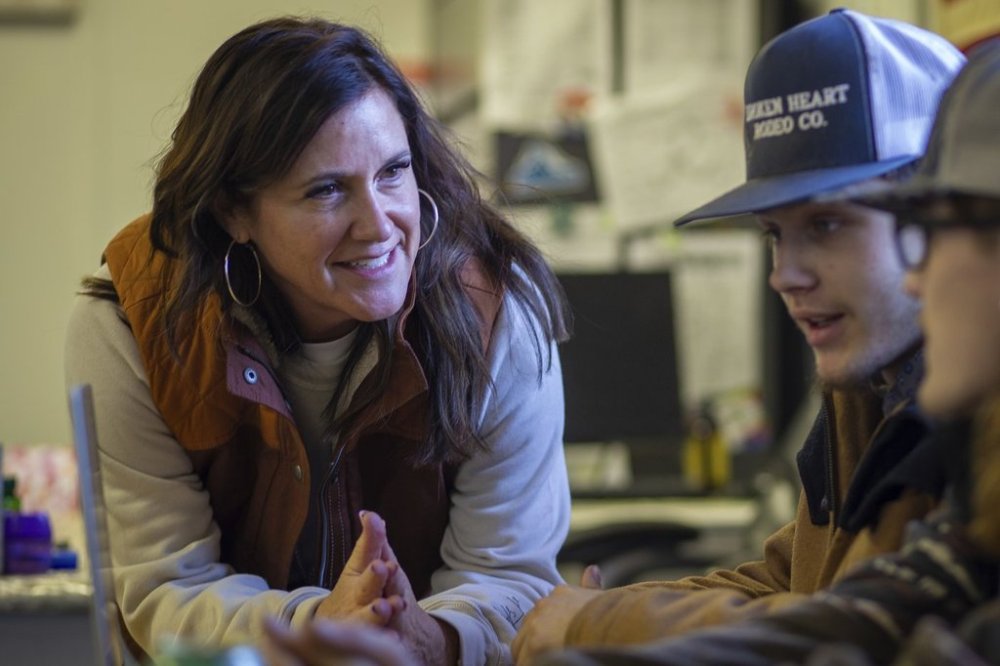
In Rigby, one of those people is Ernie Chavez, whose height makes him stick out in a hallway streaming with middle schoolers. He’s with Dads on Duty, which brings in parents to help monitor and interact with students. Throughout the school, students reach out to Chavez for high-fives. On one February afternoon, he was greeted with applause and cheers.
Similarly, the district’s Hope Squads, in place since 2021, have become an active presence on campus. The student-led coalitions, implemented in thousands of schools across the U.S. and Canada, aim to foster connection and reduce the risk of suicide.
“We refer … students every year to counselors, and those students go from some of the worst moments in their life (to getting help),” Vasquez said. “We build the connection between adults and faculty to the student.”
Hope Squad members notice peers who seem down or isolated and reach out with a greeting or handmade card. We “show them that we care and they’re not alone,” said member Dallas Waldron, a Rigby High senior.
The groups also plan special events — like a week of mental-health activities. Sophomore Emilie Raymond said the shooting showed “people need to feel included and they need to find that hope.”
Another change: a new cell phone ban. Before, students were “sitting in the corners, isolated, staring at a screen,” said Ryan Erikson, Rigby Middle’s principal. Now, “they’re playing games, they’re goofing off … they’re actually conversing.”
While the district’s approach to stemming violence is robust, “it’s not perfect,” said Martin, Jefferson’s superintendent. “We’re still going to have things come up that we haven’t prepared for or weren’t on our radar. But we address them and just try to do whatever we can to support kids.” ____ The Associated Press’ education coverage receives financial support from multiple private foundations. AP is solely responsible for all content. Find AP’s standards for working with philanthropies, a list of supporters and funded coverage areas at AP.org.