A US Navy captain ordered a military funeral for a kamikaze pilot during WWII. Here’s why
Advertisement
Read this article for free:
or
Already have an account? Log in here »
To continue reading, please subscribe:

Digital Subscription
One year of digital access for only $205*
- Enjoy unlimited reading on winnipegfreepress.com
- Read the E-Edition, our digital replica newspaper
- Access News Break, our award-winning app
- Play interactive puzzles
*First annual payment billed as $205.00 + GST for one year. This annual subscription will automatically renew at $233.00 + GST every 52 weeks (10% off the regular annual price of $259.35). Offer available to new and qualified returning subscribers only. Cancel any time.
To continue reading, please subscribe:
Add Free Press access to your Brandon Sun subscription for only an additional
$1 for the first 4 weeks*
- Enjoy unlimited reading on winnipegfreepress.com
- Read the E-Edition, our digital replica newspaper
- Access News Break, our award-winning app
- Play interactive puzzles
*Your next Brandon Sun subscription payment will increase by $1.00 and you will be charged $17.95 plus GST for four weeks. After four weeks, your payment will increase to $24.95 plus GST every four weeks.
Read unlimited articles for free today:
or
Already have an account? Log in here »
Hey there, time traveller!
This article was published 10/04/2025 (535 days ago), so information in it may no longer be current.
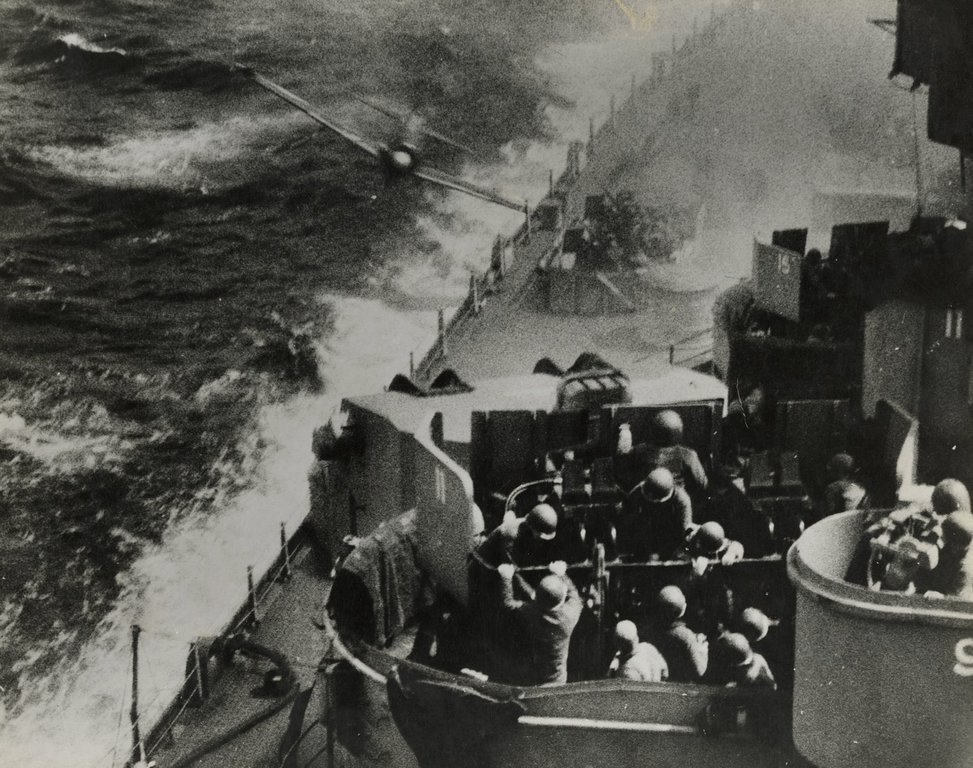
PEARL HARBOR, Hawaii (AP) — A Japanese pilot slammed his Zero fighter plane into the USS Missouri and ignited a fireball on April 11, 1945, during the Battle of Okinawa. The suicide attack instantly killed the pilot, but none of the battleship’s crew members were badly hurt.
The Missouri’s captain ordered a military burial at sea with full honors, marking one of the more unusual and little-known episodes of World War II. The pilot received the same funeral that the ship would have given one of its own sailors.
Eighty years later, the Missouri is a museum moored at Pearl Harbor, Hawaii, not far from the submerged hull of the USS Arizona, which sank in the 1941 Japanese bombing that propelled the U.S. into the war.
The museum hosted a ceremony Friday marking the anniversary of the attack and burial with three of the captain’s grandsons and the mayors of Honolulu and the Japanese city of Minamikyushu, from which many kamikaze pilots set off on their suicide missions.
“This is one of the ship’s great stories and explains, in part, why the ship became an international symbol of peace and reconciliation within two years of its launching and rather than just an instrument of destruction,” said Michael Carr, CEO of the Battleship Missouri Memorial. “This is a remarkable story of compassion and humanity, even in the midst of one of the worst battles of World War II.”
Here is what to know about the attack on the Missouri and the pilot’s burial:
What is a kamikaze pilot?
Japan launched a suicide attack campaign as a last-ditch measure to push U.S. forces back late in the war, when it was hopelessly losing.
The Imperial Navy founded the Kamikaze Tokko Tai, which translates as Divine Wind Special Attack Corps, and the Imperial Army followed with its own unit. Internationally their missions are called kamikaze, but in Japan they are better known as “tokko,” which means “special attack.”
The pilots flew hastily constructed planes and even reconnaissance and training aircraft because the military lacked sufficient equipment. They took off on one-way flights with just enough fuel to reach their targets.
Kamikaze sank their first ship on Oct. 25, 1944, when a navy Zero pilot smashed into the USS St. Lo in the Philippine Sea while carrying a pair of 550-pound (250-kilogram) bombs. Britain’s Imperial War Museum says they killed 7,000 Allied naval personnel in all.
Their initial 30% success rate fell to about 8% by mid-1945 due to declining crew skills, dwindling aircraft capabilities and improved U.S. defenses.
Some 4,000 pilots died on suicide missions, about 2,500 navy and more than 1,400 army, most of them university students drafted in late 1943. Many launched from Chiran, a tea farming town that today is part of Minamikyushu, a city in southwest Japan.
The missions became more intense as Japan’s outlook grew more dire and the military showcased the sacrifice of the pilots to drum up patriotism and support for the war. Those who failed to take off or survived were considered a disgrace.
Despite stereotypes of kamikaze as super-patriots who volunteered to die, many were not, as shown by their carefully nuanced last letters to loved ones and survivor accounts.
“They were victims of war,” said Hiroyuki Nuriki, mayor of Minamikyushu, who noted the pilots were only around 20 years old and had futures.
“I’m sure they didn’t want to die, but they still had to go,” he said. “That’s the tragedy of war, and that’s why we should never start a war again.”
What happened when the plane hit the Missouri?
The Battle of Okinawa lasted 82 todays, with fierce fighting on land and sea. On April 11 the Missouri fended off aerial assaults from multiple directions and already had downed one kamikaze plane when a second approached.
The Missouri’s gunners hit the Zero fighter with a 5-inch (12.7-centimeter) round. The plane plunged, but it leveled out about 20 feet (6 meters) above the ocean and headed for the ship’s starboard side.
The crash ripped off the plane’s right wing, which landed on the deck. Fuel in the wing caught fire, unleashing a giant plume of smoke. The crew controlled the fire within five minutes.
The dent left by the attack is still visible on the Missouri’s hull.
What happened to the pilot?
Capt. William Callaghan ordered the funeral to be held the next morning.
The crew collected red and white cloth and sewed a makeshift “rising sun” flag so he could be buried under his own colors, said Frank Clay, curator of the Battleship Missouri Memorial. They cleaned the body, wrapped it in canvas and placed it on a tray against the rail beneath the flag.
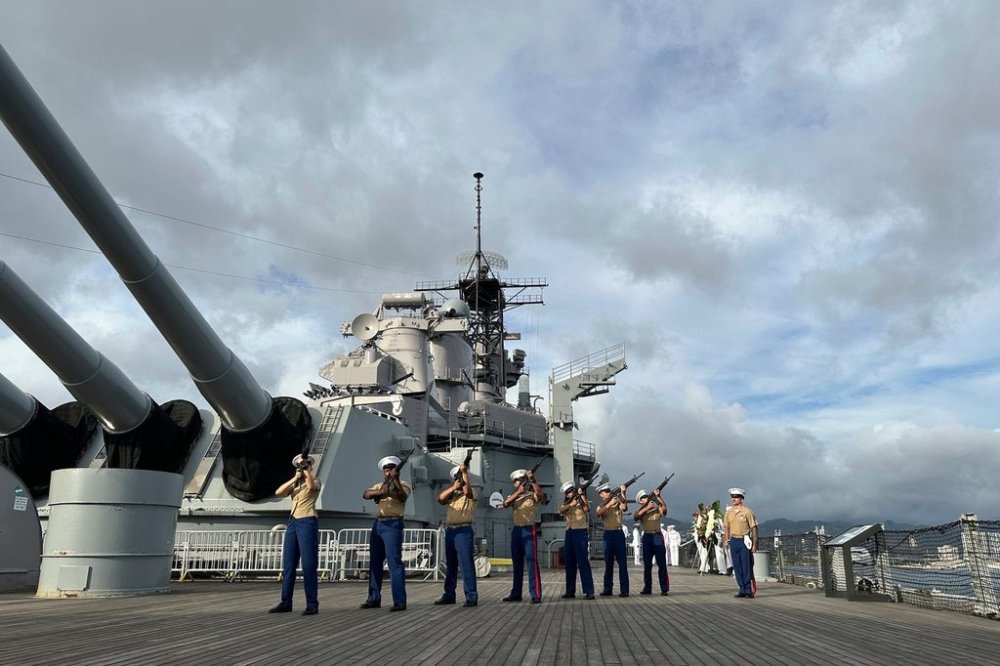
Marine rifle guards gave a gun salute and a bugler played taps. The chaplain gave an invocation and said, “Commit his body to the deep.” The crew tipped the tray and the body slid into the sea.
It was the only known instance of U.S. forces holding a military funeral for a kamikaze pilot.
Some crew members resented the ritual, while others grumbled but later came to believe it was the right thing to do, Clay said.
Ed Buffman, who was a teenage gunner’s mate 2nd class on the Missouri, said he did not dwell on it: “The next day you’re ready to go back and battle again.”
Little is known of Callaghan’s reasons for ordering the ceremony, which appeared on the ship’s daily schedule for meal times and other routine activity.
Carey Callaghan said his grandfather never spoke of the burial and his family didn’t learn about it until 2001. He said his grandfather had empathy and a sense of dignity, which was reflected by the funeral.
A remarkable thing, Callaghan said, was that three years earlier, his grandfather lost his brother, Rear Adm. Daniel Callaghan, to Japanese gunfire off Guadalcanal.
What is known about the pilot?
Scholars believe he was Setsuo Ishino, a petty officer 2nd class in a flight training program.
The pilot took off from Kanoya air base in southern Japan with 15 others as part of the No. 5 Kenmu Squadron. Most failed to hit their targets and crashed into the ocean.
“Dear Mother, The time has come for me to blossom at last. I am fulfilling my final duty with a smile. Please don’t say anything, this is for our country,” Ishino wrote. “The next time we see each other, we will be under the beautiful cherry blossom trees at Yasukuni Shrine. Please don’t cry, only smile and tell me ‘well done.’”
Why is the anniversary being remembered decades later?
Then-President Barack Obama referenced the burial in 2016 when he visited Pearl Harbor with then-Prime Minister Shinzo Abe. He told those gathered that Callaghan showed “we must resist the urge to demonize those who are different” and do so “even when hatred burns hottest.”

Thanks to Callaghan’s act, the Missouri museum and the Chiran Peace Museum, which displays army tokko artifacts, today are partners and help each other with exhibits.
Nuriki, the Minamikyushu mayor, said it is important to remember the events of April 11, 1945, and the tragedy of kamikaze pilots as Asia-Pacific tensions rise.
“We share the history between the former enemies that have become friends,” he said. “We should keep telling the story and think about peace.”
___
Yamaguchi reported from Tokyo.