WEATHER ALERT

Big Tech should pay more for data they train AI systems on, Nobel laureate says

Advertisement

Advertise with us

TORONTO - Artificial intelligence pioneer Geoffrey Hinton has thrown some support behind creative industries, which have been battling tech firms to be compensated for their work.

Read this article for free:


or

Already have an account? Log in here »

To continue reading, please subscribe:

Subscribe and receive a limited-edition Free Press branded hat or tote.

Digital Subscription

One year of digital access for only $205*

  • Enjoy unlimited reading on winnipegfreepress.com
  • Read the E-Edition, our digital replica newspaper
  • Access News Break, our award-winning app
  • Play interactive puzzles

*First annual payment billed as $205.00 + GST for one year. This annual subscription will automatically renew at $233.00 + GST every 52 weeks (10% off the regular annual price of $259.35). Offer available to new and qualified returning subscribers only. Cancel any time.

To continue reading, please subscribe:

Add Free Press access to your Brandon Sun subscription for only an additional

$1 for the first 4 weeks*

  • Enjoy unlimited reading on winnipegfreepress.com
  • Read the E-Edition, our digital replica newspaper
  • Access News Break, our award-winning app
  • Play interactive puzzles
Start now

*Your next Brandon Sun subscription payment will increase by $1.00 and you will be charged $17.95 plus GST for four weeks. After four weeks, your payment will increase to $24.95 plus GST every four weeks.

Hey there, time traveller!
This article was published 16/04/2025 (509 days ago), so information in it may no longer be current.

TORONTO – Artificial intelligence pioneer Geoffrey Hinton has thrown some support behind creative industries, which have been battling tech firms to be compensated for their work.

The British Canadian computer scientist expressed worry Wednesday about how tech companies are training their models on artists’ works and then allowing users to pump out new material based on that original content. 

“Their stuff is being used by AI to generate these things that can be created and I’m not sure they’re getting rewarded for it,” Hinton said on stage at the DiscoveryX tech conference in Toronto.
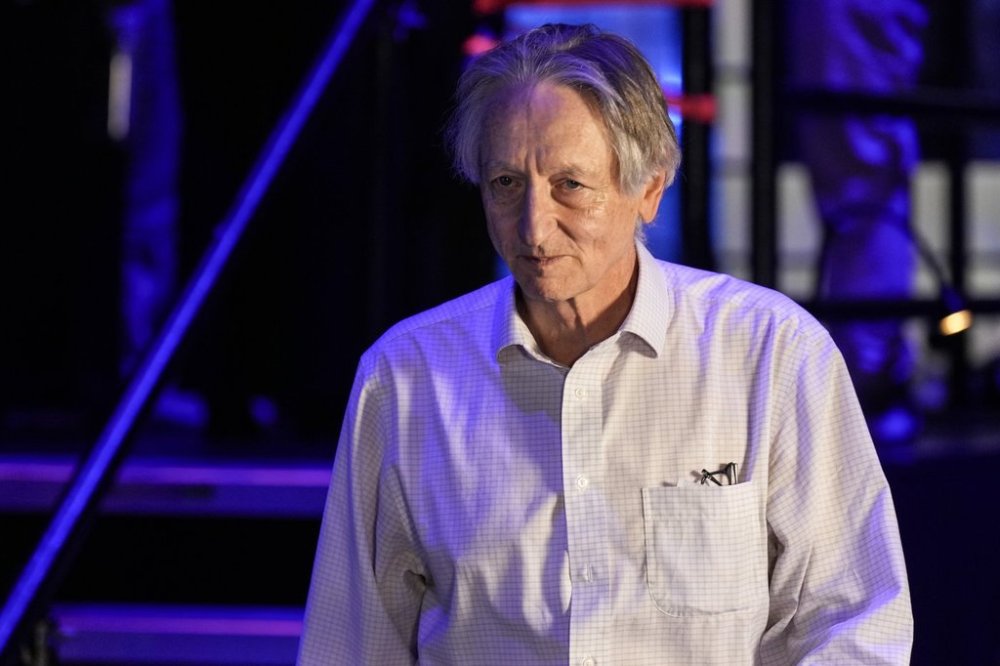
AI pioneer Geoffrey Hinton steps off stage at the Collision Conference, in Toronto, on Wednesday, June 19, 2024.THE CANADIAN PRESS/Chris Young

“I think the big tech companies should pay more for getting that training data.”

Hinton’s remarks touch on a topic that has riled up creative industries since OpenAI released its ChatGPT chatbot in November 2022, opening the floodgates for people to repurpose and reimagine just about any content they can get their hands on.

Ever since, everyone from musicians to book publishers and media companies have found instances of AI companies training their models on content they found online or in free databases. These companies have then allowed people to use their software to spit out new works based on that original material without any money making its way to back to the creators.

Hinton appears to be uneasy with the practice. Not only is he “worried about (AI’s) influence on the creative arts” because of the lack of compensation, but he also feels policymakers aren’t doing enough.

“In Britain in particular, the government seems uninterested in protecting the creative industries,” he said.

The lack of policy help has left creative companies and artists taking matters into their own hands and lobbing lawsuits at AI giants.

A coalition of media companies, including The Canadian Press, Torstar, The Globe and Mail, Postmedia and CBC/Radio-Canada, took on OpenAI in November, claiming their copyright had been infringed by the San Francisco-based firm.

Their lawsuit asks for compensation valued at $20,000 per work or an amount “the court considers just.” OpenAI has fired back, saying its models are trained on publicly available data and are “grounded in fair use and related international copyright principles that are fair for creators and support innovation.”

The legal action preceded a similar move from the owner of the Toronto Star and U.S. publishers. They alleged Toronto-based AI darling Cohere infringed on their copyright by scraping copies of their articles from the internet without the publishers’ permission or compensation. 

They want up to $150,000 for every article they allege was infringed by Cohere, which is run by some of Hinton’s proteges and has called the lawsuit “misguided and frivolous.”

The lawsuits didn’t figure into Hinton’s Wednesday talk, which was hosted by Jordan Jacobs, managing partner of Radical Ventures, which invests in AI startups.

Instead, the two men spent much of their discussion dwelling on the speed at which AI has progressed in recent years.

“I am not surprised it is everywhere, but I am surprised how fast it has been in the past few years and how slow it was before that,” Hinton said.

His early work on the technology dates back several decades and some of the most famous advances he made came in the 1980s. Those advances were only awarded with a Nobel Prize last year.

“My goal in life was to understand how the brain works,” said Hinton, who studied philosophy before psychology. “I failed, but along the way we produced some technology and it was very successful.”

Hinton has used the recent spotlight put on his accomplishments to warn of a myriad of problems he thinks may arise from AI including cyberattacks, “nasty” viruses, joblessness, election corruption, lethal autonomous weapons and even the demise of humanity.

On Wednesday, he said it’s quite likely the world will see superintelligence — AI that surpasses human intelligence — in the next 18 years.

In the more near-term, he sees “ordinary, mundane office work” being taken over by AI as well as tasks carried out by mathematicians.

“I’m a bit hesitant to make predictions about the exact timings of things in the future, but I strongly suspect the role of mathematicians will be to prompt the AI mathematicians.”

This report by The Canadian Press was first published April 16, 2025.

Report Error Submit a Tip

More Stories

Man who pleaded guilty to killing three cats dies before sentencing

Morgan Modjeski 3 minute read Preview

Man who pleaded guilty to killing three cats dies before sentencing

Morgan Modjeski 3 minute read Friday, Sep. 4, 2026

A Winnipeg man awaiting sentencing after admitting he strangled three cats to death and dumped two of their carcasses under a city bridge, has died, the Free Press has learned.

Randy Jensen, 25, pleaded guilty on May 13 to one count of wilfully causing injury or suffering to animals in connection to the 2024 killings.

He was scheduled to be sentenced in January.

“That’s not something that anybody wanted,” said Kristy Zamonsky, founder of Project Artemis Animal Advocates. “We were all hoping for justice through the courts.”

Read
Friday, Sep. 4, 2026

Mayoral candidate Gillingham vows building boom; Vogiatzakis, Woodstock promise improved safety

Joyanne Pursaga 5 minute read Preview

Mayoral candidate Gillingham vows building boom; Vogiatzakis, Woodstock promise improved safety

Joyanne Pursaga 5 minute read Friday, Sep. 4, 2026

Scott Gillingham promised several new steps to help get more homes and businesses built in Winnipeg Friday, if re-elected as mayor, amid other pledges from his competition.

Read
Friday, Sep. 4, 2026

Smith’s pretzel logic confuses

Editorial 4 minute read Preview

Smith’s pretzel logic confuses

Editorial 4 minute read Yesterday at 2:01 AM CDT

Alberta Premier Danielle Smith had both sides of her mouth working overtime on Aug. 30, when she spoke at an event in Calgary to commemorate Alberta Day, the annual celebration of the province’s entry into Confederation in 1905 (officially Sept. 1, it was celebrated on the weekend).

Smith’s comments — and the things she did not say — revealed a lot about the political tightrope the premier is trying to walk over the challenges currently faced by her province. At the top of that list of challenges is a persistent campaign to separate Alberta from the aforementioned Confederation. A campaign that Smith appears to both support and oppose, depending on which day of the week it is.

Her Alberta Day remarks were an excellent case in point.

Smith has decided that on Oct. 19, Albertans will vote on a series of non-binding propositions in a province referendum. One of those questions will ask Albertans whether they want to hold a referendum on separation, thus making this fall’s vote a “referendum on whether to hold a referendum,” as some observers have dubbed it.

Read
Yesterday at 2:01 AM CDT

Mayoralty candidate Vogiatzakis decries war of words

Joyanne Pursaga 4 minute read Preview

Mayoralty candidate Vogiatzakis decries war of words

Joyanne Pursaga 4 minute read Friday, Sep. 4, 2026

A mayoral candidate took aim at personal insults among two of his competitors Friday, stressing the election campaign should focus on city issues instead.

“I’m really embarrassed by the mayoral candidates slinging mud at each other. We should be more professional … I don’t think we need to bring up people’s past or garbage that they’ve been involved in. I think this needs to be about the City of Winnipeg and what we’re going to do for the City of Winnipeg,” Mike Vogiatzakis said at a press conference Friday.

He confirmed he was referring specifically to skirmishes between Scott Gillingham, who is seeking re-election as mayor, and Kevin Klein, a former city councillor and provincial cabinet minister who registered for the race this week.

Within a few hours of Klein’s Tuesday announcement that he would enter the mayoral contest, Gillingham issued a statement labelling Klein “toxic,” a “Caribbean political fixer” for Peter Nygard and a supporter of U.S. President Donald Trump.

Read
Friday, Sep. 4, 2026

For newcomer pizza purveyors, it’s all about crafting solid foundations

David Sanderson 7 minute read Preview

For newcomer pizza purveyors, it’s all about crafting solid foundations

David Sanderson 7 minute read Yesterday at 2:00 AM CDT

A recent poll conducted by an Internet-based market-research firm determined that close to 20 per cent of people eschew their leftover pizza crust.

Some argued that the residual crust lacks flavour. Others submitted that it’s too hard or crunchy to enjoy sans toppings. Given that information, what are we to make of Crusty Craft Pizza, a five-month-old takeout spot whose owners are so confident in their European-style pizza crust that they’ve chosen to highlight it in their business moniker?

Whenever somebody informs them they don’t like pizza crust, their response is, well, they haven’t tried theirs, says Oleksii Samokvhal, who together with his wife, Iryna Mehedyn, opened Crusty Craft Pizza in early April, at 1311 Day St. in Transcona.

“It’s thin in the middle, with raised edges we hand-form ourselves,” says Mehedyn, a native of Ukraine who, like her Kyiv-born husband, relocated to Winnipeg to escape the conflict in their home country.

Read
Yesterday at 2:00 AM CDT

News briefs for Sunday, September 6, 2026

1 minute read Updated: 2:41 PM CDT

A collection of breaking news briefs filed on Sunday, September 6, 2026

Man injured in downtown shooting

2:40 PM

A man in his 20s is in critical condition after he was shot in downtown Winnipeg early Sunday morning.