
Hikers scramble for alternatives after damage shuts B.C.’s popular Juan de Fuca Trail

Advertisement

Advertise with us

Trish Fougner still remembers the taste of the beer she enjoyed after completing the 47-kilometre Juan de Fuca Trail on Vancouver Island two years ago.

Read this article for free:


or

Already have an account? Log in here »

To continue reading, please subscribe:

Subscribe and receive a limited-edition Free Press branded hat or tote.

Digital Subscription

One year of digital access for only $205*

  • Enjoy unlimited reading on winnipegfreepress.com
  • Read the E-Edition, our digital replica newspaper
  • Access News Break, our award-winning app
  • Play interactive puzzles

*First annual payment billed as $205.00 + GST for one year. This annual subscription will automatically renew at $233.00 + GST every 52 weeks (10% off the regular annual price of $259.35). Offer available to new and qualified returning subscribers only. Cancel any time.

To continue reading, please subscribe:

Add Free Press access to your Brandon Sun subscription for only an additional

$1 for the first 4 weeks*

  • Enjoy unlimited reading on winnipegfreepress.com
  • Read the E-Edition, our digital replica newspaper
  • Access News Break, our award-winning app
  • Play interactive puzzles
Start now

*Your next Brandon Sun subscription payment will increase by $1.00 and you will be charged $17.95 plus GST for four weeks. After four weeks, your payment will increase to $24.95 plus GST every four weeks.

Hey there, time traveller!
This article was published 23/04/2025 (538 days ago), so information in it may no longer be current.

Trish Fougner still remembers the taste of the beer she enjoyed after completing the 47-kilometre Juan de Fuca Trail on Vancouver Island two years ago.

“Like I had never had a beer in my life, which is not true,” Fougner said.

But now the resident of Victoria is among hikers with a sour taste in their mouth after the British Columbia government announced that the trail, one of Canada’s most popular wilderness hikes, would be closed for the summer so crews can repair damage caused by fall and winter storms.
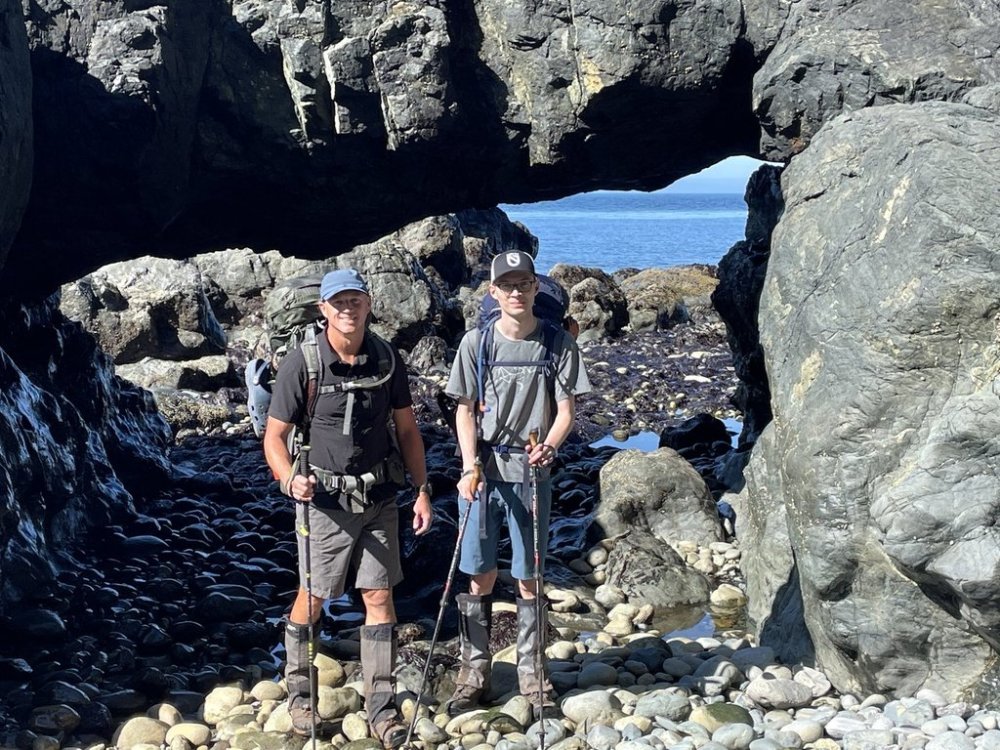
Hikers Jason Lindsay and son Cole Kosowan are pictured on a section of the Juan de Fuca Trail on Vancouver Island in 2021. THE CANADIAN PRESS/HO Neil Miller **MANDATORY HANDOUT**

“It’s sad,” said Fougner, calling the closure “a loss to the hiking community.” But she also can see the government’s side.

“It’s understandable because we live on the West Coast, where storms can happen and we have to take care of our parks too and make sure they are safe, for one thing, and that we can keep them for generations to come.”

The Juan de Fuca Trail snakes along the southwest coast of Vancouver Island, offering views of the Pacific Ocean and the Olympic Mountains in Washington State.

The government announced its closure last week, saying several key trail sections had been washed away or blocked by fallen trees, making it impassable and unsafe.

Bridges, boardwalks, shelters and campsites had suffered extensive damage, it said, and five backcountry campgrounds along the trail also remain closed.

The island was battered by a series of powerful storms in fall and winter, including November’s bomb cyclone weather system that brought winds of 170 kilometres per hour.

The government said it was planning a phased reopening of trail and backcountry campsites as crews completed repairs.

Calgary Academy teacher Jason Lindsay had been planning to bring a group 21 students and five adults to hike the trail in early May. Instead, they’ll have to make do with a hike in Alberta.

Lindsay, who is the outdoor education lead at the academy and has hiked the Juan de Fuca Trail 13 times, said the students were disappointed.

“For my Grade 12s, this would have been their capstone trip, their pinnacle trip, something they had looked forward to for the last three years,” he said, adding that some Grade 11 students had also signed up for the trip.

“Coming from the Prairies, coastal hikes are so different and so awesome. We were really looking forward to an opportunity to see something new and unique.”

“It’s spectacular,” Fougner agreed. “The views, and the scenery is so lush, and you are in such a remote area. There is lots of wildlife. We ran into a couple of bears.”

The rugged trail also inspires a sense of camaraderie with other hikers, she said. “You still meet up with people, which is kind of fun, and it is a really neat opportunity to share in a special place.”

Hikers typically access the trail from its southern end near Jordan River or from its northern end at Port Renfrew, as well as at several spots along Highway 14, with trails leading to camping sites and day-use areas.

Fougner said this made the trail appealing for both those who want to hike the whole route or just parts of it. Some even run the whole trail in one day — including her son-in-law, she said.

Its accessibility and beauty have made the trail popular. While it draws about 40,000 registered users per year, the actual number is higher, since so many hike individual sections without completing the entire route.

That type of use distinguishes the Juan de Fuca Trail from the nearby and better known West Coast Trail.

“You can’t do that on the West Coast Trail — you have to do the whole trail,” said Fougner.

And unlike the West Coast Trail, the Juan de Fuca Trail does not require a reservation.

Fougner has hiked both.

“Some people say the Juan de Fuca (Trail) is harder than the West Coast Trail, but some people argue it is the other way around,” she said.

Fougner completed the Juan de Fuca Trail at the age of 59. It took four days as part of a five-person group.

“I don’t think I have ever been so tired and so sore in my life,” Fougner says. “It was really, incredibly hard.”

But she also felt a deep sense of accomplishment. It’s not clear when she will be able to repeat it.

Fougner, who operates a Facebook page dedicated to hiking, said she would be checking out other trails across Vancouver Island and elsewhere in B.C., with an eye toward flatter terrain because of her “wonky” knees.

“I still love hiking and you just have to adapt to what you can and what you cannot do,” she said.

This report by The Canadian Press was first published April 23, 2025.
Report Error Submit a Tip

More Stories

Israel and Palestine: 30 wasted years

Gwynne Dyer 5 minute read 2:00 AM CDT

Here is how the high command of the Israel Defence Forces (IDF) laid down the rules for “remotely” killing suspected Palestinian activists in the densely populated Gaza Strip after the surprise Hamas attack on Israel on Oct. 7, 2023.

Israeli forces were told that up to 20 Palestinian civilians could be killed in a strike against a single suspected member of Hamas, even one of the lowest rank and importance. For a more “senior” Hamas member, the permissible number of non-combatants who could be ‘accidentally’ killed in the process went up to 100.

The order went out only hours after the attack, when there were not yet any IDF troops on the ground in Gaza and all strikes had to be remote, but most strikes have remained remote right down to the present because using drones and artillery keeps Israeli casualties very low.

The drone operators or artillery gunners who delivered the high explosives did not choose the targets themselves. An AI system called Lavender did that, using a network of surveillance devices that generated tens of thousands of likely targets, some known by name, some just “acting suspiciously.” Human operators spent about 20 seconds confirming each one.

Hikers scramble for alternatives after damage shuts B.C.’s popular Juan de Fuca Trail

Wolfgang Depner, The Canadian Press 5 minute read Preview

Hikers scramble for alternatives after damage shuts B.C.’s popular Juan de Fuca Trail

Wolfgang Depner, The Canadian Press 5 minute read Wednesday, Apr. 23, 2025

Trish Fougner still remembers the taste of the beer she enjoyed after completing the 47-kilometre Juan de Fuca Trail on Vancouver Island two years ago.

"Like I had never had a beer in my life, which is not true," Fougner said.

But now the resident of Victoria is among hikers with a sour taste in their mouth after the British Columbia government announced that the trail, one of Canada's most popular wilderness hikes, would be closed for the summer so crews can repair damage caused by fall and winter storms.

"It's sad," said Fougner, calling the closure "a loss to the hiking community." But she also can see the government's side.

Read
Wednesday, Apr. 23, 2025

Late philanthropist, family fill Harvest’s Empty Bowls with record-setting $5-M donation

Morgan Modjeski 3 minute read Preview

Late philanthropist, family fill Harvest’s Empty Bowls with record-setting $5-M donation

Morgan Modjeski 3 minute read Friday, Oct. 9, 2026

It was a record-breaking night for Harvest Manitoba made possible by a genuine Winnipeg hero and his family.

The organization’s annual Empty Bowls Celebrity Auction Dinner on Thursday raised $6.5 million to support Manitobans facing hunger and food insecurity.

And it was a $5-million legacy donation from late city philanthropist Doug Harvey and his family that will see the event go down in the history books as the largest gala fundraising total ever recorded in Manitoba.

“There was literally nothing that lit my dad up more than contributing himself, but even more so, inspiring others to give,” his daughter Lauren Harvey said Friday.

Read
Friday, Oct. 9, 2026

Comparing the Iran and Vietnam Wars

Peter McKenna 5 minute read Preview

Comparing the Iran and Vietnam Wars

Peter McKenna 5 minute read 2:00 AM CDT

The other day I asked my students in U.S. foreign policy to think about the relevance of the Vietnam War in relation to the ongoing war in Iran. More specifically, I wanted them to identify the similarities and differences between the two wars.

What is immediately striking is how domestic politics played such a seminal role in both conflicts. While American public opinion was generally in favour of U.S. military involvement in Vietnam in the early years, things started to turn very sour after U.S. soldiers started arriving stateside in flag-draped coffins and body bags. As for Iran, just about every single poll and TV newscast since the first few weeks of the war have illustrated an overwhelming public repudiation of President Trump’s military adventurism.

The electoral implications were also quite apparent for the two wars. The U.S.-Iran War is clearly having a positive effect on the Democratic Party’s electability, as it looks set to capture both the House of Representatives and the Senate in the Nov. 3 midterm elections. Democratic President Lyndon Johnson, reading the political tea leaves from the Vietnam fallout, opted not to contest the 1968 U.S. presidential election.

Equally interesting, the U.S. press had a crucial, and mostly negative, impact on both the Vietnam and Iran conflicts. Who could forget Gen. William Westmoreland — the commander of U.S. forces in Vietnam (1964-1968) — maintaining that it was the media’s fault the U.S. lost the war in Vietnam. While I take issue with his thesis, I do believe the news coverage and visuals of the first televised war served to raise serious concerns about why the U.S. was at war in Southeast Asia.

Read
2:00 AM CDT

Backstreet Boys extend Toronto residency to 11 nights

The Canadian Press 2 minute read Preview

Backstreet Boys extend Toronto residency to 11 nights

The Canadian Press 2 minute read Sunday, Oct. 11, 2026

TORONTO - Hit '90s boyband The Backstreet Boys are adding more tour dates to their Toronto residency.

What was first announced as a four-night run at Rogers Centre has swelled to 11 shows, with the band's recent announcement they're adding concerts on March 5 and 6.

The band says on its website the new dates were added "due to overwhelming demand."

Dubbed “Into the Millennium – Homecoming: Live in Canada,” the residency will kick off on Feb. 12.

Read
Sunday, Oct. 11, 2026

Hydro’s unpredictable fortunes

Editorial 4 minute read Preview

Hydro’s unpredictable fortunes

Editorial 4 minute read 2:00 AM CDT

Hope for rain. Or snow. Or both.

There’s a truism buried deep in a financial outlook in Manitoba Hydro’s 2025-26 annual report, released in late September: “Manitoba Hydro’s net income is highly dependent on several uncontrollable factors.”

Those factors include the risk of drought reducing hydroelectric production and sales (a situation that means the utility will have to purchase more power, especially in winter), the rate of inflation, the actual cost of purchased electricity and increased interest rates that would mean Hydro will have to spend more servicing its $26.55 billion debt.

The report outlines that several of those factors came together during the utility’s last full fiscal year — along with huge costs to replace equipment damaged in a long, dry summer of forest fires.

Read
2:00 AM CDT


