

Economy shrunk 0.2% in February, StatCan estimates 1.5% annualized growth for Q1
Advertisement
Read this article for free:
or
Already have an account? Log in here »
To continue reading, please subscribe:
Monthly Digital Subscription
$1 per week for 24 weeks*
- Enjoy unlimited reading on winnipegfreepress.com
- Read the E-Edition, our digital replica newspaper
- Access News Break, our award-winning app
- Play interactive puzzles
*Billed as $4.00 plus GST every four weeks. After 24 weeks, price increases to the regular rate of $19.95 plus GST every four weeks. Offer available to new and qualified returning subscribers only. Cancel any time.
Monthly Digital Subscription
$4.99/week*
- Enjoy unlimited reading on winnipegfreepress.com
- Read the E-Edition, our digital replica newspaper
- Access News Break, our award-winning app
- Play interactive puzzles
*Billed as $19.95 plus GST every four weeks. Cancel any time.
To continue reading, please subscribe:
Add Free Press access to your Brandon Sun subscription for only an additional
$1 for the first 4 weeks*
*Your next subscription payment will increase by $1.00 and you will be charged $16.99 plus GST for four weeks. After four weeks, your payment will increase to $23.99 plus GST every four weeks.
Read unlimited articles for free today:
or
Already have an account? Log in here »
Hey there, time traveller!
This article was published 30/04/2025 (332 days ago), so information in it may no longer be current.
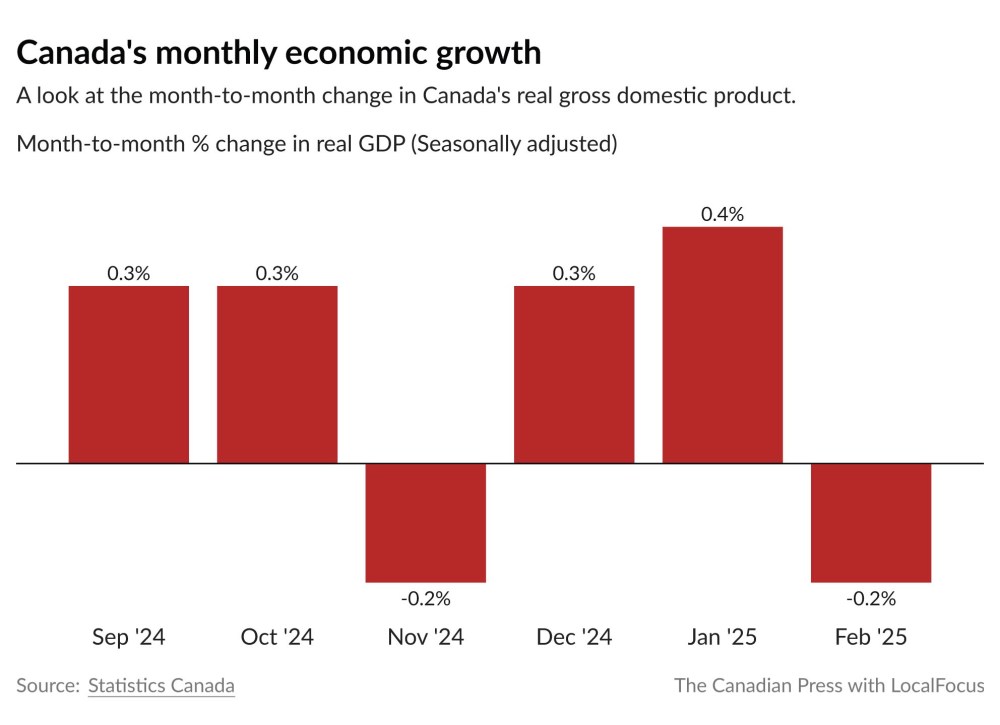
The Canadian economy shrunk in February, but economists say bad weather was likely the larger culprit than uncertainty related to the trade war with the U.S.
Statistics Canada said Wednesday that real gross domestic product decreased 0.2 per cent in February after the economy grew 0.4 per cent in the first month of 2025. It also said that early signs suggest there was moderate growth in March.
The contraction was driven by a 0.6 per cent decline for goods-producing industries, as the mining, quarrying, and oil and gas extraction sector, along with construction, contributed most to the decrease.
Following two consecutive monthly increases, the former was down 2.5 per cent and became the largest detractor from growth. Construction, which was down half a percentage point, fell for the first time in four months.
Services-producing industries edged 0.1 per cent lower in February as contractions in transportation and warehousing, along with real estate, rental and leasing, were partially offset by a rise in finance and insurance.
CIBC economist Andrew Grantham called February’s decline unexpected, but said it was likely driven more by harsh weather than tariff uncertainty, as poor winter conditions hurt sectors such as mining, oil and gas, transportation and real estate.
StatCan said transportation and warehousing declined 1.1 per cent in February after two straight monthly gains, as the sector was hurt by major snowstorms that hit Central and Eastern Canada and storms passing through B.C.
Transit, ground passenger, scenic and sightseeing transportation fell 3.4 per cent in the month, while rail transportation was down 5.6 per cent amid commuter train cancellations and capacity and speed reductions by rail carriers.
Meanwhile, manufacturing was a “bright spot,” said Desjardins managing director Royce Mendes, noting that activity may have picked up “as a result of increased demand from U.S. buyers trying to get ahead of tariffs.”
The manufacturing sector rose 0.6 per cent in February, increasing for the second month in a row, largely driven by durable-goods manufacturing industries. Machinery manufacturing grew 5.9 per cent and contributed most to the increase in that category.
StatCan’s early estimates indicate real GDP increased 0.1 per cent in March amid gains in mining, quarrying, and oil and gas extraction, retail trade and transportation and warehousing.
The agency said the annualized growth rate for the first quarter based on the March flash estimate is 1.5 per cent.

“Adding it up, the overall Q1 growth rate was a snick below the (Bank of Canada’s) estimate, but in line with our call, so no major drama here,” said BMO Capital Markets chief economist Douglas Porter in a note.
“The real drama now begins, with the tariffs much more of an issue in Q2, and the U.S. economy also now facing much heavier weather of its own. We would be surprised if GDP manages to grow in Q2.”
Michael Davenport, senior economist at Oxford Economics, added the global trade war is expected to push Canada’s economy into a recession beginning in the second quarter.
“The Liberal election win means significant new fiscal stimulus is on the way, but it won’t begin to support the economy until (the second half of the year), and we don’t think it will be enough to prevent a downturn,” he said.
This report by The Canadian Press was first published April 30, 2025.

Advertisement Advertise With Us
Advertisement Advertise With Us
History
Updated on Wednesday, April 30, 2025 8:30 AM CDT: Adds graphic