US robot makers hope to beat China in humanoid race. Tariffs could affect their ambitions
Advertisement
Read this article for free:
or
Already have an account? Log in here »
To continue reading, please subscribe:

Digital Subscription
One year of digital access for only $205*
- Enjoy unlimited reading on winnipegfreepress.com
- Read the E-Edition, our digital replica newspaper
- Access News Break, our award-winning app
- Play interactive puzzles
*First annual payment billed as $205.00 + GST for one year. This annual subscription will automatically renew at $233.00 + GST every 52 weeks (10% off the regular annual price of $259.35). Offer available to new and qualified returning subscribers only. Cancel any time.
To continue reading, please subscribe:
Add Free Press access to your Brandon Sun subscription for only an additional
$1 for the first 4 weeks*
- Enjoy unlimited reading on winnipegfreepress.com
- Read the E-Edition, our digital replica newspaper
- Access News Break, our award-winning app
- Play interactive puzzles
*Your next Brandon Sun subscription payment will increase by $1.00 and you will be charged $17.95 plus GST for four weeks. After four weeks, your payment will increase to $24.95 plus GST every four weeks.
Read unlimited articles for free today:
or
Already have an account? Log in here »
Hey there, time traveller!
This article was published 01/05/2025 (467 days ago), so information in it may no longer be current.
BOSTON (AP) — Tariffs weren’t on the agenda of this week’s Robotics Summit, where thousands of tech industry workers mingled with humanoid and other robot varieties and talked about how to build and sell a new generation of increasingly autonomous machines.
Not on the official agenda, at least.
“Jump up to the microphones,” said keynote speaker Aaron Saunders, chief technology officer of Boston Dynamics, inviting a standing-room-only crowd to ask him questions. “And I’m the CTO, so don’t ask me about tariffs.”
The crowd laughed and complied. But as they streamed onto the show floor at Boston’s convention center, greeted by a remote-controlled humanoid made by Chinese company Unitree, it was hard to ignore the shadow of President Donald Trump’s far-reaching global tariffs and retaliatory measures from Trump’s biggest target, China.
Tariffs are the “No. 1 topic that we’re discussing in the hallways and at the water cooler with people that I’ve known for a long time,” said event organizer Steve Crowe, chair of the annual Robotics Summit & Expo. “I think it’s definitely top of mind, because there’s so much uncertainty about what is going to come.”
That concern is rooted in a robot’s complex anatomy of motors and actuators to move their limbs, computers to power their artificial intelligence, and sensing devices to help them react to their surroundings. Sensors, semiconductors, batteries and rare earth magnets are among the array of components most sensitive to global trade disputes.
Tesla CEO and billionaire Trump adviser Elon Musk warned investors last week that China’s countermeasures restricting shipments of rare earth magnets will delay Tesla’s development of its Optimus humanoid robots.
At the summit on Wednesday and Thursday, some humanoid makers were looking at a potential bright side to the geopolitical shifts as American businesses look harder for domestic supplies of parts and the development of U.S.-based robots that can automate factories and warehouses.
“It’s added some inconveniences to our own supply chain. But it’s also opened up opportunities,” said Pras Velagapudi, chief technology officer at Oregon-based Agility Robotics, in an interview. The company is starting to deploy its humanoid robot, called Digit, at a U.S. plant run by German manufacturer Schaeffler, a maker of ball bearings and other components key to the auto industry.
Al Makke, a director of engineering for Schaeffler’s chassis systems, said tariffs could push many companies toward onshoring production of a variety of items in the U.S.
“And if that does happen, then local companies have to deal with high labor costs and a shortage of labor and so automation gets pushed further,” Makke said. “And one of those faces of automation is humanoids.”
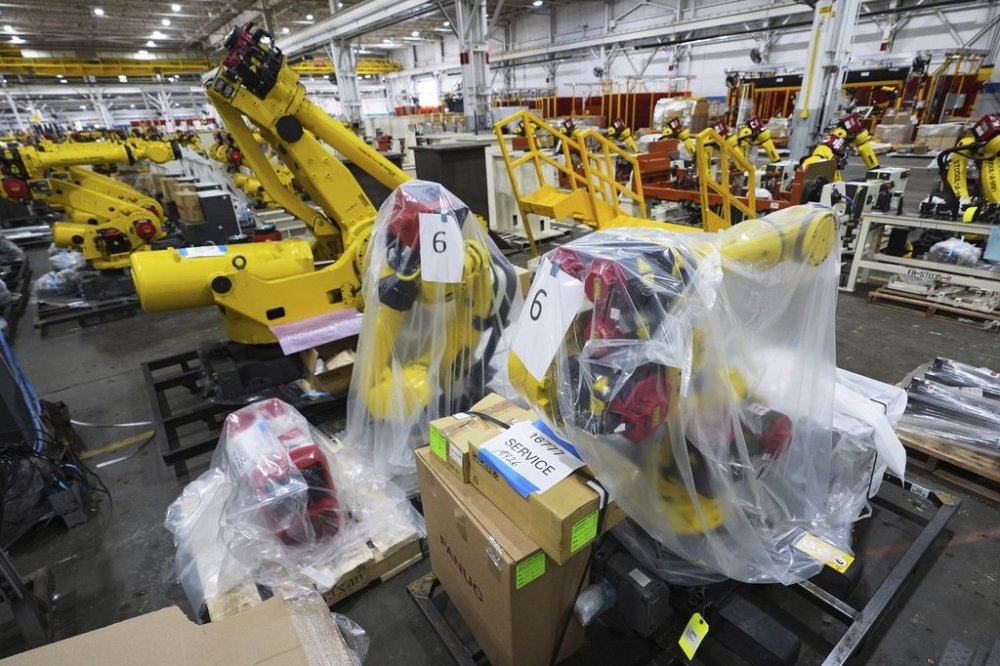
Most of the big industrial robots employed in the U.S. are used to help make cars, and are imported from countries such as Japan, Germany or South Korea.
Automakers in the U.S. installed 9.6% more robots in their plants than a year before, according to new data from the International Federation of Robotics, a trade group.
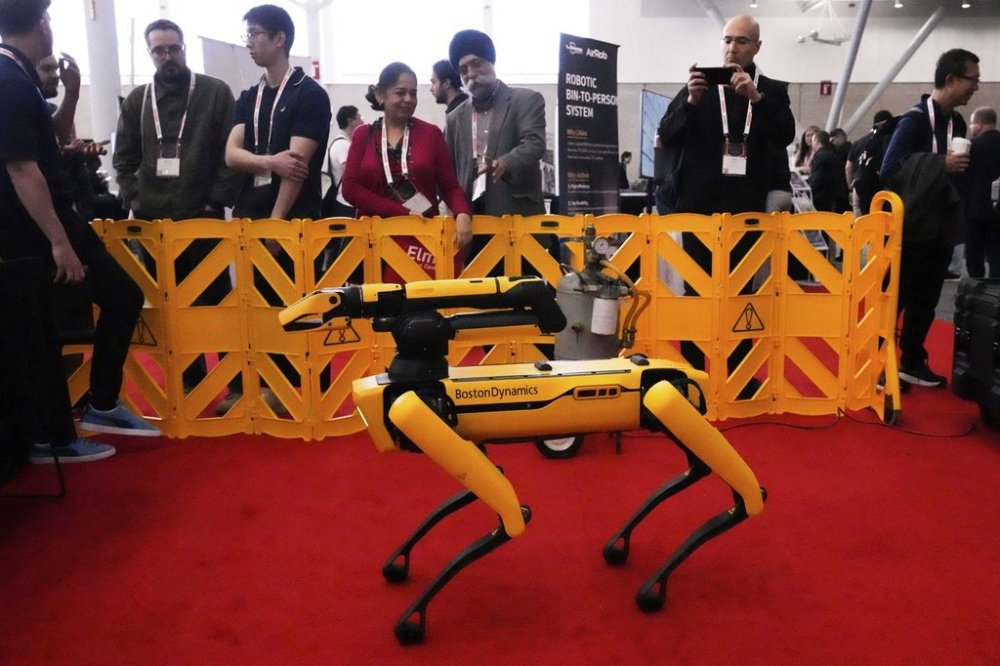
For now, humanoids are still a niche but one that invites intense curiosity, in part thanks to popular science fiction. Saunders, of Hyundai-owned Boston Dynamics, presented an update Wednesday on the development of its Atlas humanoid robot but didn’t bring a physical prototype, instead showing off a more familiar pack of its four-legged Spot robots contained in a pen on the show floor.
One humanoid at the conference was Unitree’s G1. Marketed for $16,000 and remote-controlled by an employee standing nearby, the robot fluidly shook hands, waved back at people and walked around the show floor, but it won’t be moving totes or working in a factory anytime soon.
Its main customers outside China are academic researchers and some social media influencers, and Trump’s current tariffs totaling 145% on China would raise its cost to American buyers to roughly $40,000, said Tony Yang, a Unitree vice president of business development who manages its North American sales. Nevertheless, Unitree’s strategy to rapidly develop its hardware and software is a long-term one.
“It’s still a very narrow market, but I think there’s still a huge potential market on the industry side, like for manufacturing and factory and even home use,” Yang said.
At a full pickleball court on the show floor, some conference attendees took a break to grab a racket and swing at balls tossed by a wheeled robot. Asked to describe what’s inside the Tennibot robot, its maker also had tariffs on the mind.

“Injection molded parts, rivets, screws, nuts, wheels, motors, batteries,” said Haitham Eletrabi, co-founder and CEO of Tennibot, based in Auburn, Alabama. “The supply chain gets very complex. We get parts from all over the world. Tariffs are adding a lot of uncertainty.”
It’s not just the U.S.-China trade rivalry that was weighing on some attendees. Francesca Torsiello, of the recruitment firm Adapt Talent, said she’s also hearing more wariness from Canadian robotics and engineering candidates about taking jobs in the U.S. amid a tense political environment.
“In the past, people in Canada found it attractive to come and work for U.S. companies; right now they’re being very hesitant,” Torsiello said.
————-
AP video journalist Rodrique Ngowi contributed to this report.
Related Articles
Canadian automobile parts won't be hit with Trump's tariffs

Advertisement Advertise With Us
Advertisement Advertise With Us