Cuts have eliminated more than a dozen US government health-tracking programs
Advertisement
Read this article for free:
or
Already have an account? Log in here »
To continue reading, please subscribe:

Digital Subscription
One year of digital access for only $205*
- Enjoy unlimited reading on winnipegfreepress.com
- Read the E-Edition, our digital replica newspaper
- Access News Break, our award-winning app
- Play interactive puzzles
*First annual payment billed as $205.00 + GST for one year. This annual subscription will automatically renew at $233.00 + GST every 52 weeks (10% off the regular annual price of $259.35). Offer available to new and qualified returning subscribers only. Cancel any time.
To continue reading, please subscribe:
Add Free Press access to your Brandon Sun subscription for only an additional
$1 for the first 4 weeks*
- Enjoy unlimited reading on winnipegfreepress.com
- Read the E-Edition, our digital replica newspaper
- Access News Break, our award-winning app
- Play interactive puzzles
*Your next Brandon Sun subscription payment will increase by $1.00 and you will be charged $17.95 plus GST for four weeks. After four weeks, your payment will increase to $24.95 plus GST every four weeks.
Read unlimited articles for free today:
or
Already have an account? Log in here »
Hey there, time traveller!
This article was published 04/05/2025 (524 days ago), so information in it may no longer be current.
NEW YORK (AP) — U.S. Health Secretary Robert F. Kennedy Jr.’s motto is “ Make America Healthy Again,” but government cuts could make it harder to know if that’s happening.
More than a dozen data-gathering programs that track deaths and disease appear to have been eliminated in the tornado of layoffs and proposed budget cuts rolled out in the Trump administration’s first 100 days.
The Associated Press examined draft and final budget proposals and spoke to more than a dozen current and former federal employees to determine the scope of the cuts to programs tracking basic facts about Americans’ health.
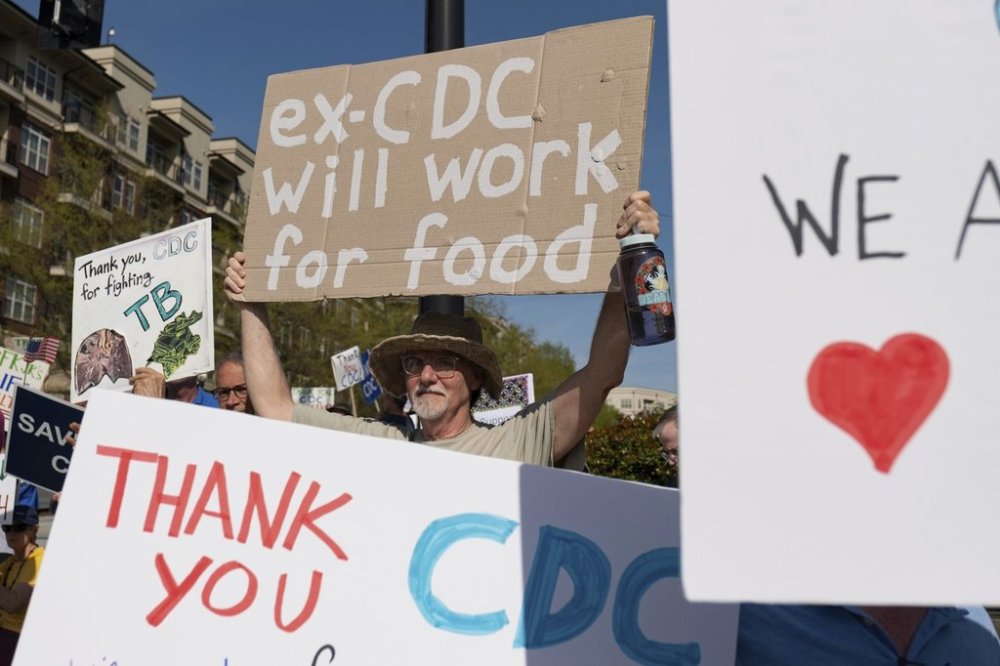
Among those terminated at the Centers for Disease Control and Prevention were experts tracking abortions, pregnancies, job-related injuries, lead poisonings, sexual violence and youth smoking, the AP found.
“If you don’t have staff, the program is gone,” said Patrick Breysse, who used to oversee the CDC’s environmental health programs.
Federal officials have not given a public accounting of specific surveillance programs that are being eliminated.
Instead, a U.S. Department of Health and Human Services spokeswoman pointed the AP to a Trump administration budget proposal released Friday. It lacked specifics, but proposes to cut the CDC’s core budget by more than half and vows to focus CDC surveillance only on emerging and infectious diseases.
Kennedy has said some of the CDC’s other work will be moved to a yet-to-be-created agency, the Administration for a Healthy America. He also has said that the cuts are designed to get rid of waste at a department that has seen its budget grow in recent years.
“Unfortunately, this extra spending and staff has not improved our nation’s health as a country,” Kennedy wrote last month in The New York Post. “Instead, it has only created more waste, administrative bloat and duplication.”
Yet some health experts say the eliminated programs are not duplicative, and erasing them will leave Americans in the dark.
“If the U.S. is interested in making itself healthier again, how is it going to know, if it cancels the programs that helps us understand these diseases?” said Graham Mooney, a Johns Hopkins University public health historian.
The core of the nation’s health surveillance is done by the CDC’s National Center for Health Statistics. Relying on birth and death certificates, it generates information on birth rates, death trends and life expectancy. It also operates longstanding health surveys that provide basic data on obesity, asthma and other health issues.
The center has been barely touched in layoffs, and seems intact under current budget plans.
But many other efforts were targeted by the cuts, the AP found. Some examples:
Pregnancies and abortion
The Pregnancy Risk Assessment Monitoring System, which surveys women across the country, lost its entire staff — about 20 people.
It’s the most comprehensive collection of data on the health behaviors and outcomes before, during and after childbirth. Researchers have been using its data to investigate the nation’s maternal mortality problem.
Recent layoffs also wiped out the staffs collecting data on in vitro fertilizations and abortions.
Those cuts are especially surprising given that President Donald Trump said he wants to expand IVF access and that the Heritage Foundation’s Project 2025 playbook for his administration called for more abortion surveillance.
Lead poisoning
The CDC eliminated its program on lead poisoning in children, which helped local health departments — through funding and expertise — investigate lead poisoning clusters and find where risk is greatest.
Lead poisoning in kids typically stems from exposure to bits of old paint, contaminated dust or drinking water that passes through lead pipes. But the program’s staff also played an important role in the investigation of lead-tainted applesauce that affected 500 kids.
Last year, Milwaukee health officials became aware that peeling paint in aging local elementary schools was endangering kids. The city health department began working with CDC to test tens of thousands of students. That assistance stopped last month when the CDC’s lead program staff was terminated.
City officials are particularly concerned about losing expertise to help them track the long-term effects.
“We don’t know what we don’t know,” said Mike Totoraitis, the city’s health commissioner.
Environmental investigations
Also gone is the staff for the 23-year-old Environmental Public Health Tracking Program, which had information on concerns including possible cancer clusters and weather-related illnesses.
“The loss of that program is going to greatly diminish the ability to make linkages between what might be in the environment and what health might be affected by that,” Breysse said.
Transgender data
In some cases, it’s not a matter of staffers leaving, but rather the end of specific types of data collection.
Transgender status is no longer being recorded in health-tracking systems, including ones focused on violent deaths and on risky behaviors by kids.
Experts know transgender people are more likely to be victims of violence, but now “it’s going to be much more challenging to quantify the extent to which they are at higher risk,” said Thomas Simon, the recently retired senior director for scientific programs at the CDC’s Division of Violence Prevention.
Violence
The staff and funding seems to have remained intact for a CDC data collection that provides insights into homicides, suicides and accidental deaths involving weapons.
But CDC violence-prevention programs that acted on that information were halted. So, too, was work on a system that collects hospital data on nonfatal injuries from causes such as shootings, crashes and drownings.
Also going away, apparently, is the CDC’s National Intimate Partner and Sexual Violence Survey. The system is designed to pick up information that’s not found in law enforcement statistics. Health officials see that work as important, because not all sexual violence victims go to police.
Work injuries
The National Institute for Occupational Safety and Health, which tracks job-related illnesses and deaths and makes recommendations on how to prevent them, was gutted by the cuts.
Kennedy has said that 20% of the people laid off might be reinstated as the agency tries to correct mistakes.
That appeared to happen last month, when the American Federation of Government Employees said that NIOSH workers involved in a black lung disease program for coal miners had been temporarily called back.
But HHS officials did not answer questions about the reinstatement. The AFGE’s Micah Niemeier-Walsh later said the workers continued to have June termination dates and “we are concerned this is to give the appearance that the programs are still functioning, when effectively they are not.”
There’s been no talk of salvaging some other NIOSH programs, including one focused on workplace deaths in the oil and gas industries or a research project into how common hearing loss is in that industry.
Smoking and drugs
The HHS cuts eliminated the 17-member team responsible for the National Survey on Drug Use and Health, one of the main ways the government measures drug use.
Also axed were the CDC staff working on the National Youth Tobacco Survey.
There are other surveys that look at youth smoking and drug use, including the University of Michigan’s federally funded “Monitoring the Future” survey of schoolkids.
But the federal studies looked at both adults and adolescents, and provided insights into drug use by high school dropouts. The CDC also delved into specific vaping and tobacco products in the ways that other surveys don’t, and was a driver in the federal push to better regulate electronic cigarettes.
“There was overlap among the surveys, but each one had its own specific focus that the other ones didn’t cover,“ said Richard Miech, who leads the Michigan study.
Data modernization and predictions
Work to modernize data collection has been derailed. That includes an upgrade to a 22-year-old system that helps local public health departments track diseases and allows CDC to put together a national picture.
Another casualty was the Center for Forecasting and Outbreak Analytics, which tries to predict disease trends.
The center, created during the COVID-19 pandemic, was working on forecasting the current multi-state measles outbreak. That forecast hasn’t been published partly because of the layoffs, according to two CDC officials who spoke on condition of anonymity because they are not authorized to discuss it and fear retribution for speaking to the press.
Trump hasn’t always supported widespread testing of health problems.

In the spring of 2020, when COVID-19 diagnoses were exploding, the president groused that the nation’s ability to do more testing was making the U.S. look like it had a worse problem than other countries. He called testing “a double-edged sword.”
Mooney, the Johns Hopkins historian, wonders how interested the new administration is in reporting on health problems.
“You could think it’s deliberate,” he said. “If you keep people from knowing, they’re less likely to be concerned.”
___
The Associated Press Health and Science Department receives support from the Howard Hughes Medical Institute’s Science and Educational Media Group and the Robert Wood Johnson Foundation. The AP is solely responsible for all content.
Related Articles
Canada could lose its measles elimination status if spread lingers, PHAC advisor says
Advertisement Advertise With Us
Advertisement Advertise With Us