

US inflation gauge cools with little sign of tariff impact, so far
Advertisement
Read this article for free:
or
Already have an account? Log in here »
To continue reading, please subscribe:

Digital Subscription
One year of digital access for only $205*
- Enjoy unlimited reading on winnipegfreepress.com
- Read the E-Edition, our digital replica newspaper
- Access News Break, our award-winning app
- Play interactive puzzles
*First annual payment billed as $205.00 + GST for one year. This annual subscription will automatically renew at $233.00 + GST every 52 weeks (10% off the regular annual price of $259.35). Offer available to new and qualified returning subscribers only. Cancel any time.
To continue reading, please subscribe:
Add Free Press access to your Brandon Sun subscription for only an additional
$1 for the first 4 weeks*
- Enjoy unlimited reading on winnipegfreepress.com
- Read the E-Edition, our digital replica newspaper
- Access News Break, our award-winning app
- Play interactive puzzles
*Your next Brandon Sun subscription payment will increase by $1.00 and you will be charged $17.95 plus GST for four weeks. After four weeks, your payment will increase to $24.95 plus GST every four weeks.
Read unlimited articles for free today:
or
Already have an account? Log in here »
Hey there, time traveller!
This article was published 30/05/2025 (470 days ago), so information in it may no longer be current.
WASHINGTON (AP) — A key U.S. inflation gauge slowed last month as President Donald Trump’s tariffs have yet to noticeably push up prices. Spending by Americans slowed despite rising incomes, potentially an early reaction to higher prices on some imported goods.
Friday’s report from the Commerce Department showed that consumer prices rose just 2.1% in April compared with a year earlier, down from 2.3% in March and the lowest since September. Excluding the volatile food and energy categories, core prices rose 2.5% from a year earlier, below the March figure of 2.7%, and the lowest in more than four years. Economists track core prices because they typically provide a better read on where inflation is headed.
The figures show inflation is still declining from its post-pandemic spike, which reached the highest level in four decades in July 2022. Economists and some business executives have warned that prices will likely head higher as Trump’s widespread tariffs take effect, though the timing and impact of those duties are now in doubt after they were struck down late Wednesday in court.
On a monthly basis, overall prices and core prices both increased just 0.1% from March to April. The cost of big-ticket manufactured goods rose a hefty 0.5%, though that increase was offset by a 0.1 decline in other goods, such as groceries. The cost of services rose just 0.1% from March to April.
The big increase in durable goods prices could reflect the early impact of tariffs. Americans also cut back their spending on longer-lasting factory goods in April, the report showed.
Overall consumer spending — which includes spending on services — rose 0.2% in April from March, the report said, but that’s down from a big 0.7% rise in March.
The slowdown in spending could reflect some early caution on the part of consumers, economists said, in response to higher goods prices. It also suggests that some of the spending jump in March reflected consumers purchasing items like cars to get in front of the impact of tariffs.
“The pulling forward of consumer spending ahead of the tariff increases will continue to dampen household spending in the coming months, especially as they face higher prices and a softening labor market,” Kathy Bostjancic, chief economist at Nationwide, said in an email. “We anticipate that the improved inflation trend will reverse in the second half of the year as companies are forced to begin passing along a portion of the increased tariffs in order to protect profit margins.”
Walmart executives said earlier this month that the retail giant would increase prices for many products in May and June to account for the tariffs, while electronics chain Best Buy’s CEO Corie Barry said Thursday the company is increasing some prices as well because of the duties, as a “last resort.”
Makeup company E.l.f. Beauty, which sources 75% of its products from China, said earlier this week it would raise its prices by $1 a product starting Aug. 1 to offset the cost of tariffs.
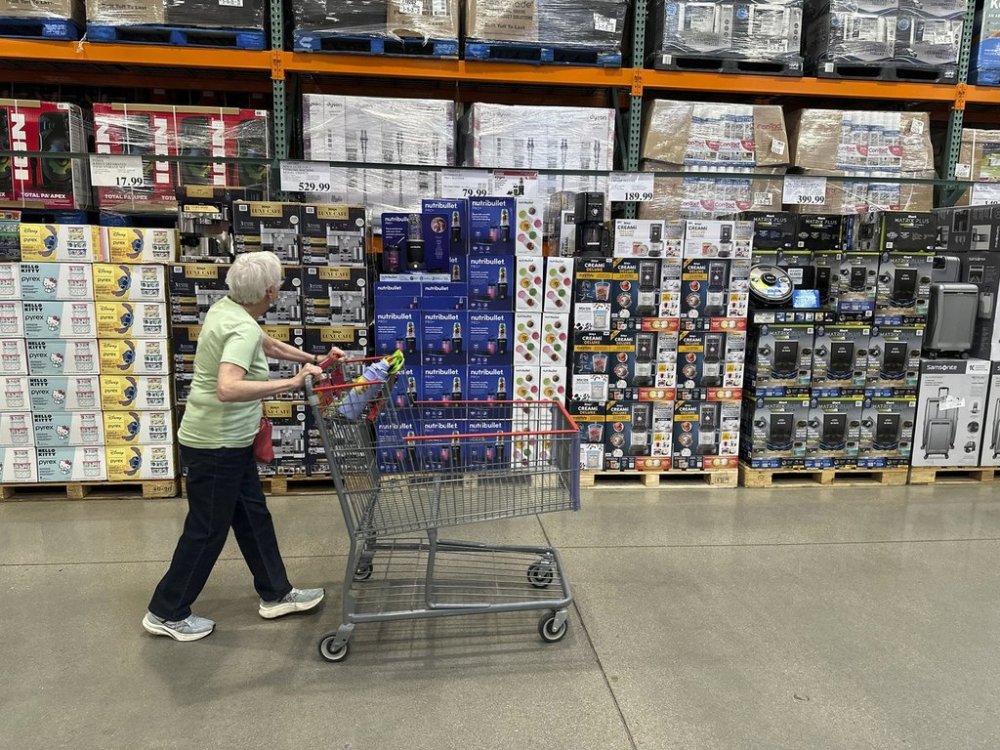
And on Thursday, warehouse retailer Costco said it has already raised prices for some products, but has held the line on others. The company largely absorbed the duties on pineapples and bananas “because they are key staple items” and “we felt it was important to really eliminate the impact there,” said Gary Millerchip, Costco’s chief financial officer.

But the company did increase prices for flowers from Central and Source America, for example, “because we felt that was something that the member would be able to absorb,” Millerchip added.
At the same time, incomes — before adjusting for inflation — rose a healthy 0.8% in April. Much of that gain reflected an increase in Social Security benefits for some retired teachers, fire fighters, and federal workers whose incomes previously weren’t fully counted toward Social Security benefits.
The inflation-fighters at the Federal Reserve said at their most recent meeting May 6-7 that inflation is still elevated, compared to their target of 2%. Fed officials, who focus more on core prices, broadly support keeping their key interest rate steady while they evaluate the impact of the tariffs on inflation and jobs.
The court ruling last Wednesday said that most of Trump’s tariffs were unlawful, including his duties on imports from Canada, Mexico, and China, as well as those on more than 50 other countries. Tariffs on steel, aluminum, and cars were implemented under different laws and remain in place.
But the duties were allowed to remain in effect while the Trump administration appeals the ruling against them. And administration officials say they will find other legal authorities, if needed, to implement the tariffs. As a result, what tariffs will end up in place and for how long remains highly uncertain.