Winds push smoke from Canadian wildfires south into US and worsen air quality
Advertisement
Read this article for free:
or
Already have an account? Log in here »
To continue reading, please subscribe:

Digital Subscription
One year of digital access for only $205*
- Enjoy unlimited reading on winnipegfreepress.com
- Read the E-Edition, our digital replica newspaper
- Access News Break, our award-winning app
- Play interactive puzzles
*First annual payment billed as $205.00 + GST for one year. This annual subscription will automatically renew at $233.00 + GST every 52 weeks (10% off the regular annual price of $259.35). Offer available to new and qualified returning subscribers only. Cancel any time.
To continue reading, please subscribe:
Add Free Press access to your Brandon Sun subscription for only an additional
$1 for the first 4 weeks*
- Enjoy unlimited reading on winnipegfreepress.com
- Read the E-Edition, our digital replica newspaper
- Access News Break, our award-winning app
- Play interactive puzzles
*Your next Brandon Sun subscription payment will increase by $1.00 and you will be charged $17.95 plus GST for four weeks. After four weeks, your payment will increase to $24.95 plus GST every four weeks.
Read unlimited articles for free today:
or
Already have an account? Log in here »
Hey there, time traveller!
This article was published 30/05/2025 (497 days ago), so information in it may no longer be current.
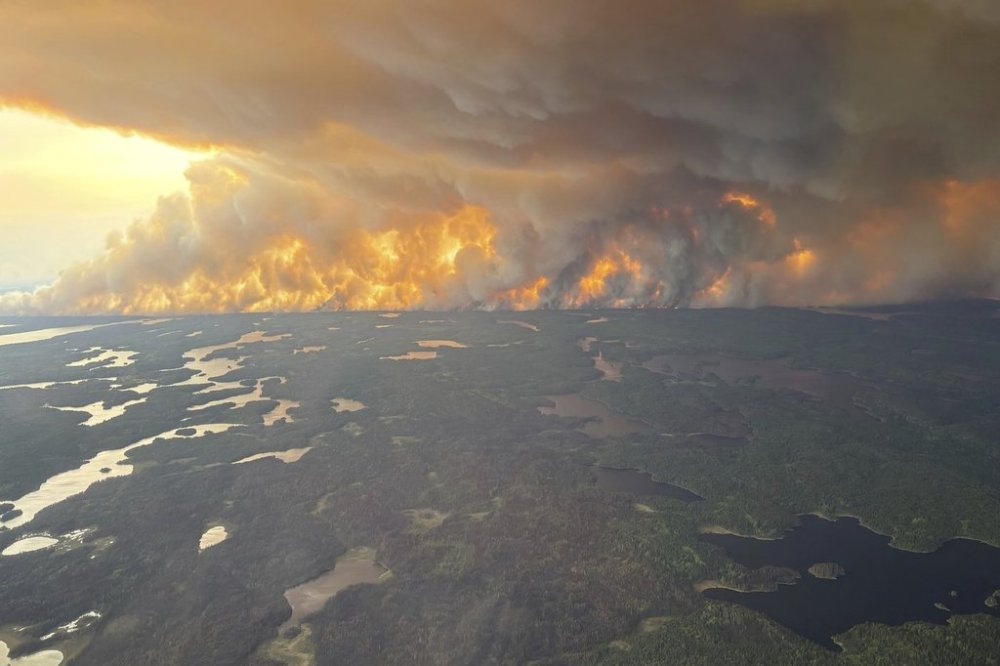
Air quality in some parts of the United States is worsening as smoke from dozens of wildfires in Canada travels south, pushed by winds high in the atmosphere.
Through parts of Minnesota and into Wisconsin, the air quality is deemed unhealthy for people and animals sensitive to pollution and other airborne particles, according to the Environmental Protection Agency’s AirNow page.
As of Friday afternoon, the interactive air quality map showed a strip of orange moving northwest to southeast across Wisconsin. Most of the state showed moderate air quality as did all of Michigan’s Upper Peninsula. Eastern Iowa and northwestern Illinois also showed moderate air quality on the AirNow map.
Over the next day or so, particulates from the burning trees, leaves and other vegetation could reach further south into Oklahoma, Tennessee and Arkansas, said Patrick Ayd, a meteorologist with the National Weather Service in Duluth, Minnesota.
Murray Kinsey, owner of a houseboat company just outside of Babbitt, Minnesota, said Friday afternoon the sky was “hazy,” but anglers still were fishing on nearby Birch Lake.
“It’s getting a little hard to breathe,” Kinsey said. “But it’s not terrible. We’ve had it before, but it’s been way worse.”
What is AQI and who is at risk?
The Air Quality Index — AQI — measures how clean or polluted the air we breathe is on a daily basis. The index focuses on the health effects that might be experienced within a few hours or days after breathing polluted air.
AQI is calculated based on ground-level ozone, particle pollution or particulate matter, carbon monoxide, sulfur dioxide, and nitrogen dioxide. Ground-level ozone and airborne particles are the two pollutants that pose the greatest threat to human health in this country.
The index ranges from green, where the air quality is satisfactory and air pollution poses little or no risk, to maroon, which is considered hazardous. That level comes with health warnings of emergency conditions where everyone is more likely to be affected, according to AirNow.
On Friday morning, the AQI showed orange around the Arrowhead, Minnesota, area, which Ayd said is a concern for people with chronic conditions, the elderly and young children. “They really should limit their time outdoors,” he added.
The path of the orange zone moved further south and southeast throughout Friday afternoon.
The level below orange is yellow and considered moderate, where the air quality is acceptable. That is what maps showed Friday for some other parts of the Midwest.
Any smoke from the Canadian wildfires may run into scattered thunderstorms forecast for Friday evening in the Chicago area.
“It looks like the smoke is moving in behind the cold front,” NWS meteorologist Zachary Yack said. Most of the smoke is “thinning behind the front,” he said.
But fine particle levels are expected to reach the red air quality index in northern Minnesota, a level that is unsafe for everyone, according to the Minnesota Pollution Control Agency. The North Dakota Department of Environmental Quality said it is monitoring air quality levels and advised individuals to limit prolonged outdoor activities.
To limit exposure to unhealthy air quality, people should stay indoors with windows and doors closed. Avoid heavy exertion outdoors, using fans or swamp coolers that take air from outside, all wood-burning appliances, and lighting candles and incense.
Where are the Canadian wildfires?
Nearly two dozens wildfires were burning in the Canadian province of Manitoba, which is just north of Minnesota and North Dakota. So far this year, the province had had more than 100 wildfires.
On Wednesday, Manitoba declared a state of emergency as the fires forced 17,000 people to evacuate homes in several communities.
Canada’s wildfire season runs May through September. Its worst-ever wildfire season was in 2023. It choked much of North America with dangerous smoke for months.
“We are getting the smoke,” said Kevin Doom, meteorologist with the National Weather Service in Chicago. “The winds way up in the atmosphere — 10,000, 20,000 feet up — are blowing in from the north today. Minnesota is kind of taking the brunt at the moment.”
“The wind is going to drag that smoke down over the next day or two,” Doom added.
Doom said a little haze was showing Friday morning over Chicago.
“It will keep moving with the wind,” he continued. “But over time, it will continue to disperse, mix in with the air until it gets thinner and thinner until it fades away.”

How did past wildfires impact air quality?
Last summer, fires burning in California, Oregon, Arizona, Washington state and other parts of the West, as well as Canada, filled the skies with smoke and haze, forcing some affected areas to declare air quality alerts or advisories.
Two years ago, smoky air from wildfires in Canada also shrouded broad swaths of the U.S. and prompted warnings for people to stay inside.
___________________
Williams reported from Detroit. Raza reported from Sioux Falls, South Dakota.
Related Articles
Mathias Colomb residents on alert for helicopters; evacuees in Winnipeg praise response

Advertisement Advertise With Us
Advertisement Advertise With Us