Cultural history of late-’60s rock hits some sour notes

Advertisement

Advertise with us

There’s a depth and richness in rock ‘n’ roll that, at its best, rivals other art forms.

Read this article for free:


By clicking the button above, an account will be created and you will begin to receive some of our recommended newsletters. You may opt out of any newsletter by visiting your Email and Communication Preferences page or by clicking "unsubscribe" at the bottom of any email.

or

Already have an account? Log in here »

To continue reading, please subscribe:

Digital Subscription

One year of digital access for only $1.44 a week*

  • Enjoy unlimited reading on winnipegfreepress.com
  • Read the E-Edition, our digital replica newspaper
  • Access News Break, our award-winning app
  • Play interactive puzzles

*Billed as $5.77 plus GST every four weeks. After 52 weeks, price increases to the regular rate of $19.95 plus GST every four weeks. Offer available to new and qualified returning subscribers only. Cancel any time.

To continue reading, please subscribe:

Add Free Press access to your Brandon Sun subscription for only an additional

$1 for the first 4 weeks*

  • Enjoy unlimited reading on winnipegfreepress.com
  • Read the E-Edition, our digital replica newspaper
  • Access News Break, our award-winning app
  • Play interactive puzzles
Start now

*Your next Brandon Sun subscription payment will increase by $1.00 and you will be charged $17.95 plus GST for four weeks. After four weeks, your payment will increase to $24.95 plus GST every four weeks.

Hey there, time traveller!
This article was published 31/05/2025 (504 days ago), so information in it may no longer be current.

There’s a depth and richness in rock ‘n’ roll that, at its best, rivals other art forms.

But to reveal it, the music has to be placed in the broader texture and framework of culture and politics.

John Einarson is the Winnipeg author of more than 20 rock-music music biographies. His past subjects include Neil Young, Randy Bachman, John Kay, Ian & Sylvia, The Byrds and Buffalo Springfield.
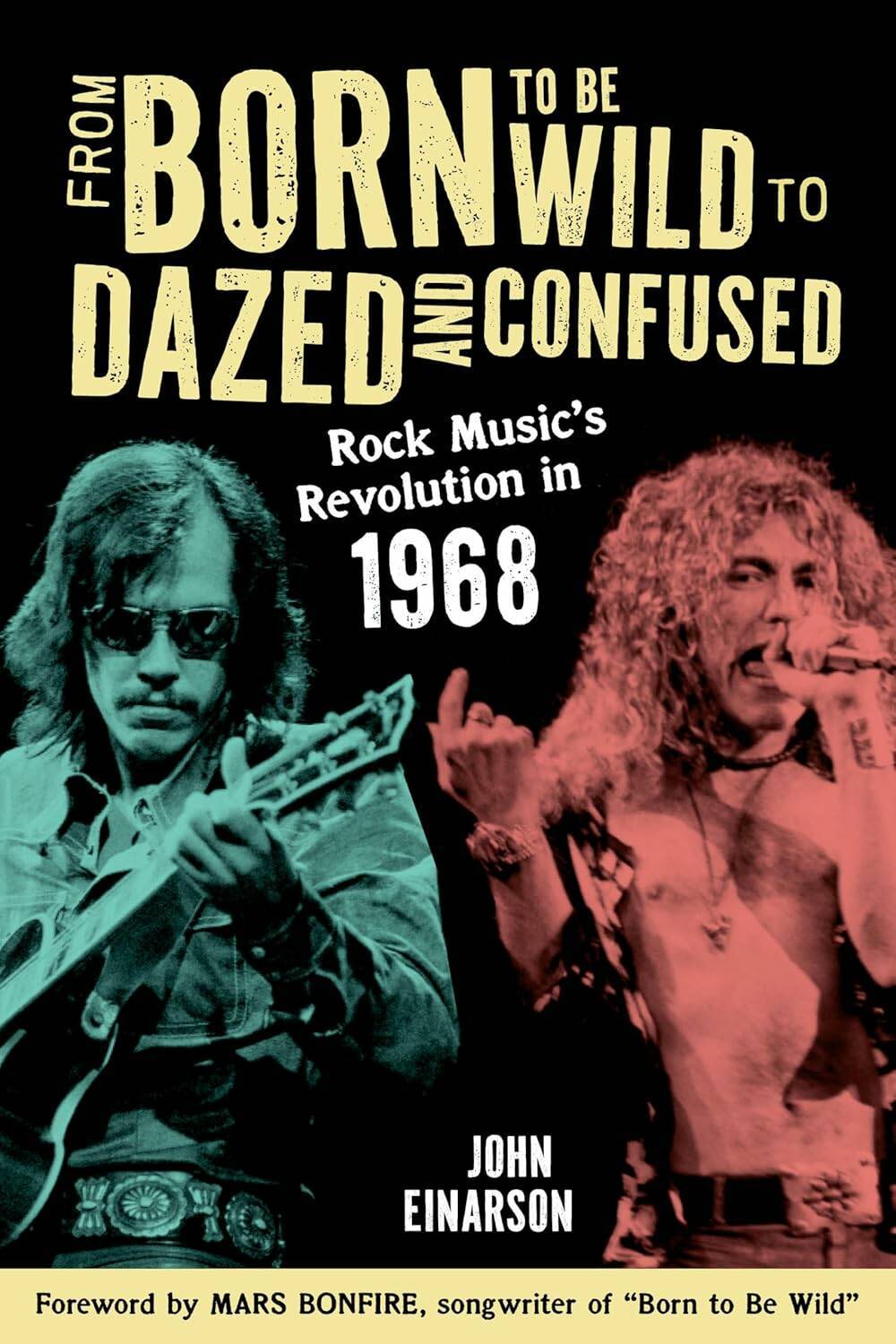
From Born to Be Wild to Dazed and Confused

From Born to Be Wild to Dazed and Confused

Despite his literary output, he allows his crowning epitaph to be that “he opened for Led Zeppelin” as the 17-year-old guitarist of local band Euphoria at the Man-Pop Festival at Winnipeg Stadium in August 1970.

He’s clearly a rock-music musicologist of the first order. And he also knows the tech stuff inside out. As a former rock musician, he writes knowledgably about guitar makes and models, tunings, chord progressions and amplifier manufacturers and sizes.

But his focus this time round is conceptual, and much more ambitious than a rock bio. It’s a cultural history, viewed through the lens of rock music in the late 1960s.

He’s set himself a tall order — one he doesn’t fill, and which is handicapped by a dubious editorial choice in the book’s format.

Einarson traces the evolution of rock ‘n’ roll from psychedelia to heavy rock to heavy metal. Each of the three years he principally treats of — 1967, ‘68 and ‘69 — is introduced by a “Timeline of Significant Events,” multi-page month-by-month one- or two-sentence bulleted lists of significant historical or musical events of each year.

It’s the kind of pedagogical aid Einarson, a former schoolteacher, might employ for instructing middle or high school students. But it has no business in a cultural history about rock music.

Some of the timeline potted summaries also surface in the chapters that follow. But far better if more of them were integrated into the music-driven narrative, and the bulleted lists nixed.

The net result: the music isn’t fully and seamlessly placed within the larger context of the times and shaping historical events.

The book’s title encompasses two songs Einarson considers signal recordings for the birth of hard rock — Steppenwolf’s Born to Be Wild, released in 1968, and Led Zeppelin’s Dazed and Confused, released in 1969.

But he begins the narrative in 1965, with the rise of psychedelic music. He charts how psychedelia’s gentler, more experimental ethos gave way through 1966-67 to a louder, heavier and more visceral sound, pioneered by the Who, the Jimi Hendrix Experience and Jeff Beck. It finally crystallized in the likes of Steppenwolf and Led Zeppelin, he maintains.

He links the evolution of psychedelic-cum-flower-power rock into a darker, heavier rock genre due to worsening geopolitical events — the Vietnam War’s Tet Offensive, the assassinations of Martin Luther King and Robert F. Kennedy, increasingly violent student and civil-rights protests, the presidential election of Richard Nixon. This heavy rock, often today dubbed “classic rock,” in turn gave way to a host of successor imitators, collectively known as heavy metal.

Heavy metal music’s intellectual quotient is near zero. It’s a kind of a soma, loudly lulling its fans into ignoring real-world issues.

Both early and later practitioners (Black Sabbath, Iron Maiden, Megadeath, Metallica) are weak derivatives of the pioneers of heavy rock (Jeff Beck, Cream, Led Zeppelin, Steppenwolf). What heavy metal imported was more overt sexual content, dilettantish dabbling in the occult, mysticism and Satanism, and adolescent proto-anarchism.

But Einarson renders neither a critical judgment nor an endorsing defence of the genre, remaining pretty much mute on its merits or lack of same.

This is an intelligent record of rock music’s evolution in the late 1960s.

But while it’s an interesting chronicle, there’s a dearth of considered scrutiny. The music’s interaction with politics and geopolitics is thin. The music’s interaction with contemporary books, movies, plays and television is negligible to non-existent. The broader context of the music is too often missing.

As cultural history, it’s criticism lite.

Douglas J. Johnston is a Winnipeg lawyer and writer.

Report Error Submit a Tip

More Stories

Not much of a race when most of the field can’t find their running shoes

Dan Lett 5 minute read Preview

Not much of a race when most of the field can’t find their running shoes

Dan Lett 5 minute read Yesterday at 2:52 PM CDT

In Winnipeg's mayoral race, there are few truly bad ideas, but hardly any really good ones.

Read
Yesterday at 2:52 PM CDT

Bayer Canada begins construction on new R&D facility in St. B

Gabrielle Piché 3 minute read Preview

Bayer Canada begins construction on new R&D facility in St. B

Gabrielle Piché 3 minute read Yesterday at 7:42 PM CDT

Instead of canola on Friday, there was sod.

But in two years’ time, by current estimates, the bare plot of land in a St. Boniface industrial park will hold canola samples and seeds for testing.

Bayer Canada officially broke ground on a 60,000-square-foot research and development facility Friday morning.

“It’s about bringing new and better innovation to farmers,” said Kacy Perry, Bayer Crop Science Canada’s country division head.

Read
Yesterday at 7:42 PM CDT

Disgraced ex-dean landed job at German university after fleeing Winnipeg

Maggie Macintosh 8 minute read Preview

Disgraced ex-dean landed job at German university after fleeing Winnipeg

Maggie Macintosh 8 minute read Yesterday at 3:07 PM CDT

Before he was arrested in a posh Paris suburb, the disgraced dean of Manitoba’s only law school — who fled the country following a 2020 expense scandal — kept a low profile at a German university.

Read
Yesterday at 3:07 PM CDT

Convicted harasser accused of targeting old, new victims, including judge

Dean Pritchard 6 minute read Preview

Convicted harasser accused of targeting old, new victims, including judge

Dean Pritchard 6 minute read Thursday, Oct. 15, 2026

Agnieszka Ciochon-Newton, who was sentenced to six years in prison for mercilessly harassing two people she believed had wronged her, as well as other crimes, wasted no time when her sentence ended to launch fresh attacks on victims new and old, including the judge who convicted her, court documents allege.

The 58-year-old former nurse was arrested last month after Winnipeg police “became aware that (Ciochon-Newton) was engaging in aggressive and harassing behaviours again, starting almost immediately upon the expiry of her parole conditions” on May 13, Det. Sgt Kylie Case wrote in search warrant documents obtained by the Free Press.

Ciochon-Newton is charged with seven counts of criminal harassment, two counts of uttering threats and one count each of fraud, breaking and entering, attempting to obstruct justice, intimidation of a justice official, mischief and defamatory libel. She remains in custody.

Search warrant documents say provincial court Judge Keith Eyrikson learned in late August that Ciochon-Newton had emailed CBC Manitoba days earlier and threatened him.

Read
Thursday, Oct. 15, 2026

Misused ensemble, underconfident script keep Street Fighter game adaptation from landing its blows clean

Darren Ridgley 5 minute read Preview

Misused ensemble, underconfident script keep Street Fighter game adaptation from landing its blows clean

Darren Ridgley 5 minute read 4:00 AM CDT

Adaptations of fighting games come built-in with a major problem: how does one tell a coherent story about a game with no true protagonist?

Sadly, Street Fighter doesn’t know.

When it debuted in 1991, Street Fighter II (upon which most of this film is based) featured 12 “world warriors,” eight of them playable and with their own motives.

Managing such a cast requires a script capable of efficiently introducing them and then giving everyone decent reasons to interact — or homing in on a few and letting the rest be set dressing. Director Kitao Sakurai opts for the latter, focusing on Japanese warrior Ryu (Andrew Koji), American Ken Masters (Noah Centineo) and Interpol agent Chun Li (Callina Liang).

Read
4:00 AM CDT

Author Emily St. John Mandel’s Exit Party a story of hope in dark times

Ben Sigurdson 6 minute read Preview

Author Emily St. John Mandel’s Exit Party a story of hope in dark times

Ben Sigurdson 6 minute read 4:00 AM CDT

If Emily St. John Mandel’s new novel Exit Party is in any way prophetic, Americans should be worried.

The B.C.-born, New York-based author’s bestselling fourth novel, 2014’s Station Eleven, chronicled a performing troupe in a post-pandemic world. The novel experienced a second wave of popularity when the COVID-19 pandemic took hold, and when HBO’s Station Eleven miniseries premièred in late 2021.

Mandel launches Exit Party, her seventh novel, at McNally Robinson Booksellers’ Grant Park location tonight, where she’ll be joined in conversation by Winnipeg novelist Joan Thomas.

Published in September by HarperCollins, Exit Party sees Mandel once again working in the near future, in this case in a novel that features two timelines — one (dubbed the A-side in the novel) where the U.S. has fractured into a number of small countries following a civil war, and another (the B-side) where a singular, autocratic surveillance state has tightened its grip over its citizens.

Read
4:00 AM CDT