A long-running experiment finds a tiny particle is still acting weird
Advertisement
Read this article for free:
or
Already have an account? Log in here »
To continue reading, please subscribe:

Digital Subscription
One year of digital access for only $205*
- Enjoy unlimited reading on winnipegfreepress.com
- Read the E-Edition, our digital replica newspaper
- Access News Break, our award-winning app
- Play interactive puzzles
*First annual payment billed as $205.00 + GST for one year. This annual subscription will automatically renew at $233.00 + GST every 52 weeks (10% off the regular annual price of $259.35). Offer available to new and qualified returning subscribers only. Cancel any time.
To continue reading, please subscribe:
Add Free Press access to your Brandon Sun subscription for only an additional
$1 for the first 4 weeks*
- Enjoy unlimited reading on winnipegfreepress.com
- Read the E-Edition, our digital replica newspaper
- Access News Break, our award-winning app
- Play interactive puzzles
*Your next Brandon Sun subscription payment will increase by $1.00 and you will be charged $17.95 plus GST for four weeks. After four weeks, your payment will increase to $24.95 plus GST every four weeks.
Read unlimited articles for free today:
or
Already have an account? Log in here »
Hey there, time traveller!
This article was published 03/06/2025 (458 days ago), so information in it may no longer be current.
NEW YORK (AP) — Final results from a long-running U.S.-based experiment announced Tuesday show a tiny particle continues to act strangely — but that’s still good news for the laws of physics as we know them.
“This experiment is a huge feat in precision,” said Tova Holmes, an experimental physicist at the University of Tennessee, Knoxville who is not part of the collaboration.
The mysterious particles called muons are considered heavier cousins to electrons. They wobble like a top when inside a magnetic field, and scientists are studying that motion to see if it lines up with the foundational rulebook of physics called the Standard Model.
Experiments in the 1960s and 1970s seemed to indicate all was well. But tests at Brookhaven National Laboratory in the late 1990s and early 2000s produced something unexpected: the muons weren’t behaving like they should.
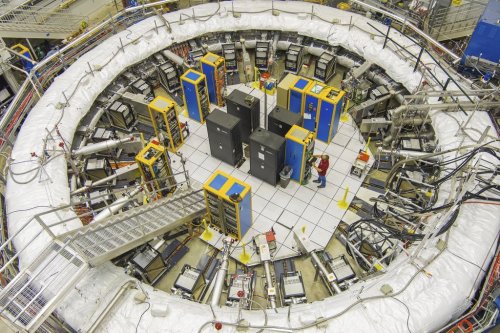
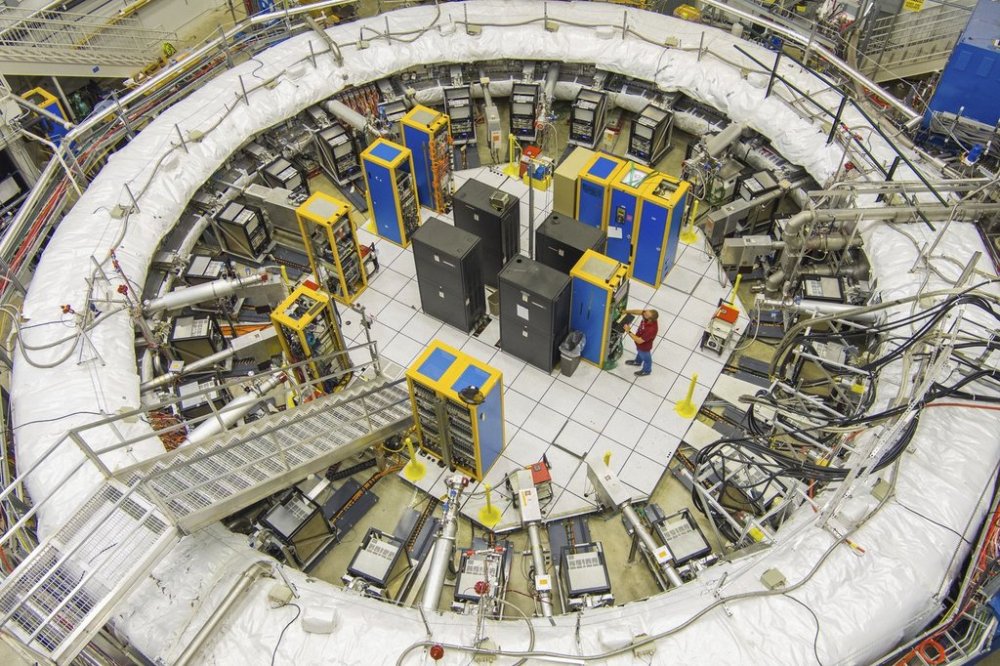
Decades later, an international collaboration of scientists decided to rerun the experiments with an even higher degree of precision. The team raced muons around a magnetic, ring-shaped track — the same one used in Brookhaven’s experiment — and studied their signature wiggle at the Fermi National Accelerator Laboratory near Chicago.
The first two sets of results — unveiled in 2021 and 2023 — seemed to confirm the muons’ weird behavior, prompting theoretical physicists to try to reconcile the new measurements with the Standard Model.
Now, the group has completed the experiment and released a measurement of the muon’s wobble that agrees with what they found before, using more than double the amount of data compared to 2023. They submitted their results to the journal Physical Review Letters.
That said, it’s not yet closing time for our most basic understanding of what’s holding the universe together. While the muons raced around their track, other scientists found a way to more closely reconcile their behavior with the Standard Model with the help of supercomputers.
There’s still more work to be done as researchers continue to put their heads together and future experiments take a stab at measuring the muon wobble — including one at the Japan Proton Accelerator Research Complex that’s expected to start near the end of the decade. Scientists also are still analyzing the final muon data to see if they can glean information about other mysterious entities like dark matter.
“This measurement will remain a benchmark … for many years to come,” said Marco Incagli with the National Institute for Nuclear Physics in Italy.
By wrangling muons, scientists are striving to answer fundamental questions that have long puzzled humanity, said Peter Winter with Argonne National Laboratory.
“Aren’t we all curious to understand how the universe works?” said Winter.
___
The Associated Press Health and Science Department receives support from the Howard Hughes Medical Institute’s Science and Educational Media Group and the Robert Wood Johnson Foundation. The AP is solely responsible for all content.