Nvidia chief calls AI ‘the greatest equalizer’ – but warns Europe risks falling behind
Advertisement
Read this article for free:
or
Already have an account? Log in here »
To continue reading, please subscribe:

Digital Subscription
One year of digital access for only $205*
- Enjoy unlimited reading on winnipegfreepress.com
- Read the E-Edition, our digital replica newspaper
- Access News Break, our award-winning app
- Play interactive puzzles
*First annual payment billed as $205.00 + GST for one year. This annual subscription will automatically renew at $233.00 + GST every 52 weeks (10% off the regular annual price of $259.35). Offer available to new and qualified returning subscribers only. Cancel any time.
To continue reading, please subscribe:
Add Free Press access to your Brandon Sun subscription for only an additional
$1 for the first 4 weeks*
- Enjoy unlimited reading on winnipegfreepress.com
- Read the E-Edition, our digital replica newspaper
- Access News Break, our award-winning app
- Play interactive puzzles
*Your next Brandon Sun subscription payment will increase by $1.00 and you will be charged $17.95 plus GST for four weeks. After four weeks, your payment will increase to $24.95 plus GST every four weeks.
Read unlimited articles for free today:
or
Already have an account? Log in here »
Hey there, time traveller!
This article was published 11/06/2025 (440 days ago), so information in it may no longer be current.
PARIS (AP) — Will artificial intelligence save humanity — or destroy it? Lift up the world’s poorest — or tighten the grip of a tech elite?
Jensen Huang — the global chip tycoon widely predicted to become one of the world’s first trillionaires — offered his answer on Wednesday: neither dystopia nor domination. AI, he said, is a tool for liberation.
Wearing his signature biker jacket and mobbed by fans for selfies, the Nvidia CEO cut the figure of a tech rockstar as he took the stage at VivaTech in Paris.
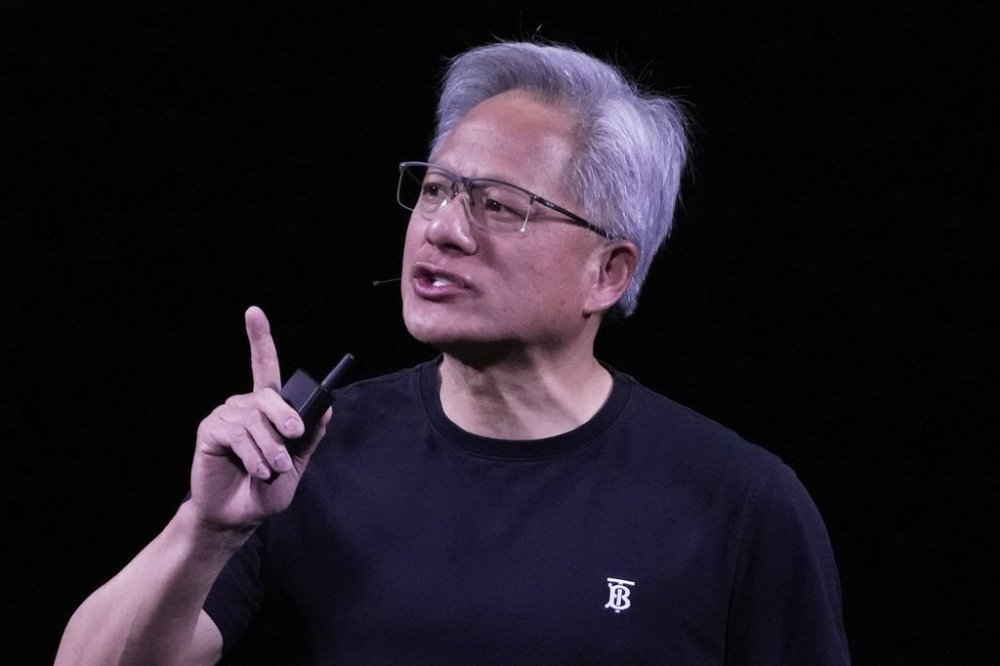
“AI is the greatest equalizer of people the world has ever created,” Huang said, kicking off one of Europe’s biggest technology industry fairs.
Huang’s core argument: AI can level the playing field, not tilt it. Critics argue Nvidia’s dominance risks concentrating power in the hands of a few. But Huang insists the opposite — that by slashing computing costs and expanding access, “we’re democratizing intelligence” for startups and nations alike.
But beyond the sheeny optics, Nvidia used the Paris summit to unveil a wave of infrastructure announcements across Europe, signaling a dramatic expansion of the AI chipmaker’s physical and strategic footprint on the continent.
In France, the company is deploying 18,000 of its new Blackwell chips with startup Mistral AI. In Germany, it’s building an industrial AI cloud to support manufacturers. Similar rollouts are underway in Italy, Spain, Finland and the U.K., including a new AI lab in Britain.
Other announcements include a partnership with AI startup Perplexity to bring sovereign AI models to European publishers and telecoms, a new cloud platform with Mistral AI, and work with BMW and Mercedes-Benz to train AI-powered robots for use in auto plants.
The announcements underscore how central AI infrastructure has become to global strategy — and how Nvidia, now the world’s most valuable chipmaker, is positioning itself as the engine behind it.
As the company rolls out ever more powerful systems, critics warn the model risks creating a new kind of “technological priesthood” — one in which only the wealthiest companies or governments can afford the compute power, energy, and elite engineering talent required to participate. That, they argue, could choke the bottom-up innovation that built the tech industry in the first place.
Huang pushed back. “Through the velocity of our innovation, we democratize,” he said, responding to a question by The Associated Press. “We lower the cost of access to technology.”
As Huang put it, these factories “reason,” “plan,” and “spend a lot of time talking to” themselves, powering everything from ChatGPT to autonomous vehicles and diagnostics.
But some critics warn that without guardrails, such all-seeing, self-reinforcing systems could go the way of Skynet in “ The Terminator ” movie — vast intelligence engines that outpace human control.
To that, Huang offers a counter-model: layered AI governance by design. “In the future,” he said, “the AI that is doing the task is going to be surrounded by 70 or 80 other AIs that are supervising it, observing it, guarding it, ensuring that it doesn’t go off the rails.”
He likened the moment to a new industrial revolution. Just as electricity transformed the last one, Huang said, AI will power the next — and that means every country needs a national intelligence infrastructure. That’s why, he explained, he’s been crisscrossing the globe meeting heads of state.
“They all want AI to be part of their infrastructure,” he said. “They want AI to be a growth manufacturing industry for them.”
Europe, long praised for its leadership on digital rights, now finds itself at a crossroads. As Brussels pushes forward with world-first AI regulations, some warn that over-caution could cost the bloc its place in the global race. With the U.S. and China surging ahead and most major AI firms based elsewhere, the risk isn’t just falling behind — it’s becoming irrelevant.
Huang has a different vision: sovereign AI. Not isolation, but autonomy — building national AI systems aligned with local values, independent of foreign tech giants.

“The data belongs to you,” Huang said. “It belongs to your people, your country… your culture, your history, your common sense.”
But fears over AI misuse remain potent — from surveillance and deepfake propaganda to job losses and algorithmic discrimination. Huang doesn’t deny the risks. But he insists the technology can be kept in check — by itself.
The VivaTech event was part of Huang’s broader European tour. He had already appeared at London Tech Week and is scheduled to visit Germany. In Paris, he joined French President Emmanuel Macron and Mistral AI CEO Arthur Mensch to reinforce his message that AI is now a national priority.
___
Chan reported from London.