‘We thought our community would burn’: Pimicikamak wildfire evacuees start to head home First Nation’s 7,500 residents warned to stay vigilant as out-of-control fires remain active
Read this article for free:
or
Already have an account? Log in here »
To continue reading, please subscribe:

Digital Subscription
One year of digital access for only $205*
- Enjoy unlimited reading on winnipegfreepress.com
- Read the E-Edition, our digital replica newspaper
- Access News Break, our award-winning app
- Play interactive puzzles
*First annual payment billed as $205.00 + GST for one year. This annual subscription will automatically renew at $233.00 + GST every 52 weeks (10% off the regular annual price of $259.35). Offer available to new and qualified returning subscribers only. Cancel any time.
To continue reading, please subscribe:
Add Free Press access to your Brandon Sun subscription for only an additional
$1 for the first 4 weeks*
- Enjoy unlimited reading on winnipegfreepress.com
- Read the E-Edition, our digital replica newspaper
- Access News Break, our award-winning app
- Play interactive puzzles
*Your next Brandon Sun subscription payment will increase by $1.00 and you will be charged $17.95 plus GST for four weeks. After four weeks, your payment will increase to $24.95 plus GST every four weeks.
Read unlimited articles for free today:
or
Already have an account? Log in here »
Hey there, time traveller!
This article was published 16/06/2025 (460 days ago), so information in it may no longer be current.
After being displaced for nearly three weeks, wildfire evacuee Elizabeth Salamandyk was looking forward to regaining a sense of normalcy while she prepared to fly home Monday.
Salamandyk boarded one of the first repatriation flights as Pimicikamak Cree Nation’s roughly 7,500 residents began a phased return by plane, bus and car after the northern community lifted a mandatory evacuation order that was issued May 28.
“I’m relieved. I’m happy that we’re going home to a house,” she said alongside family members at a Winnipeg air terminal. “That was extremely stressful because we thought our community would burn.”
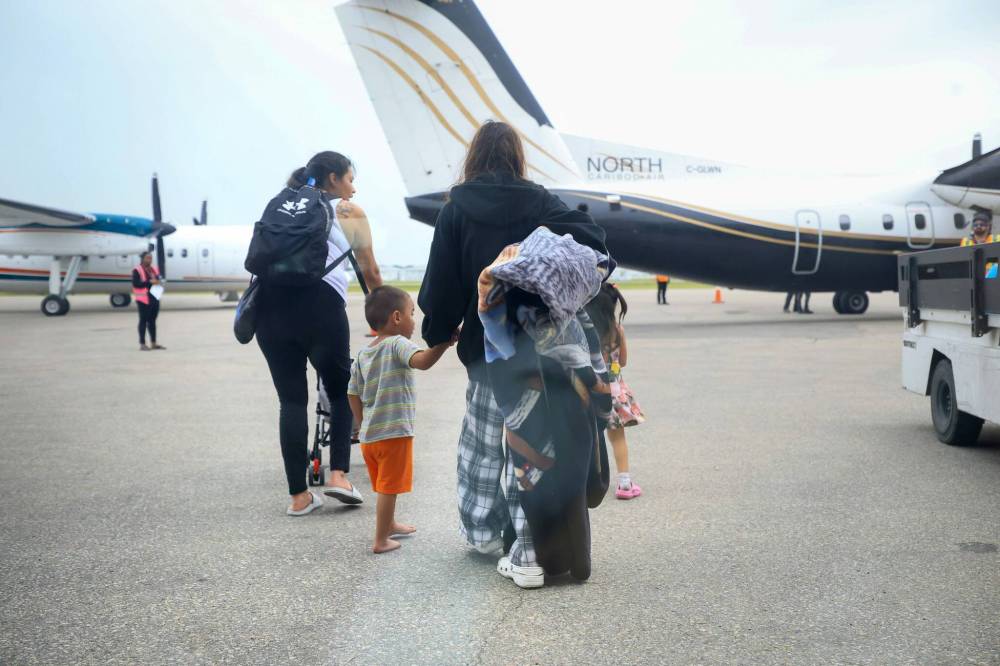
Ruth Bonneville / Free Press
Evacuees from Cross Lake make their way across the tarmac to board a flight home at Perimeter Airlines, Monday.
While Pimicikamak and a few other Manitoba communities were deemed safe to return to, provincial officials said large, out-of-control fires are still active, and new blazes are possible in the coming days.
“Our focus is on returning people home when there’s a higher level of confidence that they won’t have to leave again soon,” Christine Stevens, assistant deputy minister for the Manitoba Emergency Management Organization, told a news conference. “People do need to remain vigilant and stay aware of risk around them, unfortunately.”
Kristin Hayward, assistant deputy minister for the Manitoba Wildfire Service, said recent rain helped crews make progress on fires of concern, but rainfall amounts varied and fire activity is expected to “pick up” as areas dry out.
“(The fires) are not out, and they will not be for some time,” she said. “We are cautiously optimistic, but of course the situation can change as weather and conditions change.”

Seven of 18 active fires were deemed out of control Monday amid one of the worst wildfire seasons in recent memory.
Hayward said a couple of new fires that started in the previous 24 hours had not posed any concern. Additional fires could start after a band of lightning moved through Manitoba during that 24-hour period, she warned.
About 22,000 evacuees had registered with the Canadian Red Cross as of Monday morning, Stevens said.
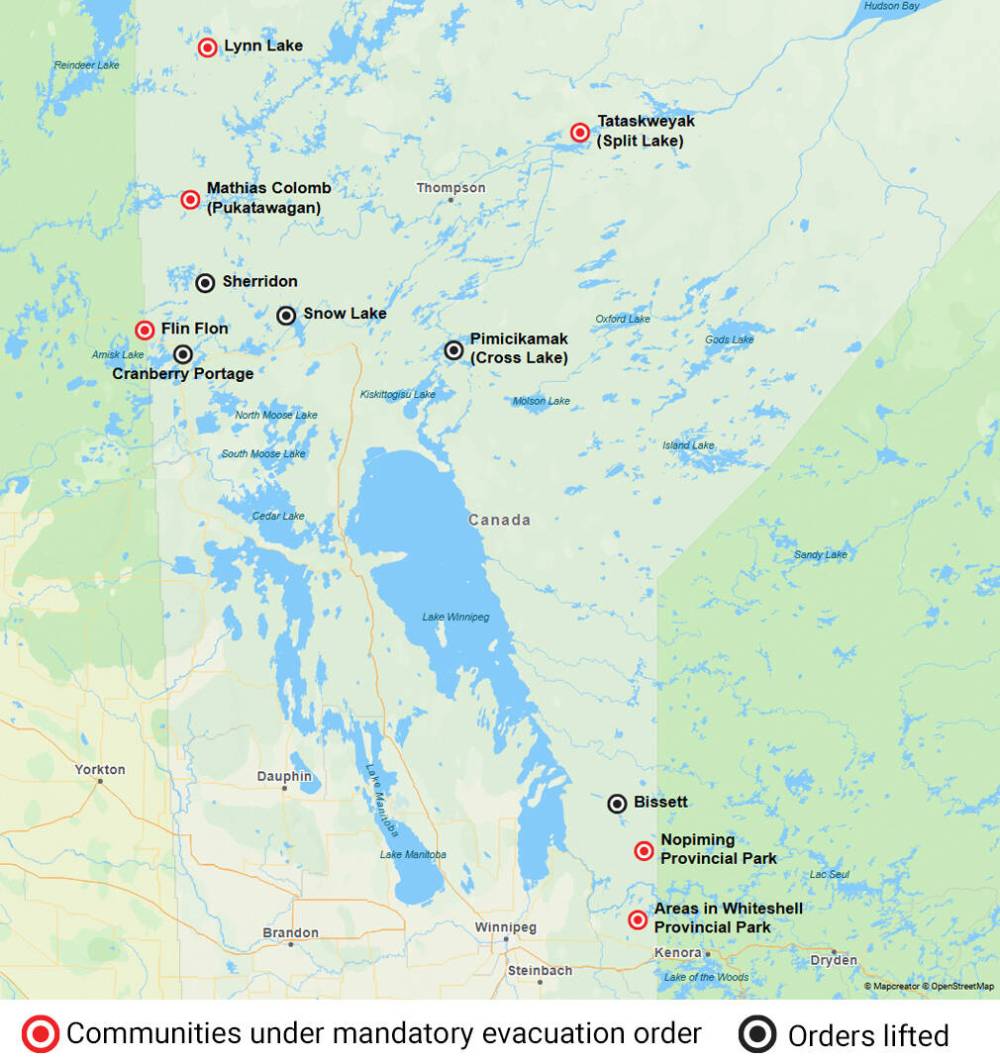
Evacuation orders were in place for 25 communities, she said.
On Saturday, about 1,800 evacuees began returning to Cranberry Portage, Herb Lake Landing, Payuk Lake, Sherridon, Snow Lake and Twin Lake.
Some evacuees returned to Grand Rapids, Misipawistik Cree Nation and St. Theresa Point First Nation Sunday.
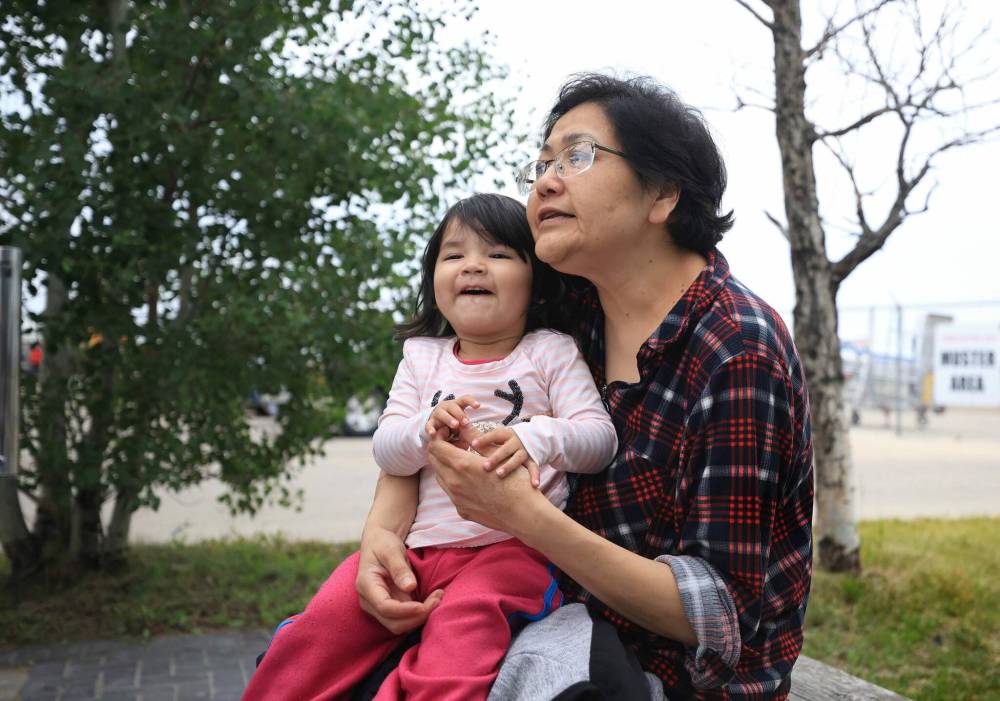
Ruth Bonneville / Free Press
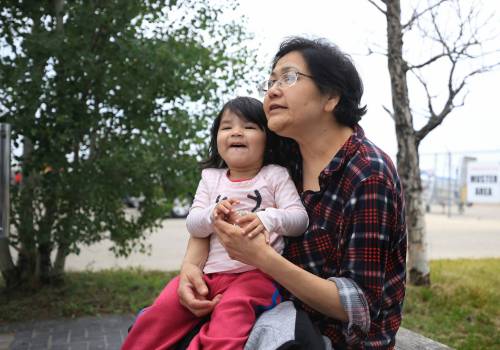
Cross Lake evacuee Elizabeth Salamandyk cuddling with her niece, Scarlett: “I think (the evacuation) had a huge impact on the children. The children were stressed out.”
Evacuees from Pimicikamak, the neighbouring community of Cross Lake, Wasagamack First Nation and Grass River Provincial Park started going home Monday.
Stevens said it could take up to a week for all of Pimicikamak’s residents to return, given the size of its population.
“It was exhausting. I’m happy to go home and go back to our normal routine.”–Jeremy Garrick
Return flights will be scheduled for about 300 residents who’ve been staying in hotels in Niagara Falls, Ont.
Bissett and Wekusko Falls Provincial Park residents are expected to head home Tuesday.
Pimicikamak had one of the largest evacuations in Manitoba this season. A fire that was once a few kilometres away was still more than 64,000 hectares.
Some families, elders or people with breathing or medical conditions left as a precaution May 21. A mandatory evacuation began a week later.
Salamandyk and family members fled by vehicle to Norway House Cree Nation, where they slept in a school gymnasium for two nights. They were among evacuees flown to Winnipeg on Canadian Armed Forces CC-130 Hercules planes.
They then stayed with relatives in the capital, with 10 people crammed into a two-bedroom house.
“We were like sardines in there,” Salamandyk said.
Evacuees Jeremy Garrick and his nearly two-year-old daughter, Scarlett, stayed in the same home. Garrick said he was relieved to be headed back to Pimicikamak.
“It was exhausting. I’m happy to go home and go back to our normal routine,” he said.
Evacuee Crystal Miller was looking forward to being reunited with her partner, a First Nation safety officer who remained in Pimicikamak as an essential worker.
“I woke up just so ecstatic to be home with him, and start my days the way I did before,” she said.
Being displaced was a stressful and depressing experience, said Miller, who believes some evacuees will be traumatized.
“Their whole life changed for those two to three weeks,” she said.
Salamandyk described the experience as challenging, frustrating and stressful.
“I’m not used to the city. It’s very fast-paced here,” she said. “I think (the evacuation) had a huge impact on the children. The children were stressed out.”
Pimicikamak Chief David Monias said the fire near the community was largely contained, with some areas still being closely monitored.
In a statement on social media, he said evacuees’ return would be done in a safe and gradual way. Monias shared a schedule that showed 16 flights, with about 500 seats for evacuees, from Winnipeg to Cross Lake’s airport Monday.
Evacuees from Flin Flon, Lynn Lake, Tataskweyak Cree Nation and Nopiming Provincial Park are among those still waiting for the OK to go home.
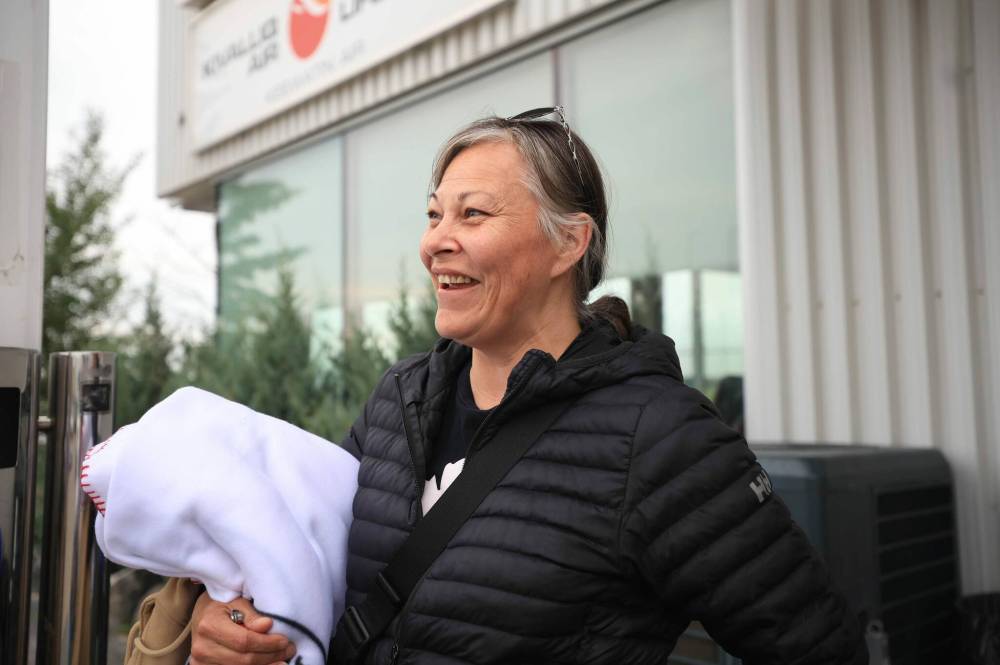
Ruth Bonneville / Free Press
Crystal Miller of Cross Lake is all smiles as she waits outside Perimeter Airlines terminal before boarding her flight back home, Monday.
“Right now, there is still some fire danger. It’s not safe to go home yet,” said Flin Flon Mayor George Fontaine, who asked evacuees to remain patient.
The decision to lift the evacuation order will be based on factors such as advice from provincial fire officials and the restoration of safety and essential services, he said.
Flin Flon, home to about 5,000 people, was evacuated May 28 due to a blaze that raged on its doorstep at one time.
“We know folks from Flin Flon are eager to get back home, just like everybody else who’s been out for a while, but it’s really important that it’s safe enough and ready for the return,” Lisa Naylor, the minister responsible for Manitoba Emergency Management Organization, said.
“Right now, there is still some fire danger. It’s not safe to go home yet.”–Flin Flon Mayor George Fontaine
Hayward said the behaviour of the Flin Flon-area fire is expected to “pick up” as early as Tuesday, after minimal rain over the weekend.
She said crews will focus efforts on some of the “hottest areas” of the fire.
The out-of-control blaze, after previously merging with other fires, was more than 370,000 hectares.
Hayward said crews made “really good progress” on an out-of-control fire that covered about 218,000 hectares in the Bird River and Nopiming areas of eastern Manitoba. Nopiming’s permanent residents have been displaced since the park closed May 13.
A provincewide state of emergency is in place until at least June 26. Congregate shelters remain open in Winnipeg (at the Leila Avenue soccer complex) and Thompson.

Ruth Bonneville / Free Press
Several bus loads of Cross Lake evacuees arrived at the airport to board flights home on Perimeter Airlines, Monday.
Naylor said about 40 people were at the Winnipeg shelter and about 150 in Thompson, while officials tried to find hotel rooms for all evacuees.
Manitoba has recorded 120 wildfires this year, above the average of 104 for June 16.
Naylor said the “big challenge” this season has been the numbers of fires and evacuees.
“We’re not used to having fires in the East, the West and the North all at the same time,” Naylor said.
Hayward said fire season is starting earlier and lasting later “year over year.”
“We did start things off very early this year,” she said. “It’s not that we didn’t necessarily expect that based on conditions, I just don’t think we were able to expect the broad scale of activity that we saw… in all of the different regions.”
chris.kitching@freepress.mb.ca

Chris Kitching is a general assignment reporter at the Free Press. He began his newspaper career in 2001, with stops in Winnipeg, Toronto and London, England, along the way. After returning to Winnipeg, he joined the Free Press in 2021, and now covers a little bit of everything for the newspaper. Read more about Chris.
Every piece of reporting Chris produces is reviewed by an editing team before it is posted online or published in print — part of the Free Press‘s tradition, since 1872, of producing reliable independent journalism. Read more about Free Press’s history and mandate, and learn how our newsroom operates.
Our newsroom depends on a growing audience of readers to power our journalism. If you are not a paid reader, please consider becoming a subscriber.
Our newsroom depends on its audience of readers to power our journalism. Thank you for your support.
Related Articles
Prairie fire officials work to support evacuees, while some areas plan return home




History
Updated on Monday, June 16, 2025 1:01 PM CDT: Updates after news conference
Updated on Monday, June 16, 2025 5:46 PM CDT: Adds quotes, details, fresh photos, tweaks headline, adds deck