Hackathon teams race to solve defense tech challenges as Europe boosts military capabilities
Advertisement
Read this article for free:
or
Already have an account? Log in here »
To continue reading, please subscribe:
Digital Subscription
One year of digital access for only $1.44 a week*
- Enjoy unlimited reading on winnipegfreepress.com
- Read the E-Edition, our digital replica newspaper
- Access News Break, our award-winning app
- Play interactive puzzles
*Billed as $5.77 plus GST every four weeks. After 52 weeks, price increases to the regular rate of $19.95 plus GST every four weeks. Offer available to new and qualified returning subscribers only. Cancel any time.
To continue reading, please subscribe:
Add Free Press access to your Brandon Sun subscription for only an additional
$1 for the first 4 weeks*
- Enjoy unlimited reading on winnipegfreepress.com
- Read the E-Edition, our digital replica newspaper
- Access News Break, our award-winning app
- Play interactive puzzles
*Your next Brandon Sun subscription payment will increase by $1.00 and you will be charged $17.95 plus GST for four weeks. After four weeks, your payment will increase to $24.95 plus GST every four weeks.
Read unlimited articles for free today:
or
Already have an account? Log in here »
Hey there, time traveller!
This article was published 25/06/2025 (483 days ago), so information in it may no longer be current.
SANDHURST, England (AP) — Hunched over laptops, the team of four raced to solve a challenge: how to get a set of drones to fly themselves from one place to another when GPS and other signals are jammed by an enemy.
Elsewhere around the hall, groups of people — engineering students, tech workers and hobbyists — gathered around long tables to brainstorm, write computer code or tinker with more drones and other hardware.
Most of them were strangers when they first gathered last month at Britain’s Sandhurst Military Academy to compete in a 24-hour “hackathon” focused on defense technology. Many were drawn to the event because they wanted to use their technical skills to work on one of the biggest challenges confronting Europe: the continent’s race to beef up its military capabilities as Russia’s war in Ukraine threatens to widen global instability.
“Given the geopolitical climate, defense tech is relevant now more than ever,” said Aniketh Ramesh, a startup founder with a Ph.D. in robotics in extreme environments and one of the drone team members. The hackathon, he said, “is a good place to sort of go and contribute your ideas.”
“Robotics and drones are having their iPhone moment” because costs have come down and the hardware is widely available, Ramesh said. That means building drones to do new things is more a “thinking challenge” than a technical one, he said.
Ramesh already knew one teammate, a former British army paratrooper, from a previous event. They recruited two others — one engineer and one with a Ph.D. in computer vision — through the event’s group chat on Signal.
The drone problem was just one of the many challenges the teams could choose to solve. The tasks were proposed by defense startups like German drone maker Helsing and robotics company Arx, the British military and Kyiv-based venture capital firm D3.
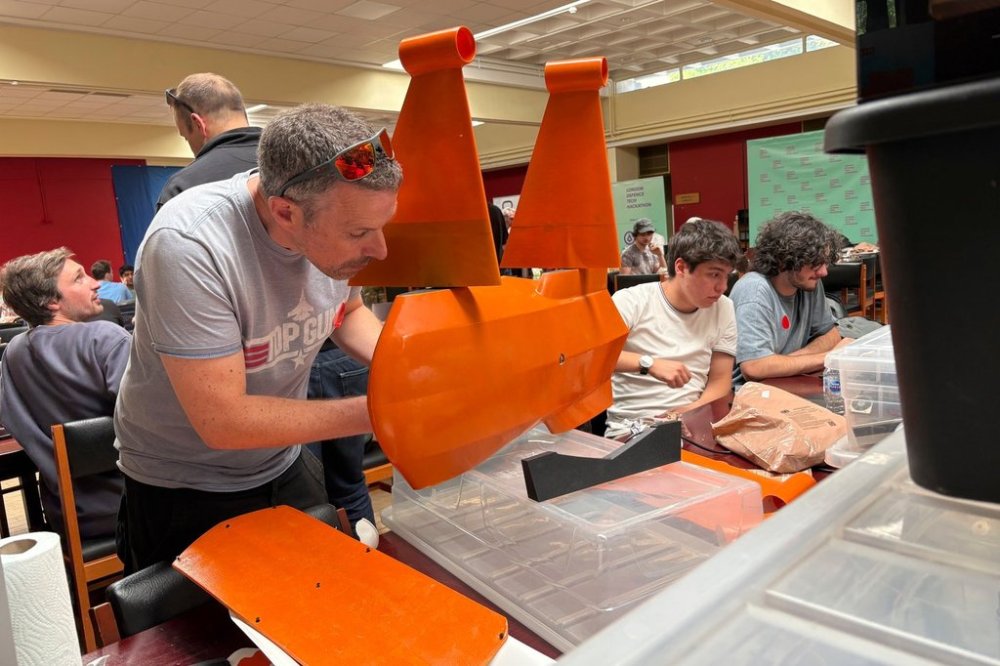
Some worked on software, such as an algorithm to predict which way a target would move. Others came with their own ideas. One team made a plastic cup packed with sensors that could be produced in large amounts to be scattered across a battlefield. Another team built a scale model of an autonomous medical evacuation aircraft.
Similar competitions have been held regularly across Europe since last year, inspired by the Ukrainian military’s on-the-fly wartime innovations to fend off the larger Russian army.
The grassroots meetups are part of a wider network of defense innovation that organizers hope to foster in Europe, underscoring the continent’s scramble to churn out weapons that have been turbocharged by U.S. President Donald Trump’s persistent threats to withdraw from the NATO trans-Atlantic security alliance.
The idea is to “go build a prototype, take your prototype to become a product, and go build a company” that can “deliver stuff to the frontline and hopefully save someone’s life,” said Benjamin Wolba, who organizes a separate but similar series, the European Defense Tech Hackathon.
Wolba’s group has held tournaments in about 10 cities in the past twelve months, including one in Lviv, Ukraine, in May, and has scheduled more this year in Sheffield, England; Gothenburg, Sweden; Marseilles, France; London; and Berlin.
The European Union-backed EUDIS Defence Hackathon holds simultaneous competitions at eight universities twice a year. Meanwhile, NATO has launched DIANA, an “accelerator” program to speed up defense innovations.
The competitions are producing real-world results. The winners of one European Defense Tech Hackathon were a team of Bulgarian high school students who came up with a de-mining solution that they used to found a startup.
At last year’s London event, the winning team devised an idea for an anti-drone system. They went to Ukraine for more testing, and then were bought by a startup that went on to raise millions in venture capital funding, said Richard Pass, co-founder of the London hackathon.
This year, instead of a trophy, some London teams signed term sheets with investors.
Hackathons have their origins in the software industry. Small teams of programmers and developers are pitted against each other in marathon brainstorming sessions to write programs that could become new products.
“The beauty of the hackathon is you get a mixture of people who never normally meet,” said Wolba. “Engineers are “paired with actual investors who understand something on the commercial side, but also, critically, military end users.”
Organizers want to foster a culture of nimble startups to join Europe’s defense ecosystem, traditionally dominated by a handful of big “prime” military contractors such as Britain’s BAE, Germany’s Rheinmetall and France’s Thales that are focused on building pricey hardware.
“There’s definitely been a shift in the industry from the purchase of more exquisite, high-cost capabilities, such as fighter jets, or submarines, or expensive tanks, towards more low-cost systems that can give you scale advantages,” said Pass.
A recent aerial confrontation between Pakistan and India further highlights how Europe is at risk of losing its edge against adversaries, he said.
Pass said reports that Pakistan used Chinese-made fighter jets armed with Chinese air-to-air missiles to down Indian air force planes, including three French-made Rafale jets, came as a big surprise.
Not only does it show “technological parity between the Chinese and leading Western industrial nations like France,” but it also hints at China’s advantages in mass-producing fighter jets that could overwhelm Western forces, he said.
Fostering a broader European defense tech start-up ecosystem is a way “to regain that technological advantage,” he said.
Defense tech startup founders can ride a wave of investment as Europe moves to beef up its military capabilities. Leaders of NATO, which includes 30 European nations, are meeting this week to endorse a goal to spend 5% of gross domestic product on defense.
The European Union has sought to mobilize 800 billion euros ($927 billion) to boost the 27-nation bloc’s defense, with priorities including drones, AI, autonomous systems and quantum computing.
Britain, which left the EU, has meanwhile pledged to spend 10% of its defense budget on new technologies.

Europe still has a long way to go. The continent’s defense tech startup ecosystem is young and about five years behind the United States, consulting firm McKinsey said in a recent report. But it’s growing rapidly as investors flock there. Venture capital investment in Europe’s defense tech sector for 2021-2024 more than quadrupled from the previous three-year period, according to Pitchbook.
At the London hackathon, teams worked into the evening, fueled by chocolate bars, energy drinks, fruit and a late-night pizza delivery. Army cots were available for those who wanted to catch a few hours of sleep.
Soldiers in camouflage and defense company reps hovered on the sidelines to provide advice and answer questions.
Andrii Solonskyi, CEO of Soloma Avionics, which fielded a team, said defense hackathons are “a bit of a novelty.”
The industry has traditionally been more structured and formal, because “it’s a serious business and there’s a lot of things that can go wrong,” he said. But, “what we definitely feel is that you can be very agile in defense right now.”