How to protect yourself from ticks year-round

Advertisement

Advertise with us

WASHINGTON (AP) — Ticks can be active in any season and it's important to check for and remove the bloodsuckers as quickly as possible — especially after you've been outside hiking, gardening or enjoying nature.

Read this article for free:


or

Already have an account? Log in here »

To continue reading, please subscribe:

Subscribe and receive a limited-edition Free Press branded hat or tote.

Digital Subscription

One year of digital access for only $205*

  • Enjoy unlimited reading on winnipegfreepress.com
  • Read the E-Edition, our digital replica newspaper
  • Access News Break, our award-winning app
  • Play interactive puzzles

*First annual payment billed as $205.00 + GST for one year. This annual subscription will automatically renew at $233.00 + GST every 52 weeks (10% off the regular annual price of $259.35). Offer available to new and qualified returning subscribers only. Cancel any time.

To continue reading, please subscribe:

Add Free Press access to your Brandon Sun subscription for only an additional

$1 for the first 4 weeks*

  • Enjoy unlimited reading on winnipegfreepress.com
  • Read the E-Edition, our digital replica newspaper
  • Access News Break, our award-winning app
  • Play interactive puzzles
Start now

*Your next Brandon Sun subscription payment will increase by $1.00 and you will be charged $17.95 plus GST for four weeks. After four weeks, your payment will increase to $24.95 plus GST every four weeks.

Hey there, time traveller!
This article was published 28/06/2025 (410 days ago), so information in it may no longer be current.

WASHINGTON (AP) — Ticks can be active in any season and it’s important to check for and remove the bloodsuckers as quickly as possible — especially after you’ve been outside hiking, gardening or enjoying nature.

“Humans are outside more in summer so we hear about more tick infections,” said Sam Telford, an infectious diseases expert at Tufts University. But he urges caution year-round because “every season is tick season.”

While tick populations vary a lot regionally, some Northeastern states including Maine, Massachusetts and Rhode Island are seeing “above average” numbers of American dog ticks this year, said Telford.
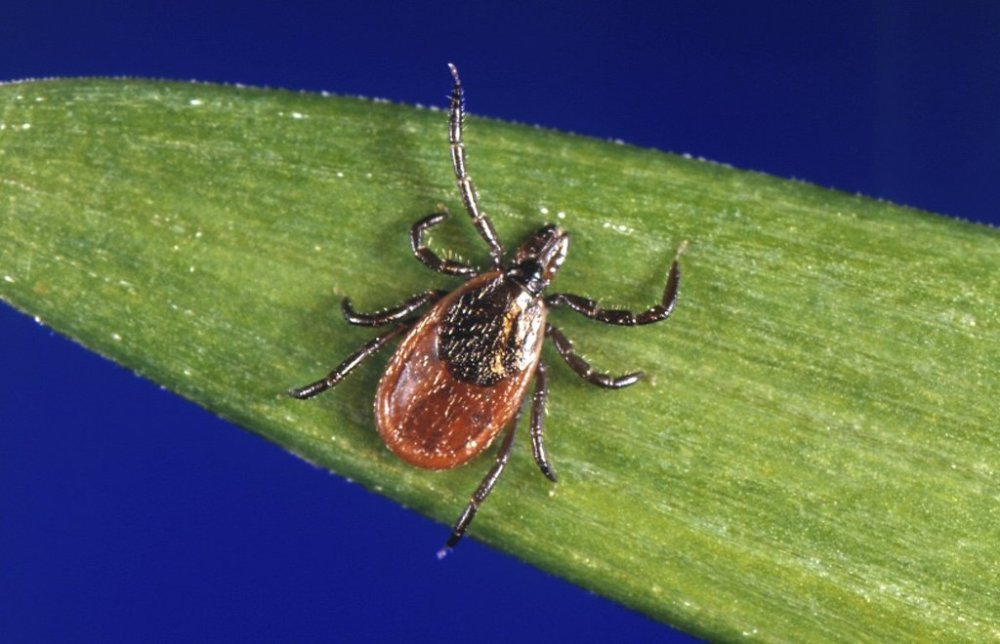
FILE - This undated photo provided by the U.S. Centers for Disease Control and Prevention (CDC) shows a blacklegged tick, also known as a deer tick, a carrier of Lyme disease. (CDC via AP, File)

And New York state is seeing a higher number of reported deer tick bites this year than last year, said Saravanan Thangamani, who studies tick-borne diseases at SUNY Upstate Medical University.

How ticks can spread disease

Ticks, like mosquitos, need to feed on blood. But instead of a quick prick, they are slow feeders – with hooked mouth parts that attach into the skin of deer, rabbits, dogs and people.

There are many different species of ticks found globally and only some spread germs that can make people sick. A main worry is blacklegged ticks, also called deer ticks, which can spread Lyme disease. Once found mainly in New England and pockets of the Midwest, the ticks are now present over a wider range.

A tick bite doesn’t always lead to illness. “If you remove a tick within 24 hours of attachment, it’s fairly unlikely that you will get infected,” said Telford.

How to check for ticks

Ticks are usually found low to the ground, in leaf litter or grassy areas.

Check your clothing for ticks and do a full-body check including under the arms and behind ears, knees and hair.

“If you’re out all day long, try to do a quick check for ticks every few hours,” said Bobbi Pritt at the Mayo Clinic. “When you go back inside, take a shower. That will wash off any unattached ticks, and you’re also more likely to spot any other ticks.”

Use tweezers to remove the tick and grasp it as close to the skin as possible to pull from the head. If you don’t have them handy, you can also use your fingernails, the edge of a credit card or any semi-sharp object.

How to keep ticks away

The best approach is to minimize tick exposure altogether.

Bug sprays containing ingredients such as DEET can be sprayed on exposed skin to ward off ticks and mosquitos, said Telford.

Wear long sleeves and pants, and you can also spray clothing with repellents containing permethrin, a chemical similar to a natural ingredient in chrysanthemums that makes ticks avoid the flowers.

Protect your pets from ticks

Don’t forget to pay attention to outdoor pets. Medications can prevent fleas and ticks from attaching to a dog’s skin. But it’s still a good idea to check the fur after being outside.

“Wherever pets can’t easily groom themselves, that’s where the ticks will be – on the ears, around the muzzle area, under the collar, between the toes,” said Thangamani.

Dogs and cats roaming outdoors can also bring ticks into the house.

“If pets bring ticks in, a tick can live in the house for months until it finds its next blood meal,” which could be another household member, he said.

What to do after a tick bite

After removing the tick, keep an eye on the skin around the bite. If a rash or flu-like symptoms appear within several days or weeks, see a doctor.

The Centers for Disease Control and Prevention does not recommend tick testing because results may not be reliable.

___

The Associated Press Health and Science Department receives support from the Howard Hughes Medical Institute’s Science and Educational Media Group and the Robert Wood Johnson Foundation. The AP is solely responsible for all content.


Report Error Submit a Tip

More Stories

The circle of life — garden-sized

5 minute read Preview

The circle of life — garden-sized

5 minute read 2:00 AM CDT

“The lesson I have thoroughly learnt, and wish to pass on to others, is to know the enduring happiness that the love of a garden gives.” — Gertrude Jekyll (1843-1932), horticulturalist

It’s a chilly day for August — more like fall — but in the garden things are progressing as nicely as if every day this summer had been the perfect combination of sun and showers.

The peonies are spent, their heavy heads with a hangdog look. Soon the petals will fall, revealing the jester-hat seedpods within. The lilacs, too, their beautiful, fragrant blossoms now transformed into brown scruff.

But the day lilies are plumping up, ready for their big reveal. And the roses are still magnificent — dozens and dozens of fuchsia, red, white and coral blooms that turn our stone circle into a heavenly scented bower. It is here where we come after a hard day’s work in the garden, newly scrubbed and wearing fresh clothes, to sit at a little bistro table and have a glass of wine and enjoy the results of our labour.

Read
2:00 AM CDT

Signs the Carney approach is working

Editorial 4 minute read Preview

Signs the Carney approach is working

Editorial 4 minute read 2:00 AM CDT

It was, if nothing else, a glowing review in trying times.

Matt Winkler, the editor in chief emeritus of Bloomberg News, spoke last week on Bloomberg Business News Daily about a recent Bloomberg analysis of the performance of the Canadian economy, and this country as a target for investment

“This is one of the greatest periods for overseas investment in Canada that we’ve seen in the century, and it may be unprecedented, because we have to wait for the rest of the year. … Money is pouring into Canada like we have not seen from everywhere. Stocks and bonds are the obvious beneficiaries,” Winkler said. He argued that Canada is both liked and seen as reasonable.

“The point is… Canada since Mark Carney became prime minister in 2025, has outperformed everyone in America and also the Eurozone and anywhere in the world. The 10 largest stock markets in the world, Canada appreciated the most, more than 40 per cent. … Its bond market is also doing great, partially because the inflation rate in Canada, unlike the Eurozone or America, is actually trending lower, and is outperforming both the Eurozone and the U.S.”

Read
2:00 AM CDT

Jarvis brings Stanley Cup to where it all began

Grace Penner 5 minute read Preview

Jarvis brings Stanley Cup to where it all began

Grace Penner 5 minute read Monday, Aug. 10, 2026

Seth Jarvis and Lord Stanley had quite the homecoming celebration with thousands of fans lining up for their arrival — some even before the sun graced the sky.

The Winnipeg community showed up to cheer on one of their own, wearing memorabilia of all of Jarvis’s achievements, with Tuxedo Lightning, Team Canada, and Carolina Hurricane jerseys aplenty in the crowd.

The Tuxedo Community Centre — where Jarvis’s storied career all began — had fans from all walks of life lined up, circling the building and fields, for the opportunity to meet the Stanley Cup champion and touch the trophy themselves.

Throughout the line, lawn chairs were assembled, picnic blankets were spread out, and umbrellas were opened — all prepared for the long wait ahead of them.

Read
Monday, Aug. 10, 2026

Missing pet tortoise found at Oak Hammock Marsh

Zoe Pierce 3 minute read Preview

Missing pet tortoise found at Oak Hammock Marsh

Zoe Pierce 3 minute read Yesterday at 6:58 PM CDT

Nobody at Oak Hammock Marsh expected to find an African spurred tortoise wandering through the wetlands. Least of all one that had travelled more than 20 kilometres from home to get there.

Read
Yesterday at 6:58 PM CDT

AI bio-weapons loom

Gwynne Dyer 4 minute read 2:00 AM CDT

‘Artificial intelligence’ based on large language models is shaping up to be the most efficient destroyer of value since the South Sea Bubble. After “the Crash”, which is inevitably coming, some specific functions of AI will eventually turn out to be genuinely revenue-generating, and a lot of jobs will duly disappear. But the biggest winner (and potentially biggest loser) is medical science.

Dr. Brian Hie, a chemical engineer at Stanford University in California, has just revealed that his team has made the first viruses designed by artificial intelligence. They are ‘bacteriophages’, viruses that only infect bacteria and are widely used to treat people with infections that resist other treatments.

However, natural bacteriophages sometimes fail, so Dr. Hie used generative AI to design new ones that might do the job. The AI generated thousands of designs for new genomes that more or less fit the bill, and he chose around 300 of them to build in the lab. It’s hard work, not magic, but he ended up with 16 ‘novel’ bacteriophages that might work.

He applied them to petri dishes containing two harmful strains of E. coli, a common bacteria that lives in the human gut, and they killed the bacteria off. It’s still early days, but if it is truly becoming possible to tailor-make bacteriophages that target specific bacteria, then we may be getting a major new weapon in the struggle against antibiotic resistance.

Fun drop-in last chance to mentor grads of inner-city school with excellent track record

Maggie Macintosh 6 minute read Preview

Fun drop-in last chance to mentor grads of inner-city school with excellent track record

Maggie Macintosh 6 minute read 2:00 AM CDT

Summer break may be in full swing, but Gonzaga Middle School invited graduates back to the building for water balloon fights and academic, employment and support services this week.

Roughly 30 alumni, including teenagers and twentysomethings, stopped by the grades 6-8 school in North Point Douglas on Tuesday afternoon. They were greeted with slime-making kits, ice cream sundaes and staff ready to answer questions.

The initiative — the final grad drop-in organized this summer — is a new extension of the mentorship and holistic programming baked into the funded independent school’s mandate.

“We have 22- and 23-year-olds coming back and checking in and asking for help on their university papers,” principal Rex Ferguson-Baird said.

Read
2:00 AM CDT