Why Canada may not be ready for ‘new reality’ of flash flooding and severe storms
Advertisement
Read this article for free:
or
Already have an account? Log in here »
To continue reading, please subscribe:

Digital Subscription
One year of digital access for only $205*
- Enjoy unlimited reading on winnipegfreepress.com
- Read the E-Edition, our digital replica newspaper
- Access News Break, our award-winning app
- Play interactive puzzles
*First annual payment billed as $205.00 + GST for one year. This annual subscription will automatically renew at $233.00 + GST every 52 weeks (10% off the regular annual price of $259.35). Offer available to new and qualified returning subscribers only. Cancel any time.
To continue reading, please subscribe:
Add Free Press access to your Brandon Sun subscription for only an additional
$1 for the first 4 weeks*
- Enjoy unlimited reading on winnipegfreepress.com
- Read the E-Edition, our digital replica newspaper
- Access News Break, our award-winning app
- Play interactive puzzles
*Your next Brandon Sun subscription payment will increase by $1.00 and you will be charged $17.95 plus GST for four weeks. After four weeks, your payment will increase to $24.95 plus GST every four weeks.
Read unlimited articles for free today:
or
Already have an account? Log in here »
Hey there, time traveller!
This article was published 08/07/2025 (442 days ago), so information in it may no longer be current.
VANCOUVER – Ryan Ness of the Canadian Climate Institute says he’s been following the “terrible tragedy” of deadly flash flooding unfolding in Texas, where more than 100 people have died.
But he’s also worried Canada isn’t doing enough to prevent such disasters here, saying the country needs to invest in flood mapping, infrastructure and early warning systems.
“Luckily, there are many ways that we can protect ourselves, but we have to make the effort,” said Ness, who is the research director for adaptation at the policy research organization.
“You know, first of all, we have to understand where the risk is.”
He said many parts of Canada don’t have flood maps, “so, it’s hard to know where to protect or where to send warnings.”
Flood warning systems are also needed to help people in the path of flash floods “prepare or get away, if they can,” while long-term infrastructure upgrades are needed to protect risk zones.
“In some cases, that means putting things in the houses like backflow valves that keep sewers from backing up,” he said.
“Or it can mean building flood walls along rivers to keep flooding from happening. Or it can mean making sure that city planning doesn’t allow more new housing in flood risk zones.”
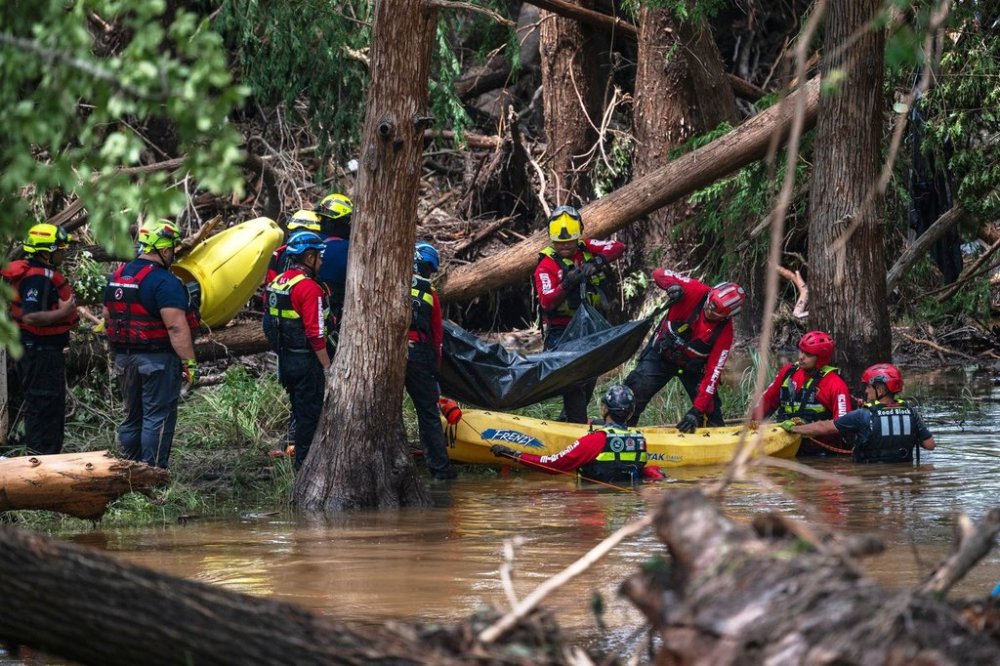
The raging flash floods in Texas — among the worst in the United States in decades — slammed into camps and homes along the Guadalupe River before daybreak Friday. Some survivors were found clinging to trees.
The disaster has put a focus on both the risk of flash flooding as well as how to predict or prevent it.
Jason Thistlethwaite, professor in the School of Environment at the University of Waterloo, agrees with Ness on the need to limit development in the high-risk areas, calling this the “biggest line of defence” in Canada.
He said there was a potential “conflict of interest” for municipal governments that could garner property taxes from developments in flood-risk zones.
But he said there had been “emerging signs” of leadership, citing the city of Grand Forks, B.C., which is buying out residents in high-risk areas with the help of provincial and federal funding, after a devastating 2018 flood.
“There are plenty of examples out there in Canada about how we do this properly,” he said.
“It’s really just a matter of getting the information out and building the political will and (having) upper-tier governments who are willing to sign the cheques.”
Ness warned that climate change is making flash flooding worse and many Canadian cities, provinces and territories don’t have laws in place to prevent development in dangerous areas.
He called increased risk of flash flooding and more severe storms “the new reality.”
Younes Alila, a professor of forest hydrology at the University of British Columbia, said the Texas flash flooding highlighted a “systematic challenge” looming across many parts of North America.
“It really underscores how much work remains to be done, whether in Texas or B.C. or Canada, especially when these extreme rainfall events are becoming more frequent as a result of global warming,” said Alila.
Flash floods have struck across Canada over the past year, including in Coquitlam, B.C., where an atmospheric river rain event triggered a mudslide that killed a teacher in October, and in Toronto, where torrential rain overwhelmed drainage last July and caused about $990 million in insured losses.
Jonathan Helmus, the director of utilities for the City of Coquitlam, also volunteers as a scout leader and runs an overnight camp for children.
He said seeing a camp overwhelmed by floodwaters in Texas “hit especially hard” for him.
But Helmus said the soil and climate in Texas are quite different from B.C.
He noted that the flash flooding in Texas was set off by about 50 centimetres of rain, more than half the rainfall the area sees all year.
“And their soil is quite dry, so it’s hard for that water to get into the ground, which produces conditions like what was seen there — the flash flooding,” said Helmus.
Helmus noted flooding events in 2021 and 2024 in Coquitlam were linked to atmospheric rivers.
He said the city has major diversion sewers, detention ponds, and base augmentation tanks that could be activated during significant events to reduce flooding risks.
Helmus said the city also has an integrated watershed management plan, allowing it to look at what’s happening within the watershed and identify where the flooding risk is before any development is allowed.
“We do have some established floodplain areas where we say, if you’re going to build in this area, we have a minimum flood construction level, and they have to build above that level,” said Helmus.
Ness said that in hilly areas of B.C.’s Interior with fast water run-off, flash floods can sweep away people’s homes with “very little warning.”
He said flash flooding can be made worse in areas burned by wildfire, where soil that is no longer held together by plant life “is much more likely to maybe turn into a mudslide or a landslide.”
He said other risk areas are in Alberta in the Front Ranges of the Rockies featuring lots of rock and little absorbent soil.
“When it does rain, it can flow downhill very quickly. The town of Canmore (Alberta), for example, has identified this as a major risk and has a strategy to try to deal with it,” said Ness. Massive floods hit the town in 2013.
In Montreal and Toronto, flash floods are usually due to paved areas with no soil to soak up heavy rain, Ness said.
“And the water rises very quickly in rivers and streams that run through those areas, and it also rises very quickly in sewers, and that’s what backs up into people’s basements most often, and causes basement flooding,” said Ness.
He said Toronto has a multibillion-dollar strategy to improve storm sewers. But it takes a long time to find that much funding, and the type of disruptive construction required isn’t an easy fix.

“That’s another reason to start making these investments as soon as possible, because it is going to take some time. But climate change isn’t going to wait,” said Ness.
He said Canada needs to adapt for flash flooding much more quickly.
“There are many smart engineers and government officials who know what to do, but we need to support and invest in the projects to adapt to this new reality. Otherwise, we are not going to be ready.”
— with files from The Associated Press
This report by The Canadian Press was first published July 8, 2025.
Advertisement Advertise With Us
Advertisement Advertise With Us