Why landscape fabric is often a bad idea for your garden

Advertisement

Advertise with us

Landscape fabric may sound like a neat, tidy and easy solution to all your weeding woes, but, as often is the case, if it sounds too good to be true, it probably is.

Read this article for free:


or

Already have an account? Log in here »

To continue reading, please subscribe:

Subscribe and receive a limited-edition Free Press branded hat or tote.

Digital Subscription

One year of digital access for only $205*

  • Enjoy unlimited reading on winnipegfreepress.com
  • Read the E-Edition, our digital replica newspaper
  • Access News Break, our award-winning app
  • Play interactive puzzles

*First annual payment billed as $205.00 + GST for one year. This annual subscription will automatically renew at $233.00 + GST every 52 weeks (10% off the regular annual price of $259.35). Offer available to new and qualified returning subscribers only. Cancel any time.

To continue reading, please subscribe:

Add Free Press access to your Brandon Sun subscription for only an additional

$1 for the first 4 weeks*

  • Enjoy unlimited reading on winnipegfreepress.com
  • Read the E-Edition, our digital replica newspaper
  • Access News Break, our award-winning app
  • Play interactive puzzles
Start now

*Your next Brandon Sun subscription payment will increase by $1.00 and you will be charged $17.95 plus GST for four weeks. After four weeks, your payment will increase to $24.95 plus GST every four weeks.

Hey there, time traveller!
This article was published 08/07/2025 (461 days ago), so information in it may no longer be current.

Landscape fabric may sound like a neat, tidy and easy solution to all your weeding woes, but, as often is the case, if it sounds too good to be true, it probably is.

To be fair, landscape fabric has its place. Unfortunately, it’s widely misused in most home landscape applications, where it does more harm than good in ornamental beds and around perennials and crops.

The woven (or sometimes non-woven) synthetic (or sometimes biodegradable) barrier is meant to suppress weeds while allowing water and air to pass through to the soil beneath it. And that’s exactly how it works -– for a short time, after which buyer’s remorse almost always sets in.
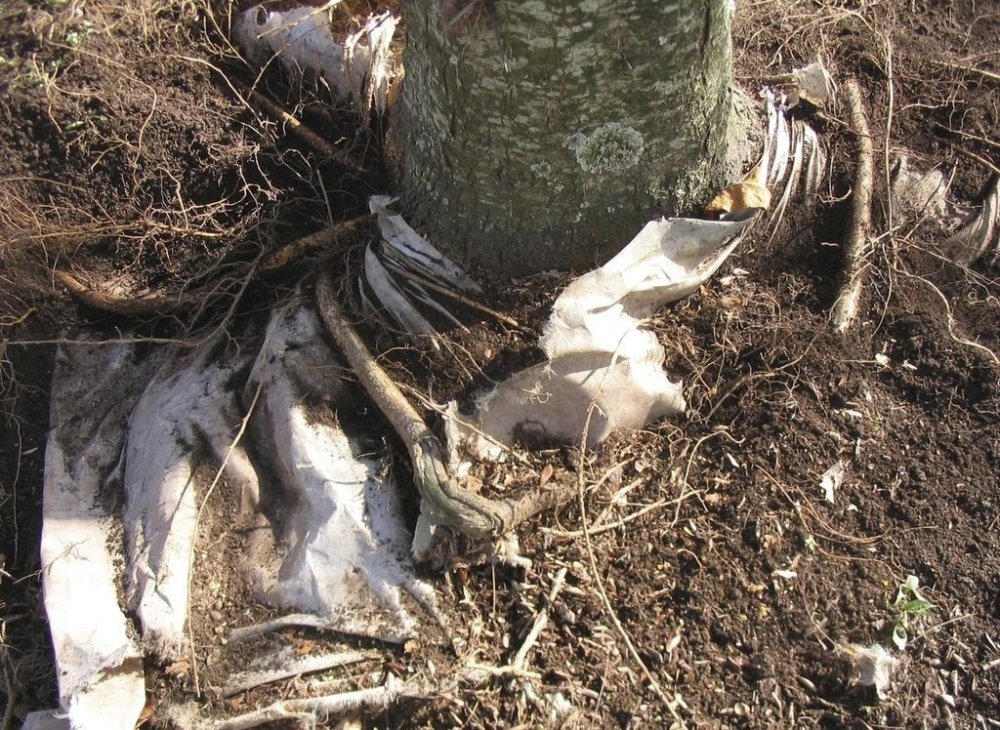
This 2010 image provided by Bugwood.org shows tree roots that have become tangled up in landscaping fabric. When this occurs, root growth is restricted, which negatively impacts tree or plant health. (Joe Murray/Treebio.com/Bugwood.org)

Before long, soil and other organic matter settle on top of the fabric, seeds find their way to the surface, and weeds begin to grow. Since their roots penetrate through the fabric, removing them becomes extremely difficult.

Under the barrier, which restricts water and oxygen from reaching the soil and carbon from escaping, microbes, earthworms and other insects die, fertility declines and roots struggle.

In perennial beds, the fabric creates heat pockets and impedes the spread and self-seeding of plants. In time, the fabric will shift and tear, and attempts to remove it will no doubt make you rue the day you had the bright idea to use it.

Plastic sheeting is even worse, as it completely blocks water and air from reaching the soil, overheats roots and releases microplastics into the ground.

There are exceptions, however. Landscape fabric can be helpful under gravel or stone paths or walkways, where it creates a barrier between the hardscape and the soil below.

It can also help smother grass and weeds when used temporarily to help create a clean slate for future planting beds in areas that are difficult to clear. Still, I recommend using thick layers of newspaper or cardboard instead, as they biodegrade naturally and perform the same function without having to be removed.

When your landscape fabric becomes a torn, weedy, root-tangled mess – and it will — good luck removing it. The painstaking process involves slowly and carefully pulling up individual fragments of the fabric, which will be heavy under the soil, and cutting them away from around and between roots, which will have grown above, below and through the textile.

Instead of shooting yourself in the foot with landscape fabric, opt for an organic mulch like shredded bark, wood chips or straw. It will regulate soil temperature and moisture, nourish the soil as it decomposes and support the soil life that supports your plants.

Apply a 2- to 4-inch layer, keeping it away from trunks and stems, and refresh it when it breaks down. You’ll still get a few weeds, but they’ll pull up easily, roots and all.

___

Jessica Damiano writes weekly gardening columns for the AP and publishes the award-winning Weekly Dirt Newsletter. You can sign up here for weekly gardening tips and advice.

___

For more AP gardening stories, go to https://apnews.com/hub/gardening.

Report Error Submit a Tip

More Stories

Trump sticks with tariffs even as US voters turn against them before the midterms

Bernard Condon, The Associated Press 5 minute read Preview

Trump sticks with tariffs even as US voters turn against them before the midterms

Bernard Condon, The Associated Press 5 minute read Updated: Yesterday at 9:13 AM CDT

NEW YORK (AP) — Maybe President Donald Trump really does believe that “tariff” is the most beautiful word in the dictionary.

Despite higher prices, criticism from trade experts and displeasure among voters, Trump holds fast to his belief that imposing the highest import duties on U.S. trading partners since the Great Depression is a winner.

A recent poll suggests that is a big gamble with less than a month before the Nov. 3 midterms. Most U.S. adults disapprove of his trade policies, with more than 64% saying he has gone too far with his latest tariffs, compared with 58% in January.

A look at the political, legal and economic challenges to the Republican president's approach to trade.

Read
Updated: Yesterday at 9:13 AM CDT

Today’s horoscope

Georgia Nicols 4 minute read Preview

Today’s horoscope

Georgia Nicols 4 minute read Yesterday at 2:00 AM CDT

MOON ALERT: Avoid shopping (except food and gas) and important decisions until after 10:45 a.m. After that, the moon moves from Libra into Scorpio.

ARIES (March 21-April 19)

You have a choice. You can either get embroiled in disputes about shared property, debt, insurance issues or inheritances; or instead, relax and have a playful day featuring sporting events, social outings and fun activities with kids.

TAURUS (April 20-May 20)

Read
Yesterday at 2:00 AM CDT

Piece of Winnipeg’s magic history disappears

Kelly-Anne Riess 5 minute read Preview

Piece of Winnipeg’s magic history disappears

Kelly-Anne Riess 5 minute read Saturday, Oct. 10, 2026

A piece of Winnipeg’s magic history has vanished, and internationally renowned escape artist Dean Gunnarson is offering a $500 reward to anyone who can make it reappear.

The plaque marked the birthplace of what has become the world’s largest organization of professional and amateur magicians, the International Brotherhood of Magicians, which was founded in Winnipeg more than a century ago.

Gunnarson said fellow magician and local magic historian Bruce Thompson discovered the disappearance Tuesday while on his way to work.

Thompson returned to inspect the site and found what appeared to be evidence it had been forcibly removed.

Read
Saturday, Oct. 10, 2026

Collaros turns back the clock in crucial win over Stamps

Taylor Allen 7 minute read Preview

Collaros turns back the clock in crucial win over Stamps

Taylor Allen 7 minute read Yesterday at 7:14 PM CDT

It was around this time seven years ago that the Winnipeg Blue Bombers officially became Zach Collaros’s team.

Making his first start in blue and gold after being acquired via trade, Collaros ran backwards to escape a collapsing pocket before rolling to his right and firing a perfect pass to Darvin Adams in the back corner of the south end zone during a home game against the Calgary Stampeders.

The play marked the beginning of the Collaros era in Winnipeg.

And a similar play Saturday night, once again against the Stampeders, served as a reminder that the 38-year-old pivot isn’t done just yet.

Read
Yesterday at 7:14 PM CDT

Hurricane Simon pounds resorts and vulnerable towns along Mexico’s Pacific coast

Fernando Llano And Martin Silva, The Associated Press 5 minute read Preview

Hurricane Simon pounds resorts and vulnerable towns along Mexico’s Pacific coast

Fernando Llano And Martin Silva, The Associated Press 5 minute read Updated: 2:38 AM CDT

PUERTO VALLARTA, Mexico (AP) — Hurricane Simon pounded Mexico’s Pacific coast as a Category 3 storm on Sunday, its eye remaining just offshore as its most powerful winds and rain slammed people living between the Sierra Madre and the ocean.

The hurricane's center swirled parallel to the coast, closing in on the Puerto Vallarta area, where its most damaging winds and rain were expected to hit around midnight and continue through Monday morning. Its maximum sustained winds weakened late Sunday to 115 mph (185 kph), according to the U.S. National Hurricane Center in Miami, but it was still expected to remain a dangerous hurricane.

That’s not good news for people in and around Puerto Vallarta, a popular tourist destination in the state of Jalisco. Just inland and uphill from the resort areas, many Mexicans live in communities where housing might not stand up to the storm.

By late Sunday, Simon's eye was moving northwest about 45 miles (75 kilometers) south of Cabo Corrientes at about 5 mph (7 kph). A senior hurricane center specialist, Philippe Papin, said this westernmost tip of mainland Mexico is the area most likely to get a direct hit from the system. Cabo Corrientes is at the southern tip of Bahia de Banderas, the wide bay where Puerto Vallarta looks out to the Pacific.

Read
Updated: 2:38 AM CDT

Carney: Trump’s ‘energy ceasefire’ could ‘de-escalate’ war in Ukraine

Kyle Duggan, The Canadian Press 4 minute read Preview

Carney: Trump’s ‘energy ceasefire’ could ‘de-escalate’ war in Ukraine

Kyle Duggan, The Canadian Press 4 minute read Updated: Yesterday at 5:18 PM CDT

OTTAWA - Mark Carney thanked U.S. President Donald Trump for “his leadership toward securing an energy ceasefire" between Ukraine and Russia, the Prime Minister's Office said on Sunday.

But on the same day, Carney also expressed to Ukraine's leader that Trump's new diesel supply agreement with Russia undermines Canada's efforts to end the war in Europe.

Trump posted on his Truth Social account on Sunday that Ukraine and Russia have agreed to an "energy ceasefire," but did not immediately offer any details.

Carney expressed “strong support for this agreement," according to a readout from the PMO that followed a conversation between the two leaders. And on his own social media account, Carney offered that Trump’s newly announced “energy ceasefire” could help wind down Russia’s war against Ukraine.

Read
Updated: Yesterday at 5:18 PM CDT