Yukon disaster one of two ‘most catastrophic’ in heap-leach mining history: expert

Advertisement

Advertise with us

The spill of about two million tonnes of cyanide-soaked ore at a Yukon gold mine was one of the two "most catastrophic failures" in the 45-year history of the heap-leaching mining process, an engineer tasked with reviewing it said.

Read this article for free:


or

Already have an account? Log in here »

To continue reading, please subscribe:

Subscribe and receive a limited-edition Free Press branded hat or tote.

Digital Subscription

One year of digital access for only $205*

  • Enjoy unlimited reading on winnipegfreepress.com
  • Read the E-Edition, our digital replica newspaper
  • Access News Break, our award-winning app
  • Play interactive puzzles

*First annual payment billed as $205.00 + GST for one year. This annual subscription will automatically renew at $233.00 + GST every 52 weeks (10% off the regular annual price of $259.35). Offer available to new and qualified returning subscribers only. Cancel any time.

To continue reading, please subscribe:

Add Free Press access to your Brandon Sun subscription for only an additional

$1 for the first 4 weeks*

  • Enjoy unlimited reading on winnipegfreepress.com
  • Read the E-Edition, our digital replica newspaper
  • Access News Break, our award-winning app
  • Play interactive puzzles
Start now

*Your next Brandon Sun subscription payment will increase by $1.00 and you will be charged $17.95 plus GST for four weeks. After four weeks, your payment will increase to $24.95 plus GST every four weeks.

Hey there, time traveller!
This article was published 08/07/2025 (439 days ago), so information in it may no longer be current.

The spill of about two million tonnes of cyanide-soaked ore at a Yukon gold mine was one of the two “most catastrophic failures” in the 45-year history of the heap-leaching mining process, an engineer tasked with reviewing it said.

Mark Smith said the disasters last year, the other occurring in Turkey, would “define the next 10 or 20 years for heap-leach practices,” in which minerals are extracted from piles of ore by running liquid chemicals through them.

Smith is a member of the independent review board that examined the disaster at the Eagle Gold Mine in June 2024, when an ore slope failed, leading to the contamination of local groundwater in central Yukon.
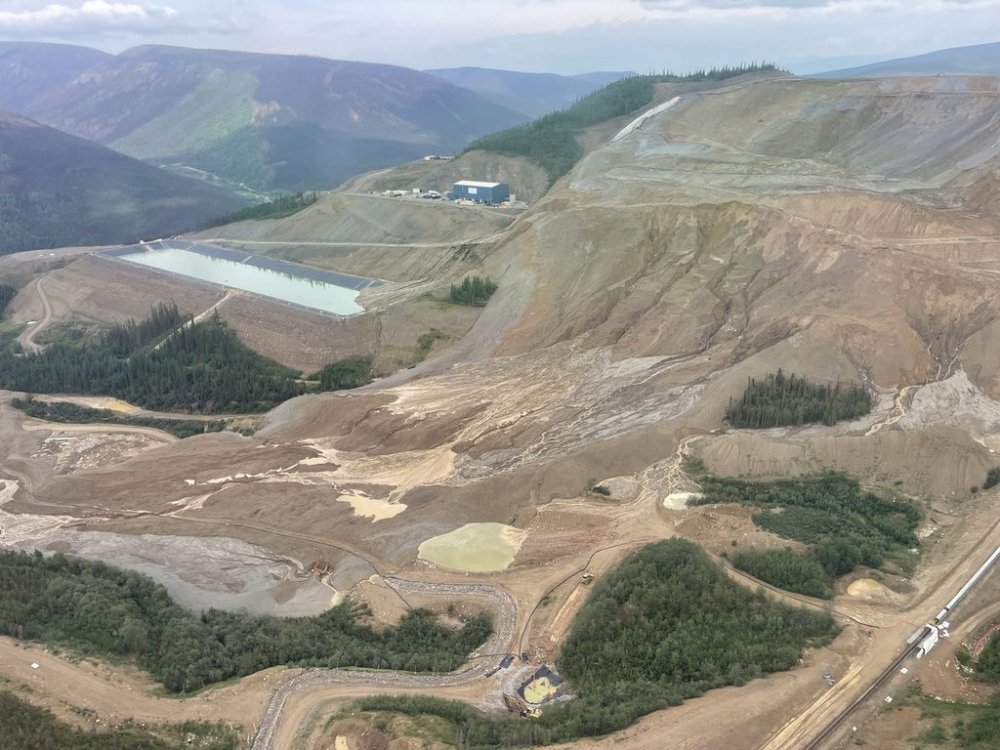
Victoria Gold's Eagle gold mine site north of Mayo, Y.T., is shown in this handout aerial photo taken Wednesday, July 3, 2024. THE CANADIAN PRESS/Handout — Yukon Government (Mandatory Credit)

He told a briefing hosted by the Yukon government on Tuesday that the board found several underlying causes along with a trigger for the disaster.

Those factors included the poor quality of ore, an “over-steepened” slope and a rising water table at the facility, as well as the “impairment” of a gravel layer that was meant to collect and move liquid, Smith explained.

Together they led to the large-scale liquefaction of saturated ore that triggered the massive failure in a matter of 10 seconds, he said. 

“All five of those things had to happen at the same time for this catastrophe to happen. If we only had the first four, and no liquefiable ore, it would have been a failure, but it wouldn’t have been a catastrophe,” he said.

The mine located about 85 kilometres north of Mayo has not operated since the collapse and Victoria Gold was placed in receivership in August 2024.

Smith said the board found irrigation of part of the heap that started in April 2024 was raising the water table and would have caused material to start moving in the weeks prior to the massive slide on June 24.

“Probably around June 1st, there would have been some evidence of distress on that slope. But there are no operators down there,” he said.

“This is not an area where people were going routinely … and there was no instrumentation on the slope. So, they didn’t know this was happening.”

If the irrigation sprinklers had been turned off, “it may have stopped the failure completely,” Smith said.

He said the site that had been operated by Victoria Gold Corp. had “almost no surveillance,” something that is “far too common” in the industry.

“We need better surveillance of these facilities across the board.”

Smith told the briefing he hopes the board’s findings and recommendations will extend beyond the territory, steering the heap-leach industry toward better practices that lower the risks of failures.

Asked if other mining companies had reached out to him after the disaster at the Eagle Gold Mine, Smith said he was receiving calls “as often as daily” in the months that followed. He also hears from regulators, insurance companies and investors asking about the future of heap leaching, he added.

Smith said he is the lead editor on the first-ever guidelines on heap and dump leaching, which are funded by industry and set for publication in 2027.

While there may always be a risk of failure, he said heap-leach facilities should aim to reduce not only the risk but also the consequences of failure.

“Things can go wrong, but they don’t go badly wrong. They don’t become catastrophic failures,” he said.

The heap-leach disaster in Turkey last year resulted in deaths, he noted.

The review board for the Eagle Gold Mine failure makes 50 recommendations in its report released this month, and Smith said none of them would be “particularly expensive” to implement.

“I’m pretty sure that the cost burden that’s now been put on the Yukon taxpayers for the Eagle Gold failure would fund all of our recommendations on every mining project that will ever be proposed in the Yukon,” he said.

“I think cost-wise, it’s nothing in comparison.”

If he had to pick, Smith said his top recommendation would be requiring independent technical review boards for all significant heap-leach projects.

Yukon officials have said the territory is reviewing the board’s report.

This report by The Canadian Press was first published July 8, 2025.

Report Error Submit a Tip

More Stories

Canada-U.S. trade relationship is broken, but the damage can — and will — be repaired

Tom Brodbeck 5 minute read Preview

Canada-U.S. trade relationship is broken, but the damage can — and will — be repaired

Tom Brodbeck 5 minute read Thursday, Sep. 17, 2026

Canada needs to get serious about diversifying its trade beyond the United States. But at the same time, Canadians should expect relations with the U.S. to normalize after Donald Trump is no longer in the White House.

For generations, Canada-U.S. trade was considered almost a fact of geography. The two countries share the world’s longest undefended border, deeply integrated supply chains and a century of commercial relationships.

Canadian manufacturers depend on American customers. American manufacturers depend on Canadian suppliers. Energy, agriculture, automotive production and countless other industries operate across the border as though it barely exists.

That isn’t going to change dramatically, even in the midst of a bitter trade war unleashed by the U.S. president.

Read
Thursday, Sep. 17, 2026

Family account spiced with magic realism, geopolitical intrigue and a ghost story

Reviewed by Zilla Jones 4 minute read Preview

Family account spiced with magic realism, geopolitical intrigue and a ghost story

Reviewed by Zilla Jones 4 minute read 2:01 AM CDT

Tom Lin’s second novel Babylon, South Dakota moves beyond a historical account of an immigrant family’s struggle, delightfully blending and bending genres.

Lin is a Chinese-born novelist whose family emigrated to the U.S. when he was four years old. His debut novel, The Thousand Crimes of Ming Tsu, won the 2022 Andrew Carnegie Medal for Excellence in Fiction, making him the youngest ever recipient of that award. He earned a PhD in English from the University of California Davis and is currently an assistant professor of English and creative writing at the University of Iowa.

Babylon, South Dakota takes place in an unspecified time period that can be understood to be during the Mao era — likely the 1950s or ’60s. A young Chinese couple, the Hsuis, immigrate to the rural community that gives the book its title. They take the names Saul and Mei and settle on a 160-acre homestead left to them by a distant relative.

Saul’s dream is to breed and sell chrysanthemums from seeds he brought from China, while Mei wants to raise livestock. They speak no English, know nothing of life in the United States, are unprepared for the harshness of winter and the isolation of the farm and bring nothing with them except some gold, which Mei hides around the house for emergencies. Their only link to the outside world is a discarded and marginally functioning TV set, which Saul rescues and rigs up.

Read
2:01 AM CDT

A Winnipeg lawyer has been disbarred after admitting to six counts of professional misconduct and two counts of providing incompetent service involving eight clients.

The career-ending decision marks the sixth time Gisele Champagne has been disciplined by the Law Society of Manitoba since she was called to the bar in 1992.

“Disbarment is the appropriate remedy when a lawyer has demonstrated a repeated pattern of conduct that violates professional standards,” a law society panel said in a written decision released Wednesday.

“A lawyer who has been unable to learn from past discipline proceedings to fulfill his or her obligation to provide ethical and high-quality legal services must at some point lose the privilege of practising law.”

Grieving child builds backyard rocket ship

Harriet Zaidman 4 minute read 2:01 AM CDT

I Built a Rocket Ship (Kids Can Press, 32 pages, hardcover, $22) by Winnipegger Anna Lazowski is a tender story for children ages 4-8 about a little girl trying to make sense of her mother’s death. The child engages in conversation with her late mom, agreeing and disagreeing about things said as she carries objects (and of course, the cat) to the backyard. There, she is building a rocket ship she will pilot into the skies to find her mom again.

Jennica Lounsbury’s varied perspectives show the range of emotions the little girl experiences.

● ● ●

Northwoods Lullaby by Mary Casanova (University of Minnesota Press, 32 pages, hardover, $25) is a bedtime book for readers up to age eight, perfect to bring a busy, happy day to a close. Just like children who are listening to adults reading the book, all the animal babies are being tucked into their nests and burrows by loving parents: “Thump and scamper,/nimble clover./ Soon it’s time to rest. Baby loon/ nestles in/as Papa floats along.”

United Way, other charities fight for dollars as donor base shrinks

Scott Billeck 7 minute read Preview

United Way, other charities fight for dollars as donor base shrinks

Scott Billeck 7 minute read Yesterday at 2:00 AM CDT

Winnipeg’s charitable sector is being squeezed from both sides: demand for help is growing while the pool of donors to meet that need is shrinking.

The imbalance is increasingly being carried by a relatively small group of deep-pocketed donors. Last year, 600 people — about three per cent of United Way Winnipeg’s individual donors — accounted for roughly $8 million, or 55 per cent of individual donations.

The fundraising pitch isn’t getting any easier.

Homelessness and public drug use have become increasingly visible, household budgets remain strained and the problems charities are trying to address can seem so entrenched that donors may reasonably wonder what difference another contribution can make.

Read
Yesterday at 2:00 AM CDT

Former Bombers linebacker Gauthier enjoying career as electrician

Taylor Allen 6 minute read Preview

Former Bombers linebacker Gauthier enjoying career as electrician

Taylor Allen 6 minute read Yesterday at 12:44 PM CDT

Most professional football players don’t ride off into the sunset on their own terms.

Shayne Gauthier was well aware of that, but it didn’t make it sting any less when the Winnipeg Blue Bombers informed the veteran linebacker that they weren’t bringing him back for 2026.

“I was really hoping to play one more (season) because it would have been my 10th season, so, I’d say it didn’t really end the way I wanted,” Gauthier recently told the Free Press.

“It left a little sour taste in my mouth, but that’s part of pro sports. If everybody got the ending that they wanted, then it wouldn’t really work.”

Read
Yesterday at 12:44 PM CDT