Booze protest costs small price to pay to send Trump a message

Advertisement
Read this article for free:
or
Already have an account? Log in here »
To continue reading, please subscribe:
Digital Subscription
One year of digital access for only $1.44 a week*
- Enjoy unlimited reading on winnipegfreepress.com
- Read the E-Edition, our digital replica newspaper
- Access News Break, our award-winning app
- Play interactive puzzles
*Billed as $5.77 plus GST every four weeks. After 52 weeks, price increases to the regular rate of $19.95 plus GST every four weeks. Offer available to new and qualified returning subscribers only. Cancel any time.
To continue reading, please subscribe:
Add Free Press access to your Brandon Sun subscription for only an additional
$1 for the first 4 weeks*
- Enjoy unlimited reading on winnipegfreepress.com
- Read the E-Edition, our digital replica newspaper
- Access News Break, our award-winning app
- Play interactive puzzles
*Your next Brandon Sun subscription payment will increase by $1.00 and you will be charged $17.95 plus GST for four weeks. After four weeks, your payment will increase to $24.95 plus GST every four weeks.
Read unlimited articles for free today:
or
Already have an account? Log in here »
Hey there, time traveller!
This article was published 09/07/2025 (465 days ago), so information in it may no longer be current.
Apparently, this is the cost of sticking to our collective guns.
A freedom of information request filed by a former leader of the Manitoba Green party found out Manitoba Liquor and Lotteries is in possession of $3.4 million in unsold wine, spirits and beer from the United States.
The booze — which includes product pulled from Liquor Mart shelves and product that was ordered and on the way here — marks the front line in Manitoba’s war with U.S. President Donald Trump.
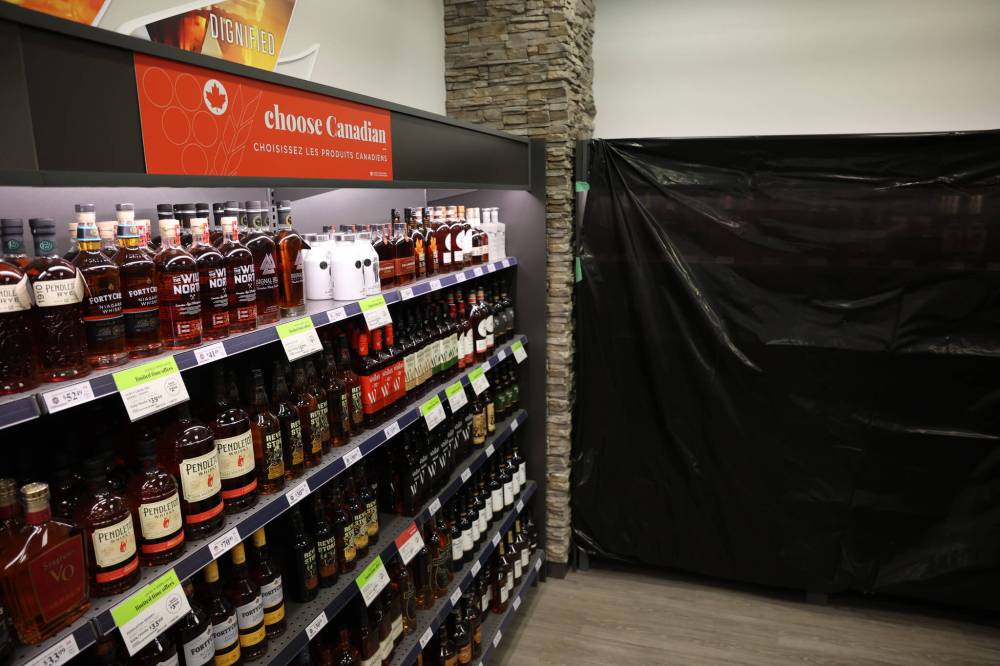
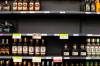
Canadian whisky is advertised at a Liquor Mart in March while black plastic covers the U.S. whiskey section. The Manitoba government ordered American products removed from Liquor Marts in response to tariffs imposed by U.S. President Donald Trump. (Tim Smith / The Brandon Sun files)
Most government-owned liquor stores and some private wine and spirit companies across the country rushed to pull U.S. alcohol off its shelves in February after Trump threatened us with crippling tariffs and mused one too many times about bringing Canada into the union as the 51st state.
The cost of this protest was never discussed with the public. The premiers who ordered the alcohol to be removed — including Manitoba’s Wab Kinew and Ontario’s Doug Ford — hardly stopped to discuss the fiscal implications while they were gleefully ordering government liquor commission workers to strip the shelves of Jack Daniel’s whiskey and Napa Valley wines. But we all had to know there was a cost.
In Manitoba, the up-front cost is $3.4 million. That is, of course, just a fraction of the retail value.
For example, Manitoba marks up wine by 95 per cent. So, $1 million in wine represents nearly $2 million in lost sales, and significant tax revenue. Remember, all net profits from Manitoba Liquor and Lotteries go directly into the province’s general revenue. In the 2023-24 fiscal year, that added up to a whopping $732 million.
Based on the total transfer — which also includes profits from lottery and gaming — you could easily dismiss the loss of $3 million as chump change. But it’s still lost revenue.
The only remaining question is — is $3.4 million a fair price to pay for the political dividends derived from hauling U.S. alcohol off Manitoba shelves?
To date, the answer is absoposilutely.
The fact is that Canadians started looking for ways to avoid buying American products well before Canadian politicians got in on the action. The militant Shop Canadian campaign was organic and extremely effective. So much so that just about every good and service in this country that can lay tenuous claim to being Canadian has engaged in concerted red washing, draping their offerings with Canadian flags and slogans.
How committed are we to continuing the various boycotts? Depends on which boycott you’re talking about.
Government liquor stores are boycotting U.S. booze, it appears that private stores never started.
A quick and totally unscientific survey of Winnipeg wine stores shows that most are still selling a wide variety of U.S. wines online. And if they’re selling it, it’s likely because many of us are still buying it. That suggests that the longer it goes on, the more we will find a way of sneaking a bottle of American Pinot Noir now and again.
Other aspects of the Canadian “elbows up” protest movement seem to show no signs of weakening.
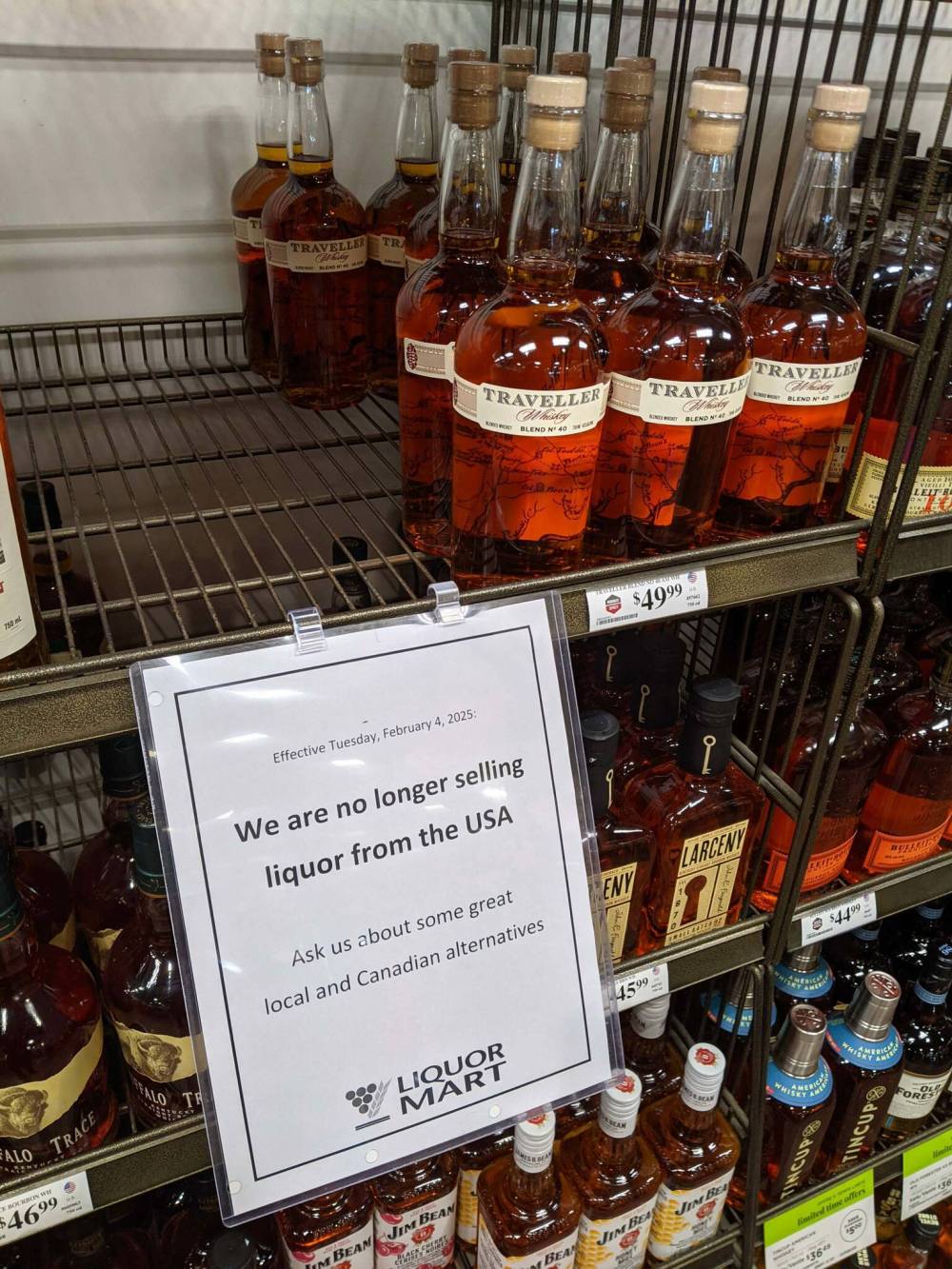
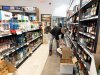
A Manitoba Liquor Mart shelf encouraging Canadian alternatives to U.S. liquor. (Chris Kitching / Free Press files)
On the travel front, Canadians have sent Trump a very strong message. More than a quarter of all tourist visits to the U.S. come from Canada, and last year, we spent more than $20 billion south of the border. Trump’s new-age manifest destiny and his tariff threats have driven down road-trip visits by nearly 40 per cent, and air travel by about a quarter. The industry estimates that every 10 per cent loss in visits by Canadians translates into $2 billion less revenue for hospitality businesses.
What does the future hold for the channels of the boycott?
Boycotts of food and alcohol will eventually lose their bite. The bigger concern for U.S. producers is whether Canadians learn to drink wine from other regions of the world and simply do not want or need to go back to American products.
The food boycott seems headed in the same direction. Don’t be surprised if, come December, we drop our elbows long enough to stuff some California strawberries into our berry holes.

On travel, there are signs the boycott will continue longer, and have longer-lasting impacts. Discovering new places and new ways of getting there could very easily curb our appetite for U.S. visits. At least, until the U.S. industry starts offering travel deals that Canadians simply cannot refuse. (Are you listening Walt Disney Co.?)
Which brings us back to $3.4 million in unsold alcohol in Manitoba.
In the midst of a still-simmering trade war with the U.S., should we be fretting the government’s decision to pull that much booze from Manitoba shelves? The quick answer is “no.”
Very little of this product will go bad. Which means, like good wine and whiskey, it’s a protest that will only get better with age.
dan.lett@freepress.mb.ca
Dan Lett is a columnist for the Free Press, providing opinion and commentary on politics in Winnipeg and beyond. Born and raised in Toronto, Dan joined the Free Press in 1986. Read more about Dan.
Dan’s columns are built on facts and reactions, but offer his personal views through arguments and analysis. The Free Press’ editing team reviews Dan’s columns before they are posted online or published in print — part of the our tradition, since 1872, of producing reliable independent journalism. Read more about Free Press’s history and mandate, and learn how our newsroom operates.
Our newsroom depends on a growing audience of readers to power our journalism. If you are not a paid reader, please consider becoming a subscriber.
Our newsroom depends on its audience of readers to power our journalism. Thank you for your support.
Dan Lett is a columnist for the Free Press, providing opinion and commentary on politics in Winnipeg and beyond. Born and raised in Toronto, Dan joined the Free Press in 1986. Read more about Dan.
Dan’s columns are built on facts and reactions, but offer his personal views through arguments and analysis. The Free Press’ editing team reviews Dan’s columns before they are posted online or published in print — part of the our tradition, since 1872, of producing reliable independent journalism. Read more about Free Press’s history and mandate, and learn how our newsroom operates.
Our newsroom depends on a growing audience of readers to power our journalism. If you are not a paid reader, please consider becoming a subscriber.
Our newsroom depends on its audience of readers to power our journalism. Thank you for your support.
Related Articles
Manitoba paid $3.4M for U.S. booze currently in storage
Advertisement Advertise With Us
Advertisement Advertise With Us