‘It’s distressing’: Poor air quality can worsen pre-existing mental health challenges
Advertisement
Read this article for free:
or
Already have an account? Log in here »
To continue reading, please subscribe:

Digital Subscription
One year of digital access for only $205*
- Enjoy unlimited reading on winnipegfreepress.com
- Read the E-Edition, our digital replica newspaper
- Access News Break, our award-winning app
- Play interactive puzzles
*First annual payment billed as $205.00 + GST for one year. This annual subscription will automatically renew at $233.00 + GST every 52 weeks (10% off the regular annual price of $259.35). Offer available to new and qualified returning subscribers only. Cancel any time.
To continue reading, please subscribe:
Add Free Press access to your Brandon Sun subscription for only an additional
$1 for the first 4 weeks*
- Enjoy unlimited reading on winnipegfreepress.com
- Read the E-Edition, our digital replica newspaper
- Access News Break, our award-winning app
- Play interactive puzzles
*Your next Brandon Sun subscription payment will increase by $1.00 and you will be charged $17.95 plus GST for four weeks. After four weeks, your payment will increase to $24.95 plus GST every four weeks.
Read unlimited articles for free today:
or
Already have an account? Log in here »
Hey there, time traveller!
This article was published 15/07/2025 (426 days ago), so information in it may no longer be current.
TORONTO – The poor air quality that has blanketed swaths of central and Western Canada is not only infiltrating the lungs, but also distressing the mind.
The federal government says people with mental illness are in a high-risk group prone to health problems when exposed to air pollution.
Others who are most impacted when air quality plummets include seniors, pregnant people and those with lung or heart conditions.
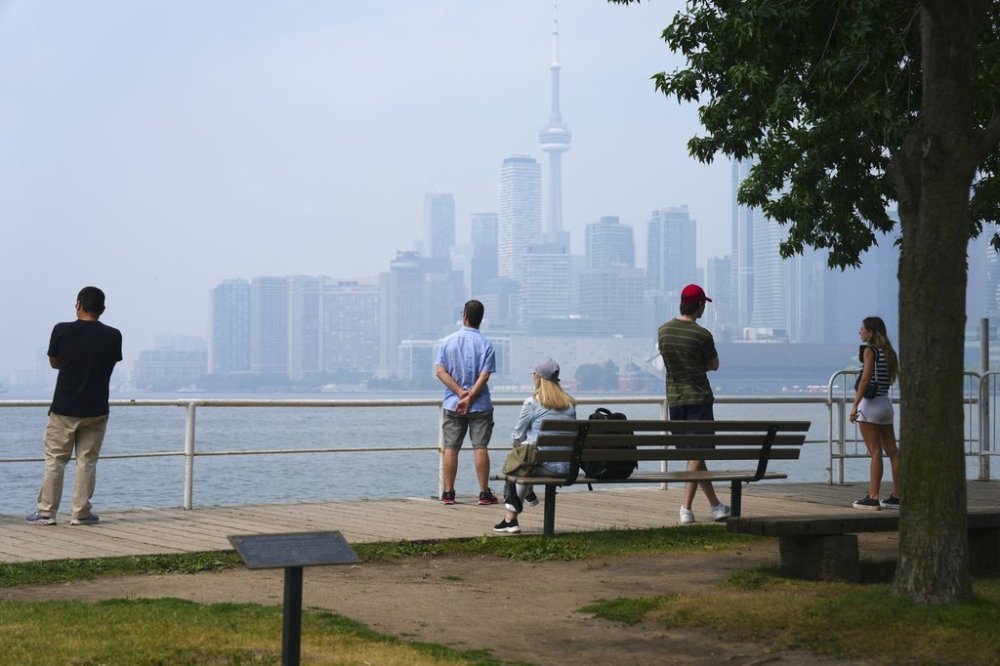
Environment Canada said Tuesday the air in parts of Saskatchewan and Inuvik is “very high risk,” while Ontario, Quebec, Manitoba and Yellowknife are high- and moderate-risk areas due to wildfire smoke.
Dr. Sean Kidd, a senior scientist at the Centre for Addiction and Mental Health, said polluted air can make people feel trapped, particularly those who are homeless and can’t avoid the outdoors, as well as people who don’t have air conditioning and have to open their windows during heat waves.
That can exacerbate stressors and intensify distress for anyone who experiences mental-health challenges.
“Being out in an environment like this, it’s distressing, right? Especially if you can’t escape it.”
The combination of heat, humidity and air pollution can also cloud cognition, making people more irritable and reactive, which can lead to substance abuse, Kidd said.
Kidd said evidence suggests there’s also an increase in domestic violence and interpersonal conflict during extreme weather events.
The United Nations (UN) reported in April that climate change could be linked to one in every ten cases of intimate partner violence by the end of the century if action is not taken to interrupt that trajectory.
A 2018 study cited in the UN report found intimate partner femicide rose 28 per cent during heat waves in Madrid.
Among the solutions is creating better, more stable housing that reduces exposure to high-risk air, and in doing so, improves health and well-being across the board, Kidd said.
“It’s not just about breathing bad air,” Kidd said. “(It’s) ultimately about having fewer people breathing air like this.”
Still, those who have access to cool indoor spaces can feel stuck inside and socially isolated, which can result in doom scrolling and worsen feelings of loneliness.
Jiaying Zhao, a professor of psychology and sustainability at the University of British Columbia, said when wildfires pollute the air in Vancouver and the sky turns an orange hue, she tends to stay home.
“I just don’t interact with people. I’m isolated as a result of air pollution and that’s not good. That can really exacerbate depressive symptoms and any kind of mental-health issues associated with depression,” Zhao said.
Some young people struggle with the crushing reality of climate change, said Zhao.
When air quality plummets, those feelings can swing from abstract to material.
“That further exacerbates eco-anxiety, climate anxiety, that makes me, as well as others, think this is the end of the world. It does seem like an apocalypse,” said Zhao.
Dr. Zarina Giannone, a registered psychologist in Vancouver, said it helps to think about what makes you feel safe and more in control of the exposure, which can include connecting with other people who are also exposed and isolated.
“When they’re not breathing in clean air or there’s been a forest fire, which is common out here in B.C. — for the, for the air to really change suddenly and quite significantly like that — that can impact how people feel, how safe they feel; can kind of provoke more situational change in their mental status and wellness.”
This report by The Canadian Press was first published July 15, 2025.
Canadian Press health coverage receives support through a partnership with the Canadian Medical Association. CP is solely responsible for this content.
Related Articles
Carney to meet with Incident Response Group to discuss the wildfire situation


Advertisement Advertise With Us
Advertisement Advertise With Us