Russian lawmakers pass a bill punishing online searches for information deemed to be ‘extremist’

Advertisement

Advertise with us

MOSCOW (AP) — Russian lawmakers on Tuesday approved a bill that punishes online searches for information that is deemed “extremist,” the latest move by government authorities in their relentless crackdown on dissent.

Read this article for free:


or

Already have an account? Log in here »

To continue reading, please subscribe:

Subscribe and receive a limited-edition Free Press branded hat or tote.

Digital Subscription

One year of digital access for only $205*

  • Enjoy unlimited reading on winnipegfreepress.com
  • Read the E-Edition, our digital replica newspaper
  • Access News Break, our award-winning app
  • Play interactive puzzles

*First annual payment billed as $205.00 + GST for one year. This annual subscription will automatically renew at $233.00 + GST every 52 weeks (10% off the regular annual price of $259.35). Offer available to new and qualified returning subscribers only. Cancel any time.

To continue reading, please subscribe:

Add Free Press access to your Brandon Sun subscription for only an additional

$1 for the first 4 weeks*

  • Enjoy unlimited reading on winnipegfreepress.com
  • Read the E-Edition, our digital replica newspaper
  • Access News Break, our award-winning app
  • Play interactive puzzles
Start now

*Your next Brandon Sun subscription payment will increase by $1.00 and you will be charged $17.95 plus GST for four weeks. After four weeks, your payment will increase to $24.95 plus GST every four weeks.

Hey there, time traveller!
This article was published 22/07/2025 (445 days ago), so information in it may no longer be current.

MOSCOW (AP) — Russian lawmakers on Tuesday approved a bill that punishes online searches for information that is deemed “extremist,” the latest move by government authorities in their relentless crackdown on dissent.

The bill passed by the lower house, the State Duma, moves to its all-but-certain endorsement in the upper house and then goes to President Vladimir Putin to be signed into law.

The legislation punishes what it describes as “deliberately searching for and accessing extremist materials” online. First-time offenders face a fine of up to the equivalent of $64.
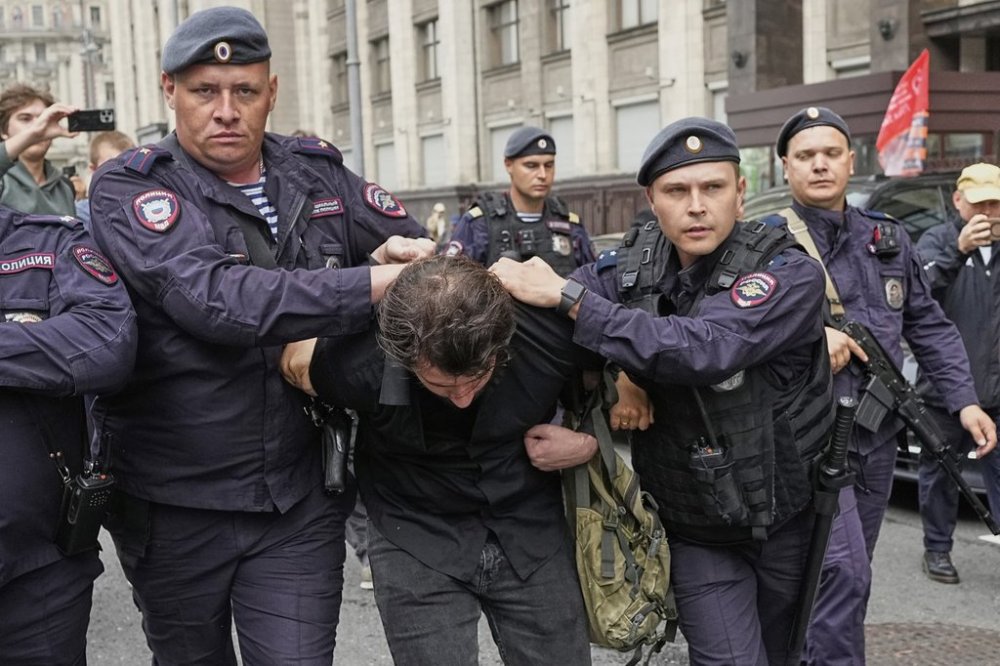
Police detain an activist during a picket against internet limitations in front of The State Duma, the lower house of the Russian Parliament, prior to consider the third and final reading of a bill, criminalising the search of
Police detain an activist during a picket against internet limitations in front of The State Duma, the lower house of the Russian Parliament, prior to consider the third and final reading of a bill, criminalising the search of "extremist materials" in Moscow, Russia, Tuesday, July 22, 2025. (AP Photo)

The official definition of extremist activity is extremely broad and includes opposition groups like the Anti-Corruption Foundation, created by the late opposition leader Alexei Navalny, and the “international LGBT movement.”

It’s not clear how authorities will track down violators. Officials and lawmakers said ordinary internet users won’t be affected and only those who methodically seek outlawed content will be targeted. They didn’t explain how the authorities would differentiate between them.

Some observers have suggested the information would likely come from internet providers or social media platforms, and police also could randomly check the search history of cellphones or computers.

The new legislation also contained a ban on advertising of virtual private network services and fines for VPN resources that fail to comply with government regulations, but stopped short of banning their use. It did list the use of a VPN as an “aggravating circumstance” in case of other violations of the law.

Russians widely use VPN services for access to banned content, but authorities have sought to tighten restrictions, trying to close the loopholes. The state communications watchdog has increasingly used technology to analyze traffic and block specific VPN protocols.

The Russian authorities have ramped their multipronged crackdown on dissent after sending troops into Ukraine in February 2022.

Since then, online censorship and prosecutions for social media posts and comments have soared. Multiple independent news outlets and rights groups have been shut down, labeled as “foreign agents” or outlawed as “undesirable.” Hundreds of activists and critics of the Kremlin have faced criminal charges.

The new legislation has sparked broad public criticism. The Duma, which unanimously supports most government initiatives, was markedly divided in Tuesday’s vote, with 306 backing the measure, 67 voting against it and 22 abstaining. Among those who opposed the bill were some members of the Communist Party, Just Russia and the liberal New People party who usually follow the Kremlin’s wishes.

Liberal politician Boris Nadezhdin, who sought to challenge Putin in last year’s presidential election but was denied a spot on the ballot, told reporters outside the State Duma that he opposed the new legislation. “It creates real problems for tens of millions of people,” he said.

Nadezhdin’s aide, Dmitry Kisiev, who picketed the parliament building with a poster likening the legislation to the world of George Orwell’s dystopian “1984,” was quickly rounded up by police, who also detained several reporters covering the protest.

Even some pro-Kremlin figures have criticized the bill, arguing it would make it impossible for them to track down and deflect comments by Kremlin critics.

Margarita Simonyan, head of the state-funded RT channel, has spoken against the legislation, questioning how her media group could “investigate and bring to shame” anti-Kremlin outlets “if we are forbidden to even read them.”

And Yekaterina Mizulina, whose group Safe Internet League has frequently reported dissenters to authorities, also strongly condemned the new bill, arguing it would make it impossible for her group to monitor “extremist communities” on the web.

Report Error Submit a Tip

More Stories

Jets’ game flies south against Ducks

Mike McIntyre 7 minute read Preview

Jets’ game flies south against Ducks

Mike McIntyre 7 minute read Yesterday at 10:38 PM CDT

The Winnipeg Jets sure looked like a team that was running on fumes Friday night.

Playing for the fifth time in eight days, the club suffered its first regulation loss of the young season — a lacklustre 5-1 showing against the Anaheim Ducks at Canada Life Centre.

While we won’t question the effort, the execution was a different story. Sloppy plays, missed passes, porous defensive-zone coverage and iffy goaltending made this a tough watch for the 13,693 fans in attendance.

“Just some mental things that happened. Obviously some physical things as well,” said head coach Scott Arniel.

Read
Yesterday at 10:38 PM CDT

Chopped trees will leave a ‘blight’ on Windsor Park

Kelly-Anne Riess 3 minute read Preview

Chopped trees will leave a ‘blight’ on Windsor Park

Kelly-Anne Riess 3 minute read Yesterday at 8:04 PM CDT

Robert Gordon has watched the trees grow along a popular Windsor Park walking path for nearly six decades.

Now, as Manitoba Hydro cuts them down to protect nearby power lines, he says a familiar part of his childhood neighbourhood is disappearing.

Although he no longer lives in the area, Gordon regularly returns to walk or cycle along the tree-lined path, which runs parallel to Archibald Street.

He was concerned when he recently spotted crews clearing vegetation near the entrance to the path, but initially assumed they were removing brush. When he returned, he discovered the clearing had extended farther along the corridor.

Read
Yesterday at 8:04 PM CDT

Police looking into robbery of children captured on video

Morgan Modjeski 3 minute read Preview

Police looking into robbery of children captured on video

Morgan Modjeski 3 minute read Yesterday at 3:08 PM CDT

The Winnipeg Police Service said it is aware of a video circulating online that appears to show two children robbed while walking home from the library.

The mother of the siblings said the Sept. 26 incident, which happened in the area of Andrews Street and Magnus Avenue at around 7:30 p.m., has left her children afraid and her feeling guilty.

“I should have been there with them. I felt horrible,” said Brittany Beaudet. “I would have been out the door if I knew any sooner to help them out.”

In the 40-second video, the two children, 14-year-old Mason and nine-year-old Kenzie, are approached by a man wearing a black shirt, black pants and white shoes.

Read
Yesterday at 3:08 PM CDT

Dog feces vandalism shuts down food pantry

Kelly-Anne Riess 4 minute read Preview

Dog feces vandalism shuts down food pantry

Kelly-Anne Riess 4 minute read Thursday, Oct. 8, 2026

A few shelves set up beneath a West End community notice board were meant to offer a place where neighbours could leave food for anyone who needed it.

Read
Thursday, Oct. 8, 2026

A Rocky day on the mayoral campaign trail for Kevin Klein

Malak Abas 12 minute read Preview

A Rocky day on the mayoral campaign trail for Kevin Klein

Malak Abas 12 minute read Yesterday at 12:00 PM CDT

Kevin Klein acknowledges it’s hard to foresee what he’ll wake up to each morning in the final weeks of a mayoral campaign.

But the seasoned politician, who has served as both a city councillor and a provincial cabinet minister, couldn’t have predicted the events — what he describes as “drama” — that unfolded last Sunday.

Fellow mayoral candidate Mike Vogiatzakis accused Klein’s campaign team of offering him a job to drop out of the race, while a guest writer’s column in the Winnipeg Sun that questioned the deaths of Indigenous children at residential schools, just days after the National Day for Truth and Reconciliation, sparked condemnation from a prominent Indigenous organization. (Klein is the CEO of the Klein Group, the company that owns the Sun. He has maintained he is not involved in its operations while running for mayor.)

The Free Press had already been scheduled to join Klein on the campaign trail Monday, intending to document a day in the life of the front-running candidate to unseat incumbent Scott Gillingham, before the controversies hit.

Read
Yesterday at 12:00 PM CDT

A Life's Story: Writer built bridges with genuine curiosity, compassion for diversity of religious practices

Janine LeGal 6 minute read Preview

A Life's Story: Writer built bridges with genuine curiosity, compassion for diversity of religious practices

Janine LeGal 6 minute read 6:00 AM CDT

Brenda Suderman knew how to make people feel comfortable. For a journalist, that character trait is a real strength, and it made people trust and appreciate her.

Whether covering musicals, worship spaces, the effects of pandemic shutdowns, death rituals and practices of different traditions, the discovery of the burial of 2,284 infants in unmarked graves, or any other of the countless topics she wrote about in her four- decade career, Suderman did it with genuine interest and care.

Born and raised in Winkler, Suderman grew up on a farm. Much of her childhood was spent in gardens and sugar beet fields.

Baptized at 16, she became a member of the Winkler Bergthaler Mennonite Church. The restrictions against women at the time contributed to planting the seeds of Suderman’s feminist perspective.

Read
6:00 AM CDT