Owners shocked Falcon Beach Ranch could be wiped out by Trans-Canada twinning
Read this article for free:
or
Already have an account? Log in here »
To continue reading, please subscribe:

Digital Subscription
One year of digital access for only $205*
- Enjoy unlimited reading on winnipegfreepress.com
- Read the E-Edition, our digital replica newspaper
- Access News Break, our award-winning app
- Play interactive puzzles
*First annual payment billed as $205.00 + GST for one year. This annual subscription will automatically renew at $233.00 + GST every 52 weeks (10% off the regular annual price of $259.35). Offer available to new and qualified returning subscribers only. Cancel any time.
To continue reading, please subscribe:
Add Free Press access to your Brandon Sun subscription for only an additional
$1 for the first 4 weeks*
- Enjoy unlimited reading on winnipegfreepress.com
- Read the E-Edition, our digital replica newspaper
- Access News Break, our award-winning app
- Play interactive puzzles
*Your next Brandon Sun subscription payment will increase by $1.00 and you will be charged $17.95 plus GST for four weeks. After four weeks, your payment will increase to $24.95 plus GST every four weeks.
Read unlimited articles for free today:
or
Already have an account? Log in here »
Hey there, time traveller!
This article was published 23/07/2025 (420 days ago), so information in it may no longer be current.
The owners of a ranch that has been in Whiteshell Provincial Park for 60-plus years fear it will cease to exist if a new Trans-Canada Highway corridor cuts through the area.
Kendra Imrie said land and horse-riding trails used by Falcon Beach Ranch, which is also her family’s home, would be expropriated if the province builds a new segment nearby when Manitoba’s only undivided section of the Trans-Canada is twinned.
“There would be no ranch if that option was chosen,” said Imrie, who co-owns the site with her husband, Devin. “Until we hear the final decision, it’s something that is going to be hanging over us. We’re worried.”
JESSICA FINN / FREE PRESS FILES “Until we hear the final decision, it’s something that is going to be hanging over us. We’re worried,” said Kendra Imrie.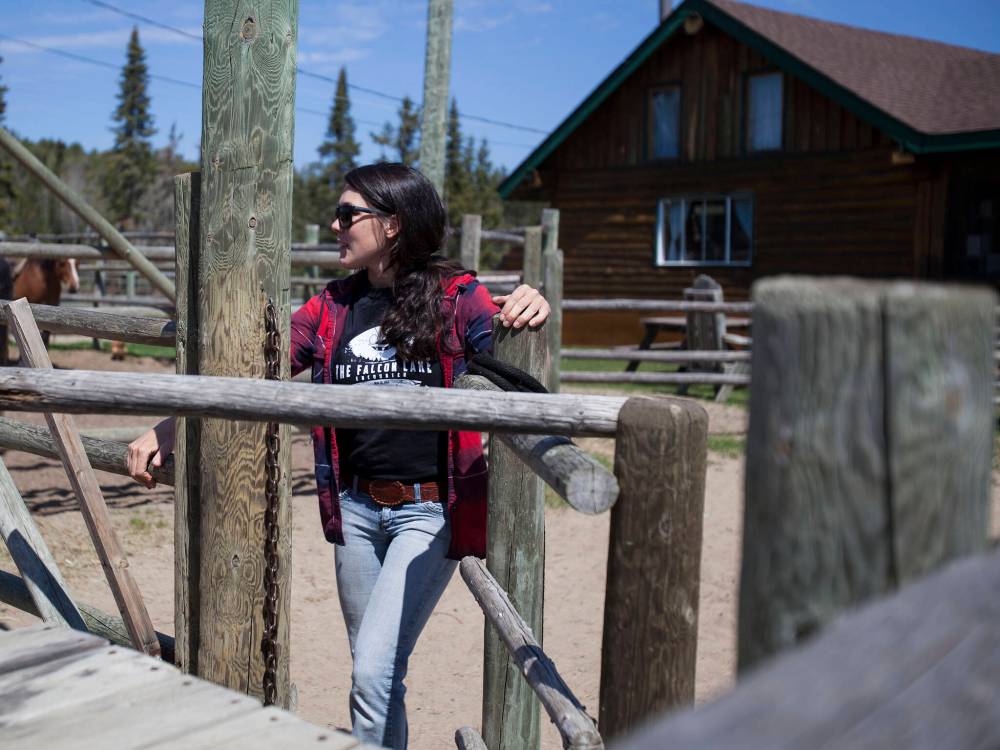
Consultants hired by the Manitoba government are studying potential corridors to align with Ontario’s twinned highway.
About half a dozen variations are being evaluated with the aim of improving safety and journey times on the trade and travel route, which has become increasingly congested.
Several people have been killed or injured in crashes on the existing two-lane, 16-kilometre stretch between Falcon Lake and the provincial boundary in recent years.
A preferred corridor has not yet been selected during a three-year conceptual design phase, which will be followed by a functional design. The province has not set a construction start date or estimated cost.
At a July 3 community meeting, the Imries learned an option that includes a new highway segment just east of the ranch, which would require expropriation, is being considered since an earlier presentation.
SUPPLIED The six highway route alternatives that are under review.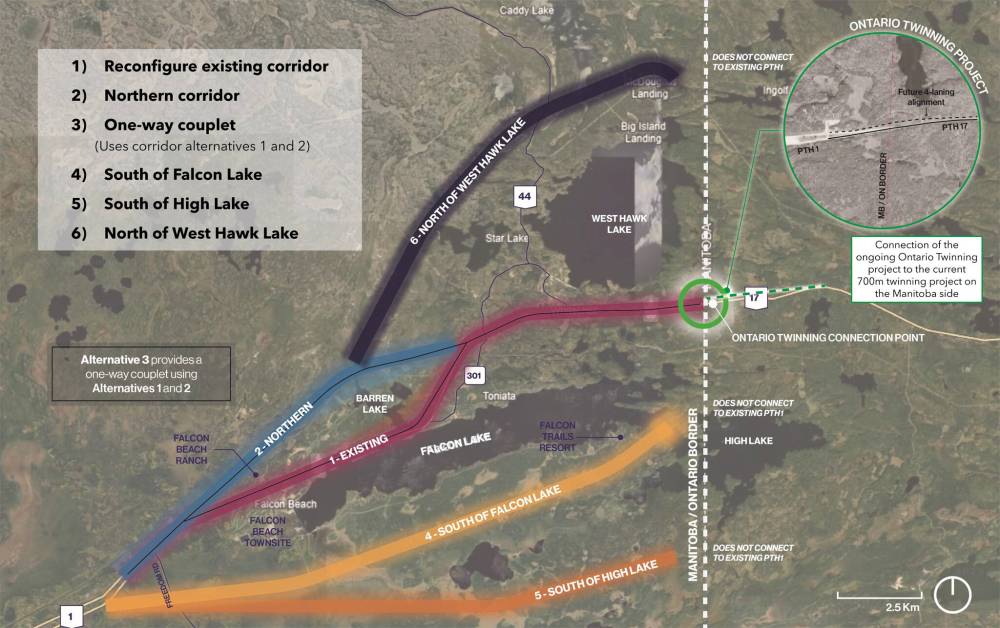
“We were pretty shocked,” Imrie said.
The Imries shared their concerns with consultants and Manitoba Transportation and Infrastructure.
“Safe roads for Manitobans are a top priority, and twinning Highway 1 is a key step toward improving safety and supporting our trade network,” Transportation and Infrastructure Minister Lisa Naylor said in a statement. “We know how important this project is for families, businesses, Indigenous nations, and the economy, and we’re taking the time to consult and move it forward thoughtfully and responsibly.”
The Imries’ lease of 40 acres of Crown land, just north of the Trans-Canada, includes a clause that allows them to make and maintain the trails.
Imrie said it is a unique spot in eastern Manitoba because it has a pasture and sandy, horse-friendly trails in a boreal forest, with minimal rock and no bogs.
“A loss of the ranch would be a loss for Manitobans,” she said. “It would have far-reaching implications for this area.”
The ranch welcomes thousands of guests each year, and currently employs 15 people, Imrie said. The site opened in 1963. It was acquired by the Imrie family 47 years ago.
SUPPLIED Route 1 alternatives: 1A: Add two lanes just north of existing lanes (red); 1B: Add two lanes just south of existing lanes (yellow); 1C: Four new lanes over part of Barren Lake (blue).
One proposed corridor would double the existing highway to four lanes. A variation includes a new crossing over Barren Lake.
Two other proposals involve a new northern corridor that would go around Barren Lake. New lanes would be constructed just east of the ranch or west of Falcon Beach, creating a bypass of the community.
The northern corridor would be a four-lane stretch (turning the existing highway into a local park road) or a two-way couplet with the existing section.
While a route that goes as far north as possible would benefit the ranch, business owners in Falcon Beach fear a bypass would lead to a downturn in customers, Imrie said.
For each proposed corridor, consultants are considering the potential effect on everything from the environment and cultural sites to homes and businesses.
Ontario highway twinning
After more than a decade of discussions, studies and planning, Ontario started construction in 2022 on the first of a three-phase plan to twin some 40 kilometres of the Trans-Canada Highway from its boundary with Manitoba to the Kenora area.
After more than a decade of discussions, studies and planning, Ontario started construction in 2022 on the first of a three-phase plan to twin some 40 kilometres of the Trans-Canada Highway from its boundary with Manitoba to the Kenora area.
The first phase, starting at the provincial boundary, expanded about six km of Ontario Highway 17 from two lanes to four at a cost of more than $30 million.
Construction has not yet started on the second section, which will be 8.5 kilometres from Highway 673 to Rush Bay Road. The final phase will be 24 kilometres to the Kenora bypass (Highway 17A).
An environmental assessment and preliminary design for the second phase are ongoing, the engineering firm WSP Canada Group Ltd., which has been contracted by Ontario’s government, said on the project’s website July 2.
Ontario’s transportation ministry has a preferred alignment for the second stage, and is developing mitigation strategies “to best address potential impacts and concerns” before finalizing a transportation environmental study report, the update said.
A construction timeline is expected to be developed after a public review period.
Ontario began a route planning and preliminary design study for its Highway 17 “four-laning” project in 2009.
Meetings sought feedback from Indigenous land and water rights holders, permanent residents, cottagers, local businesses and industry.
Niiwin Wendaanimok (Four Winds) Partnership, which includes Shoal Lake 40 First Nation on the Manitoba-Ontario boundary, will sign a memorandum of understanding with the Manitoba government Aug. 12 to set a “collaborative path forward,” the organization said in a social media post.
Niiwin Wendaanimok signed an MOU with Ontario before its twinning project began east of the provincial boundary.
Following its own technical review, the Manitoba Métis Federation has significant concerns about the footprint of the linear corridor, and the project’s impacts on the rights, claims and interests of the Red River Métis, said Jack Park, the federation’s minister of energy and infrastructure.
“The MMF has made several recommendations to Manitoba seeking to avoid and/or mitigate these impacts such as reconsidering the preferred route and having a Red River Métis monitor on site during construction,” he said in a statement.
SUPPLIED Route 2 alternatives: In both options, the existing highway becomes a local park road. In option 2A, four new lanes are added west of the existing pipeline; in 2B, four new lanes are added just east of Falcon Beach Ranch.
Whiteshell Cottagers Association president Ken Pickering said attendees’ concerns at the July 3 meeting included potential expropriations and the loss of natural land.
Some properties could be in the way if the province chooses to expand the existing highway, he said. At least one attendee asked if the highway can remain as is.
“There’s a broad range of concern, depending on where you are in the Whiteshell,” Pickering said. “People do tend to understand there’s limited real estate they can go through on that existing route. There’s concern that properties would potentially have to be dealt with in those areas.”
He said he left the meeting with the impression that everyone understood there are downsides to every option. The assocaition isn’t advocating for one option over another.
Earlier this month, Premier Wab Kinew announced the Manitoba government will not proceed with a restricted crossing U-turn, or RCUT, at the Trans-Canada and Highway 5 junction — where 17 bus passengers died in a crash in 2023 — following objections from Carberry-area residents. Other options are being explored.
chris.kitching@freepress.mb.ca
SUPPLIED Route 3 alternatives: In both options, the existing highway becomes the eastbound lanes. In option 3A, two new lanes are added west of the existing pipeline to become new westbound lanes; in 3B, two new lanes are added just east of Falcon Beach Ranch to become new westbound lanes.


Chris Kitching is a general assignment reporter at the Free Press. He began his newspaper career in 2001, with stops in Winnipeg, Toronto and London, England, along the way. After returning to Winnipeg, he joined the Free Press in 2021, and now covers a little bit of everything for the newspaper. Read more about Chris.
Every piece of reporting Chris produces is reviewed by an editing team before it is posted online or published in print — part of the Free Press‘s tradition, since 1872, of producing reliable independent journalism. Read more about Free Press’s history and mandate, and learn how our newsroom operates.
Our newsroom depends on a growing audience of readers to power our journalism. If you are not a paid reader, please consider becoming a subscriber.
Our newsroom depends on its audience of readers to power our journalism. Thank you for your support.
Related Articles
Trio urges wildlife protection for highway twinning project