High in India’s Himalayan mountains, yak herders struggle to survive a warming world
Advertisement
Read this article for free:
or
Already have an account? Log in here »
To continue reading, please subscribe:

Digital Subscription
One year of digital access for only $205*
- Enjoy unlimited reading on winnipegfreepress.com
- Read the E-Edition, our digital replica newspaper
- Access News Break, our award-winning app
- Play interactive puzzles
*First annual payment billed as $205.00 + GST for one year. This annual subscription will automatically renew at $233.00 + GST every 52 weeks (10% off the regular annual price of $259.35). Offer available to new and qualified returning subscribers only. Cancel any time.
To continue reading, please subscribe:
Add Free Press access to your Brandon Sun subscription for only an additional
$1 for the first 4 weeks*
- Enjoy unlimited reading on winnipegfreepress.com
- Read the E-Edition, our digital replica newspaper
- Access News Break, our award-winning app
- Play interactive puzzles
*Your next Brandon Sun subscription payment will increase by $1.00 and you will be charged $17.95 plus GST for four weeks. After four weeks, your payment will increase to $24.95 plus GST every four weeks.
Read unlimited articles for free today:
or
Already have an account? Log in here »
Hey there, time traveller!
This article was published 29/07/2025 (441 days ago), so information in it may no longer be current.
LADAKH, India (AP) — Carrying her 1-year-old son on her back, Tsering Dolma herds a dozen yaks into a stone-walled corral as evening approaches in the desolate mountains of India’s remote Ladakh region.
A few herders tending livestock are the only people visible for miles on the wind-swept plains where patchy grass gives way to gravelly foothills and stony peaks. For generations, herders such as Dolma have relied on snowmelt that trickled down the mountain folds to sustain the high-altitude pastures where their herds graze. But now, herders say, the snow and rain are less predictable, and there is less grass for yaks to eat.
“Earlier, it used to snow and rain, but now it has reduced a lot,” the 32-year-old says. “Even the winters are getting warmer than before.”
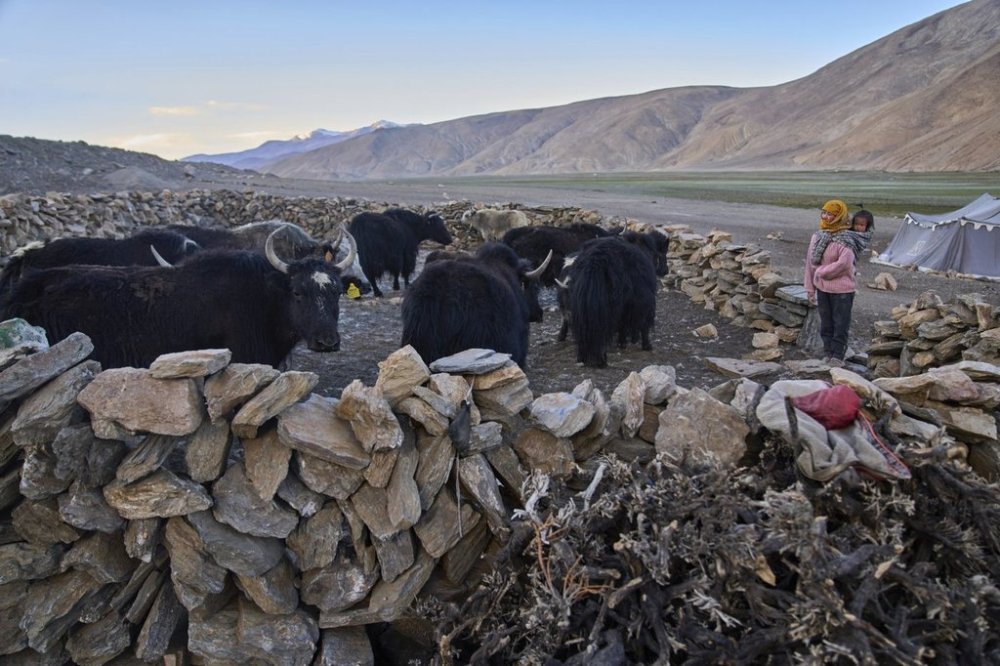
Much of the herding, milking and gathering of wool is done by women in Ladakh, an area near Tibet that was part of the ancient Silk Route. It’s work mostly done by hand.
In another valley, Kunzias Dolma is busy making tea with yak milk and checking her yak butter, while spinning her Buddhist prayer wheel with her right hand. The 73-year-old, who’s not related to Tsering Dolma, has spent her life around yaks, working long hours to make products from their milk and sewing blankets from their wool.
“We wake up early morning around 5 a.m. every day,” she says. “My husband and I milk the yaks and do all of the other yak-related work until about lunch. Then we take a break and get back to work in the evening. We have been doing this all our life.”
But that way of life is threatened as climate change makes Ladakh less hospitable to yaks and many in the younger generation seek other jobs.
Rising temperatures and erratic rainfall in the area have made it harder for yaks, which are related to bison and cattle, to find nourishing vegetation and have also exposed the shaggy, cold-loving animals’ bodies to more stress. Researchers have found that the average temperature in the Ladakh region has increased by 3 C (5.4 F) in the last four decades, while heat waves have become more extreme and rains more unpredictable.
While it’s hard to precisely quantify climate change’s impact on yak numbers in the area, scientists say it appears to be a factor in their decline. The government estimates the yak population in Ladakh has fallen from nearly 34,000 in 2012 to fewer than 20,000 in 2019, the most recent year for which the data is available. Globally, the yak population remains in the millions, but scientists say the ecosystem in this part of the Himalayas is particularly vulnerable to global warming.
A threatened way of life
Herder Kunzang Angmo has seen the changes up close.
“Earlier, there were a lot of yaks, but now there aren’t as many,” she says. “It used to snow a lot before, but now the snowfall is decreasing, and due to less water, we have less grass available.”
Generations of Tsering Angchok’s family have relied on yaks, but the number of herders in the area is dropping.
“We get everything from the yak—food, milk, clothing, butter, cheese, meat, wool, even dung,” says the 75-year-old who has 80 yaks. “Nothing goes to waste. We and our ancestors have grown up living on all of this.”
As weather patterns change, native vegetation is being crowded out by less nourishing shrubs and weeds, according to researchers. Herders say grazing lands are becoming smaller.
Thering Norphel, a 70-year-old former yak herder, remembers when pastures had more vegetation and life with yaks was easier.
“When I was younger, there was more grass, more water and more wildlife,” he says. Pointing to bare mountains in the distance, he said: “Earlier, all those mountains were filled with snow. Now it’s just rock. As there is no snow or ice, there is less water. This affects the growth of grass that yaks feed on.”
Consequences for a fragile ecosystem
Tashi Dorji, a livestock and rangelands specialist with the International Centre for Integrated Mountain Development, says the region and its people are being hit especially hard by global warming.
“Fast-melting glaciers, intense, erratic rainfall and reducing snow levels are all having a direct impact on both the herders and their animals,” Dorji says.
Stanzin Rabgais, a livestock officer with the Ladakh government, attributes a rise in bacterial diseases among yaks in recent years to hotter temperatures in the region.
Experts warn that the decline in yak herding has consequences for Ladakh and its fragile Himalayan ecosystem, because pastoralists manage grazing lands, keep invasive plants in check and help maintain the area’s biodiversity. The sparsely populated region, most of which is is above 3,000 meters (9,842 feet), is also home to wildlife including the snow leopard, red fox and blue sheep.
“If the herders disappear, the landscape changes,” Dorji says. “Unpalatable shrubs take over, wildlife loses food sources and the ecosystem starts to collapse. This is not just about animals—it’s about a way of life and the health of the land.”
Rabgais believes that yak products could sell beyond the area if properly marketed and developed. He describes yak calf wool, for example, as finer than most commercial wool, rivaling cashmere in softness.
A traditional livelihood in a changing job market
Jobs in tourism and other industries, along with educational opportunities, also draw people away from herding. Herders say younger Ladakhis prefer less arduous work with potentially better pay than tending to yaks. Herders travel long distances over rough mountain land to find grazing areas and are constantly on the move.
“The next generation doesn’t want to do this work. They work for the Indian Army as laborers or are getting an education and looking for other jobs,” says Norphel, the former yak herder.
Ladakh, famous for its Buddhist monasteries and hiking trails, has experienced a significant increase in tourism in recent years as transportation infrastructure has made the area easier to reach, which has created new jobs.
Rabgais, the government official, says most yak herders are older now and unless greater numbers of young people take up herding, “the future is bleak” for the occupation.
Among the exceptions is 32-year-old yak herder Punchuk Namdol, who chose the traditional profession even as other people his age look for different options.
“Earlier, we didn’t have any other work — we only had yaks and other cattle,” Namdol says. “But now, there’s no one to take care of them. Yak herding is a difficult task, and fewer people are willing to do it.”
___

Follow Sibi Arasu on X at @sibi123
___
Follow Dar Yasin on Instagram at @daryasinap
___
The Associated Press’ climate and environmental coverage receives financial support from multiple private foundations. AP is solely responsible for all content. Find AP’s standards for working with philanthropies, a list of supporters and funded coverage areas at AP.org.