Addressing fear in Alberta’s Mennonite community amid a measles outbreak
Advertisement
Read this article for free:
or
Already have an account? Log in here »
To continue reading, please subscribe:

Digital Subscription
One year of digital access for only $205*
- Enjoy unlimited reading on winnipegfreepress.com
- Read the E-Edition, our digital replica newspaper
- Access News Break, our award-winning app
- Play interactive puzzles
*First annual payment billed as $205.00 + GST for one year. This annual subscription will automatically renew at $233.00 + GST every 52 weeks (10% off the regular annual price of $259.35). Offer available to new and qualified returning subscribers only. Cancel any time.
To continue reading, please subscribe:
Add Free Press access to your Brandon Sun subscription for only an additional
$1 for the first 4 weeks*
- Enjoy unlimited reading on winnipegfreepress.com
- Read the E-Edition, our digital replica newspaper
- Access News Break, our award-winning app
- Play interactive puzzles
*Your next Brandon Sun subscription payment will increase by $1.00 and you will be charged $17.95 plus GST for four weeks. After four weeks, your payment will increase to $24.95 plus GST every four weeks.
Read unlimited articles for free today:
or
Already have an account? Log in here »
Hey there, time traveller!
This article was published 04/08/2025 (409 days ago), so information in it may no longer be current.
Quelling the spread of measles involves immunization campaigns and public health protocols, but Tina Meggison says it also requires sitting down and having an open and honest conversation.
That’s what she’s working to do within the Low German-speaking Mennonite community in Alberta.
Meggison has more than a decade of professional — and a lifetime of personal — experience under her belt.
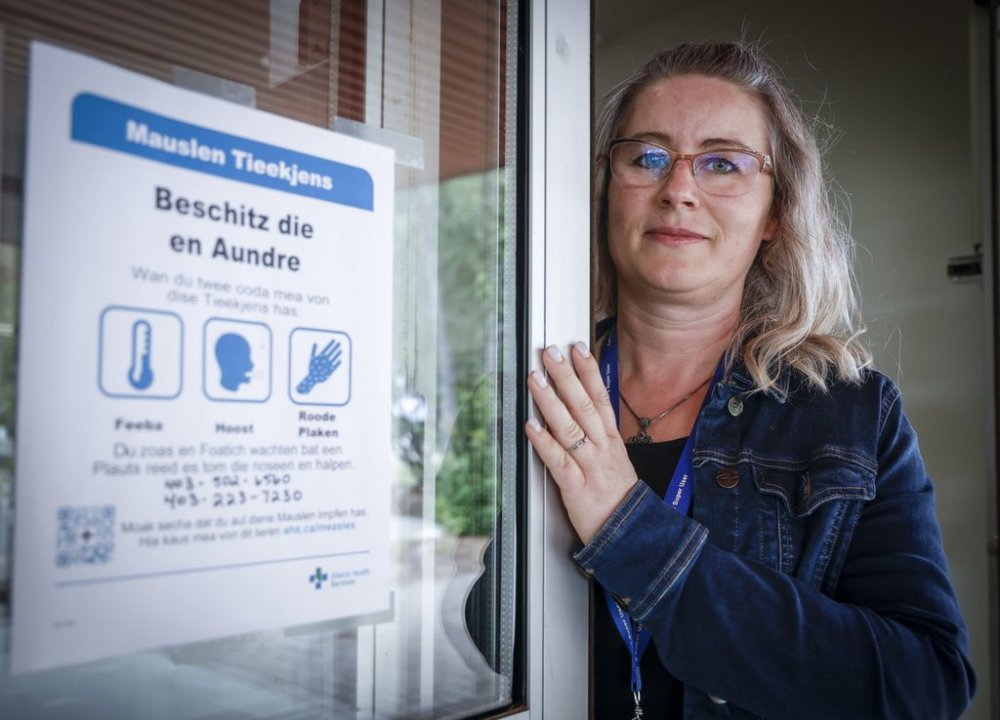
Her team of community health representatives with Primary Care Alberta has seen a 25 per cent increase in demand for their services, which include accompanying patients to doctor’s appointments and interpreting and answering questions in Low German, since the onset of an outbreak in March.
That’s about 350 calls per month on average, compared to 285 before the contagious disease spread to 1,656 people in the province.
Meggison said the rise of people reaching out to the provincial health agency shows an interest to engage in the health-care system, which historically has not always been the case.
The next step is taking that outstretched hand and placing knowledge into it.
“We can invite our families to start thinking from a different lens, or see things through a different lens, and maybe start to answer those questions.”
MEASLES IN ALBERTA
Health-care hesitancy is rooted in fear for many Low German-speaking Mennonites. Meggison would know.
She remembers a public health nurse rolling into her Mexican hometown of Durango on horse-and-buggy with a cooler of vaccines. The nurse told Meggison’s mother to line up her 12 children in the yard, asked for their ages, and immunized them, without explanation.
“She didn’t know what had been given to her kids. She didn’t have the language skills to ask the questions,” Meggison said about her mother, whose primary language was Low German.
Her family moved from Durango to Ontario when she was four years old, returned to Mexico more than a decade later, and then to Alberta in 2001. She started accompanying her mother to medical appointments and interpreting for her at 16 years old.
“Unbeknownst to me at that time, I was training for this work,” Meggison said, speaking from Lethbridge, near the Canadian Rocky Mountains.
When she started this line of work in an official capacity, she estimates the Low German Mennonite population in Alberta was 15,000. That’s since grown to approximately 25,000 to 30,000, based on her organization’s last tally. But she says given the transient nature of the population, it’s likely an underestimate.
Many came from Mexico to work the land in Canada. They migrated to Ontario and Manitoba, and from there some made their way to Alberta. The government had offered religious and educational autonomy in exchange for agricultural labour in the 1870s. But that freedom never materialized, leading some to mistrust and question the government’s authority, said Margarita Penner, a newcomer and Low German Mennonite family liaison with Barons-Eureka-Warner Family and Community Support Services based in Taber.
Penner said Mennonites settled all over Alberta – from La Crete in the north to 40 Mile County in the south, on the border of Montana.
Community health representatives dedicated to the Low German-speaking Mennonite community are currently only based in southern Alberta, with two full-timers based in Taber; Meggison in Lethbridge; and a roster of casuals. The demand has been so high that they boosted their availability from five to seven days a week.
And now, Primary Care Alberta is hiring two more in the south, a third in the central health zone, and a fourth in the north.
Southern Alberta has 945 measles cases while the north zone has 534, and central has 108.
There, 68 per cent of kids had one dose and 56 per cent had two doses of the measles vaccine by age two in 2024, according to the province’s figures for southern Alberta.
Local breakdowns for the age group show 40 per cent two-dose measles vaccine coverage in Lethbridge, 29 per cent in Taber, and 71 per cent in Medicine Hat.
Dr. Joan Robinson, a pediatric infectious diseases physician in Edmonton, said the rest of the province is not much better off. Alberta has an average immunization of 80 per cent with one dose, and 68 per cent with two doses for two-year-olds.
Robinson says Alberta’s low vaccination rates are due to myriad of factors, including a broader mistrust in the health-care system and a public shift towards misinformation during the COVID-19 pandemic. She says people began getting information on immunizations on social media, rather than from medical experts, and began believing that vaccines are harmful.
She also says it would be helpful if the Alberta government debunked this belief.
Though Edmonton and Calgary have lower case counts than the rest of the province, she points to particular areas within the urban cities that are not much better.
“The highest immunization rate in the whole province is barely over 80 per cent in Provost. It means that every community that measles is introduced into, there’s a reasonable chance of more cases,” Robinson said.
“In order to prevent measles, we really do need community immunization rates as high as 95 per cent.”
RUN AND HIDE
Meggison said health education starts with identifying misinformation that heightens deeply entrenched fear.
She holds focus groups for Low German communities that open the door to seemingly simple, yet controversy-riddled topics, such as, what is measles? What are its long-term consequences? What is in the vaccine that prevents it?
“If you don’t know what it is you’re preventing … then what is the motivation to prevent it?”
This is all done in Low German because many members of the community don’t fluently speak or understand English, and don’t read or write, making it challenging to access credible information, Meggison said.
She shows them places they can source accurate facts, such as a YouTube channel where she hosts videos in Low German on health topics, with some gaining more than 1,000 views.
Proudly, she recalls seeing a lightbulb go off for one woman who described an epiphany in one of her recent groups.
“She said, ‘I can make decisions for my family, and it doesn’t have to be public knowledge. I can make these decisions and not share it with my family members if they ask and I can just say that’s my business,'” Meggison said, and described other women nodded in response to this passionate declaration, which strays far from their community’s everybody-knows-everything way of life.
“You could see that there was a sense of freedom that came out of that group.”
Her hope is that conversation will spread within the tight-knit community.
NEEDLE IS NEUTRAL
Alberta’s health-care system has translation services, but the challenge is Low German is not common outside of the community. It holds shared cultural significance, which makes interpretation hard to come by and word choice paramount.
Nely Penner, a community health representative in Taber, said the word “vaccine” was an obvious roadblock to upping measles immunization in southern Alberta.
“When I think of the word vaccine in German, I just think of the history of immunization in Mexico,” Penner, who grew up in a Low German community in Mexico’s northern Chihuahua region, said.
Though Penner never personally experienced “vaccine nurses” like Meggison did, similar stories were passed down from her parents and grandparents.
“People didn’t understand what they were getting. It was fear-based. People would run and hide to not get these vaccines.”
To mitigate the negative connotation, she suggested Alberta health providers use the word needle instead.
“Needle is just more neutral,” Penner said.
Little changes like this can have a big impact in facilitating a health space that feels safer, acknowledges and validates feelings of mistrust, Penner said.
“When you’re getting information, especially sensitive information, you want to be able to trust that person. And so that’s such a huge part of what we do.”
This report by The Canadian Press was first published Aug. 4, 2025.
Canadian Press health coverage receives support through a partnership with the Canadian Medical Association. CP is solely responsible for this content.
Related Articles
Southern Health region households ignored public health measles directives, May documents reveal
Advertisement Advertise With Us
Advertisement Advertise With Us