

As insect numbers continue to fall, scientists worry
Advertisement
Read this article for free:
or
Already have an account? Log in here »
To continue reading, please subscribe:
Digital Subscription
One year of digital access for only $1.44 a week*
- Enjoy unlimited reading on winnipegfreepress.com
- Read the E-Edition, our digital replica newspaper
- Access News Break, our award-winning app
- Play interactive puzzles
*Billed as $5.77 plus GST every four weeks. After 52 weeks, price increases to the regular rate of $19.95 plus GST every four weeks. Offer available to new and qualified returning subscribers only. Cancel any time.
To continue reading, please subscribe:
Add Free Press access to your Brandon Sun subscription for only an additional
$1 for the first 4 weeks*
- Enjoy unlimited reading on winnipegfreepress.com
- Read the E-Edition, our digital replica newspaper
- Access News Break, our award-winning app
- Play interactive puzzles
*Your next Brandon Sun subscription payment will increase by $1.00 and you will be charged $17.95 plus GST for four weeks. After four weeks, your payment will increase to $24.95 plus GST every four weeks.
Read unlimited articles for free today:
or
Already have an account? Log in here »
Hey there, time traveller!
This article was published 06/08/2025 (299 days ago), so information in it may no longer be current.
Say hello to a male Hexagenia limbata, one of the burrower mayflies.
He’s not a particularly special or handsome creature; the insect, sometimes called the giant mayfly, has a range that’s spread across most of the United States and Canada.
And he wouldn’t have hung around for long after this picture was taken: the winged, airborne part of his life lasts just a day or two, long enough to find a mate and, after mating, die.
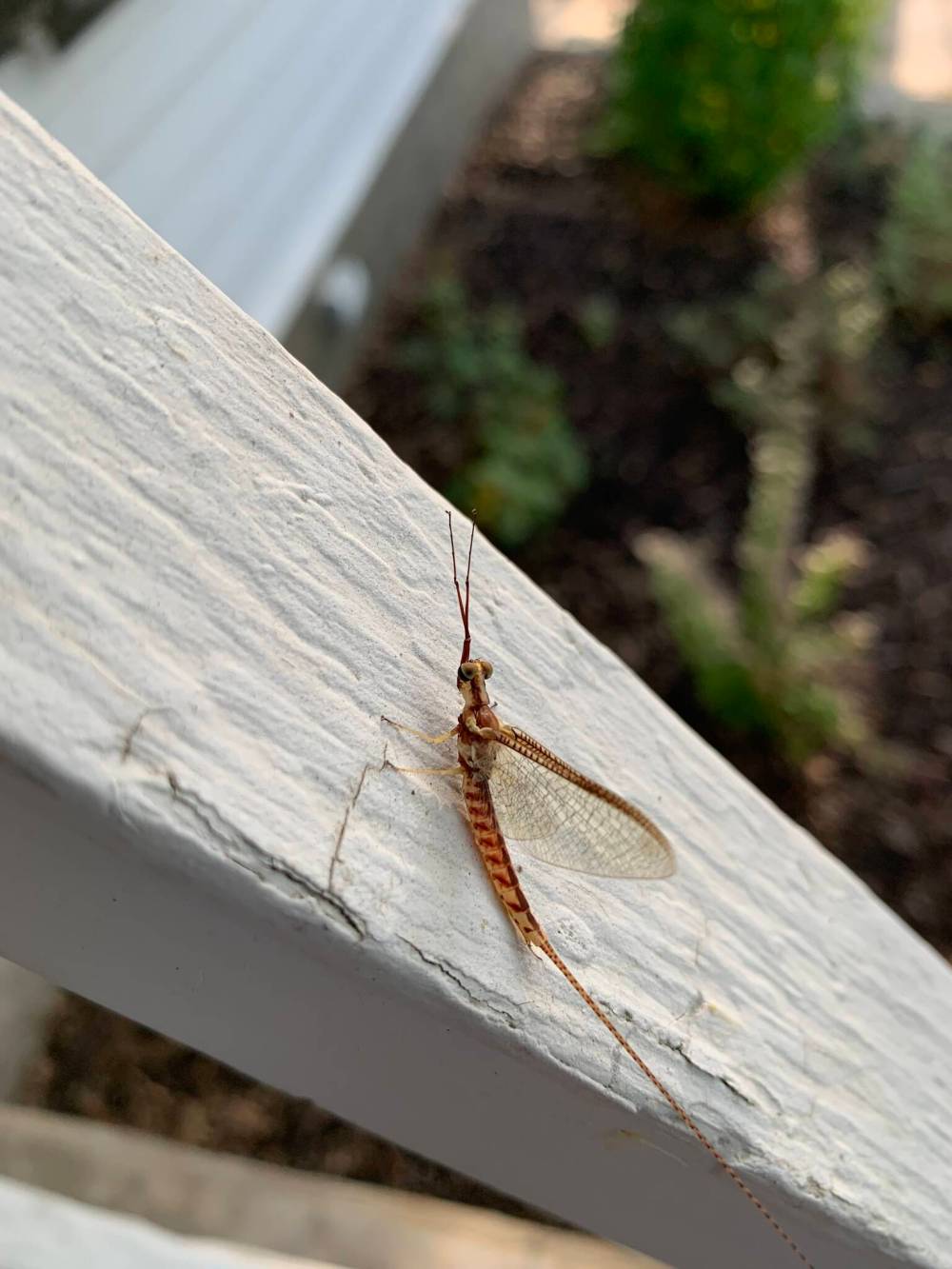
Russell Wangersky/Free Press
Hexagenia limbata mayfly
But that’s the way it’s supposed to be. After spending between two and four years as a nymph — a period that depends on water temperature — the mayfly gets a few hours in its adult form to mate. Males die pretty soon after mating — females get a few more hours to lay their thousands of eggs, and then they die, too.
And that’s it.
A day in the life — or death — of one of millions of members of one specific insect species. Scientific estimates like those of the Royal Entomological Society suggest there are as many as 10 million species of insects, though only about one-fifth of those have been formally identified. The population numbers are staggering: 1.4 billion insects for every human on Earth, or 10 quintillion of them. That’s 10,000,000,000,000,000,000, for those who like to see their numbers typed out.
Yet…
Yet, despite those huge numbers, insects are in trouble.
Studies about the collapse of insect populations are piling up — over the past 20 years, butterfly populations in the U.S. have dropped by almost one-quarter. Another study showed that there are fewer bumblebees in Britain than there have been since records started being kept, with some bees showing as much as a 74 per cent drop in populations.
There are a variety of threats facing insect species, ranging from monoculture farming to pesticides and fertilizers, from loss of habitat to diminishing plant and flower species that specialized insects need to survive. If you’re a longtime reader of this space, you might remember that there are 900 individual species of fig wasps, each kind of fig wasp necessary for pollinating each of the 900 individual species of figs. If just one kind of fig wasp disappears, so will its corresponding variety of fig. And vice versa.
This spring, a remarkably participatory British study — Bugs Matter — used photographs of automobile front licence plates uploaded with details like the location of travel, weather conditions, speed, type of vehicle. The bugs splatted on the licence plates were identified and counted. Overall, the study has found that British flying insect populations had declined by 63 per cent in just three years. Other studies are finding similar large-scale drops in insect populations all over the world.
You might not care much about any of that. In fact, bugs might just bug you.

But insects — all insects — have a role to play. With their overwhelming numbers and diversity, they fit into virtually every facet of life on Earth — from the pollination of the smallest sort of flower to their crucial role in the decomposition of dead plant and animal life.
It may not be as obviously important a role to humans as, say, honeybees, with their central role in pollination of crops.
But even Hexagenia limbata, in its nymph form, is an important food species for fish and other insects, and its two years of tunnelling around in brook and lake mud plays an important role in freshwater ecosystems.
And the decline of all insects, in their role as an environmental canary in the coal mine, should be priceless.
If only we were paying more attention.