Great Barrier Reef records largest annual coral loss in 39 years
Advertisement
Read this article for free:
or
Already have an account? Log in here »
To continue reading, please subscribe:

Digital Subscription
One year of digital access for only $205*
- Enjoy unlimited reading on winnipegfreepress.com
- Read the E-Edition, our digital replica newspaper
- Access News Break, our award-winning app
- Play interactive puzzles
*First annual payment billed as $205.00 + GST for one year. This annual subscription will automatically renew at $233.00 + GST every 52 weeks (10% off the regular annual price of $259.35). Offer available to new and qualified returning subscribers only. Cancel any time.
To continue reading, please subscribe:
Add Free Press access to your Brandon Sun subscription for only an additional
$1 for the first 4 weeks*
- Enjoy unlimited reading on winnipegfreepress.com
- Read the E-Edition, our digital replica newspaper
- Access News Break, our award-winning app
- Play interactive puzzles
*Your next Brandon Sun subscription payment will increase by $1.00 and you will be charged $17.95 plus GST for four weeks. After four weeks, your payment will increase to $24.95 plus GST every four weeks.
Read unlimited articles for free today:
or
Already have an account? Log in here »
Hey there, time traveller!
This article was published 06/08/2025 (400 days ago), so information in it may no longer be current.
MELBOURNE, Australia (AP) — The Great Barrier Reef has experienced its greatest annual loss of live coral across most of its expanse in four decades of record-keeping, Australian authorities say.
But due to increasing coral cover since 2017, the coral deaths — caused mainly by bleaching last year associated with climate change — have left the area of living coral across the iconic reef system close to its long-term average, the Australian Institute of Marine Science said in its annual survey on Wednesday.
The change underscores a new level of volatility on the UNESCO World Heritage Site, the report said.
Mike Emslie, who heads the tropical marine research agency’s long-term monitoring program, said the live coral cover measured in 2024 was the largest recorded in 39 years of surveys.
The losses from such a high base of coral cover had partially cushioned the serious climate impacts on the world’s largest reef ecosystem, which covers 344,000 square kilometers (133,000 square miles) off the northeast Australian coast, he said.
“These are substantial impacts and evidence that the increasing frequency of coral bleaching is really starting to have detrimental effects on the Great Barrier Reef,” Emslie said on Thursday.
“While there’s still a lot of coral cover out there, these are record declines that we have seen in any one year of monitoring,” he added.
Emslie’s agency divides the Great Barrier Reef, which extends 1,500 kilometers (900 miles) along the Queensland state coast, into three similarly-sized regions: northern, central and southern.
Living coral cover shrunk by almost a third in the south in a year, a quarter in the north and by 14% in the central region, the report said.
Because of record global heat in 2023 and 2024, the world is still going through its biggest — and fourth ever recorded — mass coral bleaching event on record, with heat stress hurting nearly 84% of the world’s coral reef area, including the Great Barrier Reef, according to the U.S. National Oceanic and Atmospheric Administration’s coral reef watch. So far at least 83 countries have been impacted.
This bleaching event started in January 2023 and was declared a global crisis in April 2024. It easily eclipsed the previous biggest global coral bleaching event, from 2014 to 2017, when 68.2% had bleaching from heat stress.
Large areas around Australia — but not the Great Barrier Reef — hit the maximum or near maximum of bleaching alert status during this latest event. Australia in March this year started aerial surveys of 281 reefs across the Torres Strait and the entire northern Great Barrier Reef and found widespread coral bleaching. Of the 281 reefs, 78 were more than 30% bleached.
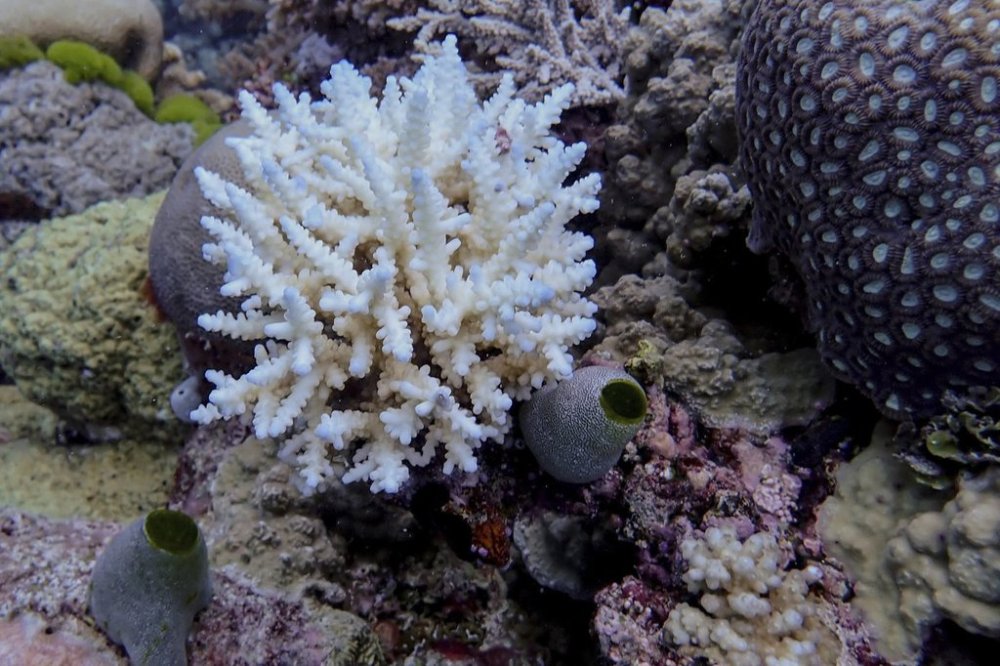
Coral has a hard time thriving and at times even surviving in prolonged hot water. They can survive short bursts, but once certain thresholds of weeks and high temperatures are passed, the coral is bleached, which means it turns white because it expels the algae that live in the tissue and give them their colors. Bleached corals are not dead, but they are weaker and more vulnerable to disease.
Coral reefs often bounce back from these mass global bleaching events, but often they are not as strong as they were before.
Coral reefs are considered a “unique and threatened system” due to climate change and are especially vulnerable to global warming beyond 1.5 degrees Celsius (2.7 degrees Fahrenheit) since pre-industrial times, the United Nations Intergovernmental Panel on Climate Change proclaimed in 2018. The world has now warmed 1.3 degrees Celsius since pre-industrial times. That report said “tropical corals may be even more vulnerable to climate change than indicated in assessments made in 2014.”
The report said back-to-back big bleaching events at the Great Barrier Reef in the mid 2010s “suggest that the research community may have underestimated climate risks for coral reefs.”
“Warm water (tropical) coral reefs are projected to reach a very high risk of impact at 1.2°C, with most available evidence suggesting that coral-dominated ecosystems will be non-existent at this temperature or higher. At this point, coral abundance will be near zero at many locations,” the report said.
____
Associated Press Science Writer Seth Borenstein in Washington, D.C., contributed to this report.

Advertisement Advertise With Us
Advertisement Advertise With Us