Americans get more than half their calories from ultra-processed foods, CDC report says

Advertisement

Advertise with us

Most Americans get more than half their calories from ultra-processed foods, those super-tasty, energy-dense foods typically full of sugar, salt and unhealthy fats, according to a new federal report.

Read this article for free:


or

Already have an account? Log in here »

To continue reading, please subscribe:

Subscribe and receive a limited-edition Free Press branded hat or tote.

Digital Subscription

One year of digital access for only $205*

  • Enjoy unlimited reading on winnipegfreepress.com
  • Read the E-Edition, our digital replica newspaper
  • Access News Break, our award-winning app
  • Play interactive puzzles

*First annual payment billed as $205.00 + GST for one year. This annual subscription will automatically renew at $233.00 + GST every 52 weeks (10% off the regular annual price of $259.35). Offer available to new and qualified returning subscribers only. Cancel any time.

To continue reading, please subscribe:

Add Free Press access to your Brandon Sun subscription for only an additional

$1 for the first 4 weeks*

  • Enjoy unlimited reading on winnipegfreepress.com
  • Read the E-Edition, our digital replica newspaper
  • Access News Break, our award-winning app
  • Play interactive puzzles
Start now

*Your next Brandon Sun subscription payment will increase by $1.00 and you will be charged $17.95 plus GST for four weeks. After four weeks, your payment will increase to $24.95 plus GST every four weeks.

Hey there, time traveller!
This article was published 06/08/2025 (430 days ago), so information in it may no longer be current.

Most Americans get more than half their calories from ultra-processed foods, those super-tasty, energy-dense foods typically full of sugar, salt and unhealthy fats, according to a new federal report.

Nutrition research has shown for years that ultra-processed foods make up a big chunk of the U.S. diet, especially for kids and teens.

For the first time, however, the U.S. Centers for Disease Control and Prevention has confirmed those high levels of consumption, using dietary data collected from August 2021 to August 2023.
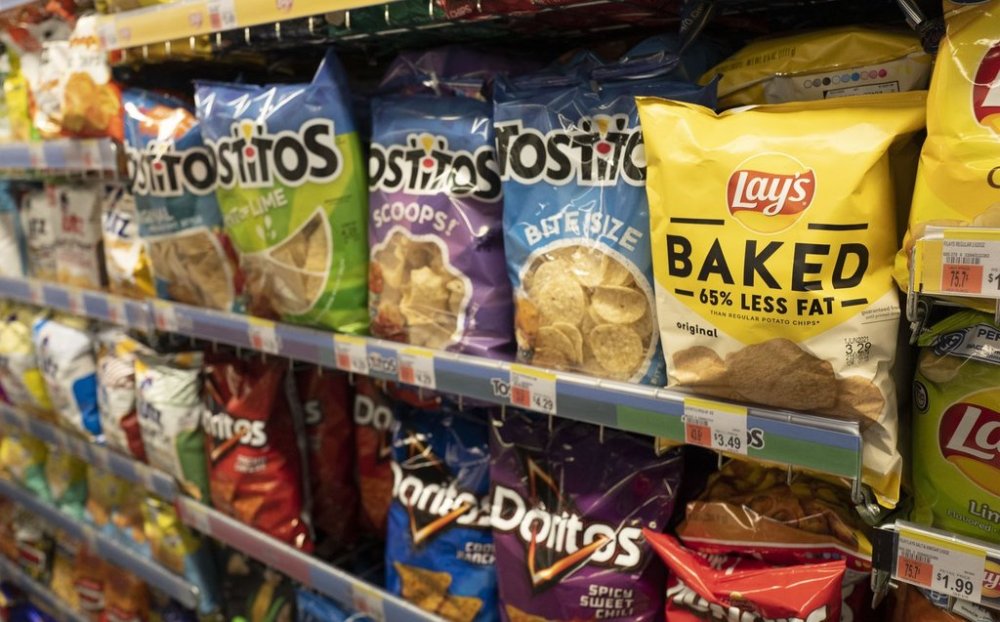
FILE - Potato chips are displayed at a store in New York, March 25, 2021. (AP Photo/Mark Lennihan, file)

The report comes amid growing scrutiny of such foods by Health Secretary Robert F. Kennedy Jr., who blames them for causing chronic disease.

“We are poisoning ourselves and it’s coming principally from these ultra-processed foods,” Kennedy told Fox News earlier this year.

Overall, about 55% of total calories consumed by Americans age 1 and older came from ultra-processed foods during that period, according to the report. For adults, ultra-processed foods made up about 53% of total calories consumed, but for kids through age 18, it was nearly 62%.

The top sources included burgers and sandwiches, sweet baked goods, savory snacks, pizza and sweetened drinks.

Young children consumed fewer calories from ultra-processed foods than older kids, the report found. Adults 60 and older consumed fewer calories from those sources than younger adults. Low-income adults consumed more ultra-processed foods than those with higher incomes.

The results were not surprising, said co-author Anne Williams, a CDC nutrition expert.

What was surprising was that consumption of ultra-processed foods appeared to dip slightly over the past decade. Among adults, total calories from those sources fell from about 56% in 2013-2014 and from nearly 66% for kids in 2017-2018.

Williams said she couldn’t speculate about the reason for the decline or whether consumption of less processed foods increased.

But Andrea Deierlein, a nutrition expert at New York University who was not involved in the research, suggested that there may be greater awareness of the potential harms of ultra-processed foods.

“People are trying, at least in some populations, to decrease their intakes of these foods,” she said.

Concern over ultra-processed foods’ health effects has been growing for years, but finding solutions has been difficult. Many studies have linked them to obesity, diabetes and heart disease, but they haven’t been able to prove that the foods directly cause those chronic health problems.

One small but influential study found that even when diets were matched for calories, sugar, fat, fiber and micronutrients, people consumed more calories and gained more weight when they ate ultra-processed foods than when they ate minimally processed foods.

Research published this week in the journal Nature found that participants in a clinical trial lost twice as much weight when they ate minimally processed foods — such as pasta, chicken, fruits and vegetables — than ultra-processed foods, even those matched for nutrition components and considered healthy, such as ready-to-heat frozen meals, protein bars and shakes.

Part of the problem is simply defining ultra-processed foods.

The new CDC report used the most common definition based on the four-tier Nova system developed by Brazilian researchers that classifies foods according to the amount of processing they undergo. Such foods tend to be “hyperpalatable, energy-dense, low in dietary fiber and contain little or no whole foods, while having high amounts of salt, sweeteners and unhealthy fats,” the CDC report said.

U.S. health officials recently said there are concerns over whether current definitions “accurately capture” the range of foods that may affect health. The U.S. Food and Drug Administration and the Agriculture Department recently issued a request for information to develop a new, uniform definition of ultra-processed foods for products in the U.S. food supply.

In the meantime, Americans should try to reduce ultra-processed foods in their daily diets, Deierlein said. For instance, instead of instant oatmeal that may contain added sugar, sodium, artificial colors and preservatives, use plain oats sweetened with honey or maple syrup. Read food packages and nutrition information, she suggested.

“I do think that there are less-processed options available for many foods,” she said.

___

The Associated Press Health and Science Department receives support from the Howard Hughes Medical Institute’s Department of Science Education and the Robert Wood Johnson Foundation. The AP is solely responsible for all content.


Report Error Submit a Tip

More Stories

Booze sales down, gaming and cannabis up in Manitoba

Carol Sanders 4 minute read Preview

Booze sales down, gaming and cannabis up in Manitoba

Carol Sanders 4 minute read Yesterday at 2:01 AM CDT

MANITOBA Liquor and Lotteries delivered $724.1 million in profits to the province in 2025-26, with the lion’s share coming from alcohol, even as booze sales continue to shrink.

The Crown corporation’s contribution to Manitoba’s general revenues decreased by $6 million or 0.8 per cent from last year’s allocation of $730.1 million, its annual report shows.

That indicates stable overall performance “despite a changing operating environment,” the recently-released report said.

Those changes include the order from Premier Wab Kinew last year to remove U.S. alcohol from Liquor Mart store shelves after President Donald Trump launched a trade war against Canada as well as Manitobans’ changing tastes.

Read
Yesterday at 2:01 AM CDT

Alberta’s gopher museum closed until further notice as owners find new facility

Daniela Germano, The Canadian Press 3 minute read Preview

Alberta’s gopher museum closed until further notice as owners find new facility

Daniela Germano, The Canadian Press 3 minute read Updated: 12:54 PM CDT

A quirky Alberta roadside attraction that has delighted travellers for decades with its stuffed rodents in tiny costumes is closed until further notice.

The World Famous Gopher Hole Museum, located in Torrington, a hamlet about 120 kilometres north of Calgary, made the announcement online earlier this week.

Laural Kurta, museum director, said she was forced to close the doors because the two historical buildings that house the exhibits need to be replaced.

"We have done every patch repair, staple, spackle, everything we could possibly do, and it is just at its end," Kurta said in an interview Tuesday.

Read
Updated: 12:54 PM CDT

Klein insists premier has police HQ inquiry report, accuses mayor of trying to suppress it

Erik Pindera 3 minute read Preview

Klein insists premier has police HQ inquiry report, accuses mayor of trying to suppress it

Erik Pindera 3 minute read 5:55 PM CDT

Mayoral candidate Kevin Klein came out swinging Friday.

At a campaign appearance, Klein emphatically claimed Premier Wab Kinew must have an advance copy of the final report from the public inquiry into the Winnipeg Police Service headquarters, which Kinew, through his spokeswoman, outright denied.

Klein also claimed that his main election rival, Winnipeg’s current mayor Scott Gillingham, has been trying to prevent the final report from becoming an election issue.

Klein also alleged staff in the mayor’s office have been calling provincial politicians to try to prevent the report from being discussed in the legislature.

Read
5:55 PM CDT

Crime spree lands accused murderers behind bars

Dean Pritchard 4 minute read Preview

Crime spree lands accused murderers behind bars

Dean Pritchard 4 minute read 6:00 AM CDT

Three men have been sentenced to jail terms for a commercial robbery spree in southern Manitoba launched just two weeks after they are accused of killing a 19-year-old man in Abbotsford, B.C.

Twenty-two-year-old Ravdeep Gill of Winnipeg, pleaded guilty Monday to four counts of robbery and Harmandeep Gill, 27, of Brampton, Ont. and Jaskaran Singh, 21, of Surrey, B.C., each pleaded guilty to two counts of robbery for a 10-day crime blitz that targeted gas bars in Swan Lake, Teulon and St. Laurent, and a meat shop in Winnipeg.

Ravdeep Gill was sentenced to four years custody while Harmandeep Gill and Singh each received sentences of 30 months.

According to B.C. media reports, all three men are charged with first-degree murder in a Feb. 1, 2025 killing in Abbotsford that police there described as a targeted hit.

Read
6:00 AM CDT

Powerful allegory, magic wonder as ballet takes on Stravinsky

Holly Harris 5 minute read Preview

Powerful allegory, magic wonder as ballet takes on Stravinsky

Holly Harris 5 minute read 6:50 PM CDT

The Royal Winnipeg Ballet opened its mainstage season with fire and ice Thursday, as it paid homage to Russian composer Igor Stravinsky with Stravinsky Stories.

Local balletomanes may remember Alexei Ratmansky as a principal dancer during the early 1990s. The internationally renowned dance artist returns in a full-circle moment to stage The Fairy’s Kiss, the 50-minute work his first collaboration with the RWB in more than 30 years. He began flexing his choreographic muscles in its downtown studios with an earlier, reimagined incarnation in 1994, based on Hans Christian Andersen’s fairy tale The Ice Maiden, in turn set to Stravinsky’s own tribute to Tchaikovsky’s lushly romantic ballet scores.

Its narrative follows the journey of a Young Man (newly minted principal dancer Skylar Campbell, with all leads alternating) saved — and kissed — by a Fairy (principal dancer Elizabeth Lamont, who rips off a dizzying set of “fouettes”) after his Mother (former principal dancer Vanessa Léonard adding her own gravitas) perishes in a blizzard.

After falling in love with his fiancée (principal dancer Alanna McAdie, infusing her character with innocent youthfulness grounded by intricate footwork), he is tricked on his wedding day by the now disguised Fairy who reveals her true identity — and his ultimate destiny.

Read
6:50 PM CDT

Get to know your Jet: Mario Ferraro

Mike McIntyre 8 minute read Preview

Get to know your Jet: Mario Ferraro

Mike McIntyre 8 minute read Yesterday at 5:39 PM CDT

A one-on-one conversation with a Winnipeg Jet about the stuff you don't always hear in the media scrum

Read
Yesterday at 5:39 PM CDT