Lower flows, rising fears More frequent, longer periods of severe drought may hamper Manitoba Hydro’s generating capacity and profitability projections
Read this article for free:
or
Already have an account? Log in here »
To continue reading, please subscribe:

Digital Subscription
One year of digital access for only $205*
- Enjoy unlimited reading on winnipegfreepress.com
- Read the E-Edition, our digital replica newspaper
- Access News Break, our award-winning app
- Play interactive puzzles
*First annual payment billed as $205.00 + GST for one year. This annual subscription will automatically renew at $233.00 + GST every 52 weeks (10% off the regular annual price of $259.35). Offer available to new and qualified returning subscribers only. Cancel any time.
To continue reading, please subscribe:
Add Free Press access to your Brandon Sun subscription for only an additional
$1 for the first 4 weeks*
- Enjoy unlimited reading on winnipegfreepress.com
- Read the E-Edition, our digital replica newspaper
- Access News Break, our award-winning app
- Play interactive puzzles
*Your next Brandon Sun subscription payment will increase by $1.00 and you will be charged $17.95 plus GST for four weeks. After four weeks, your payment will increase to $24.95 plus GST every four weeks.
Read unlimited articles for free today:
or
Already have an account? Log in here »
Hey there, time traveller!
This article was published 08/08/2025 (416 days ago), so information in it may no longer be current.
Manitoba is the last stop for a tangle of waterways that pour from the Rocky Mountains and out across the North American plains and Prairies, a catchment for water that passes through numerous provinces and U.S. states.
The province receives 70 per cent of its water from other jurisdictions, leaving Manitoba vulnerable to upheavals, whether climate-related or political in nature.
During a drought, this tangle of factors can lead to significant ramifications that can negatively impact the generating capacity — and profitability — of Manitoba Hydro.
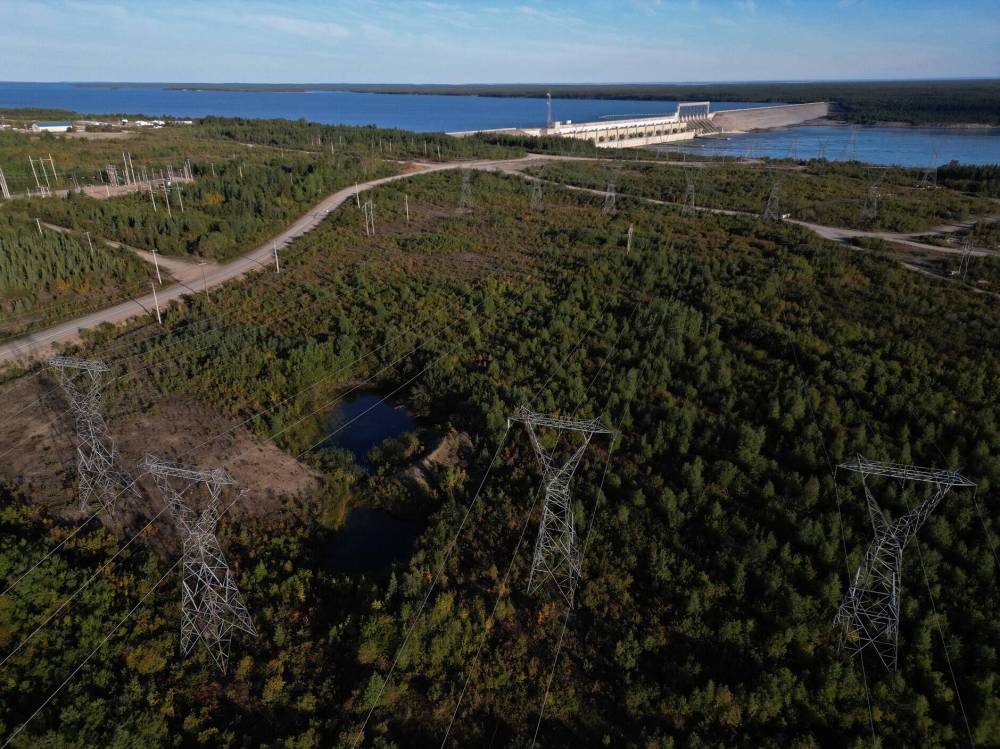
Tim Smith for The Narwhal
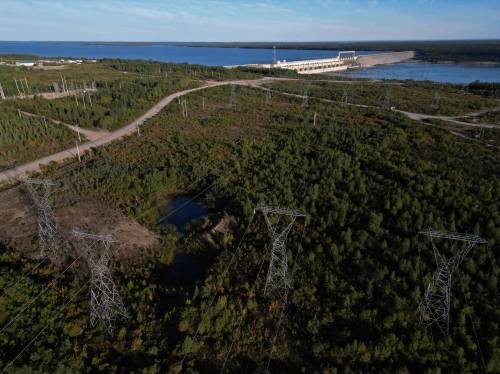
Manitoba Hydro power lines lead away from the Kettle Generating Station along the Nelson River overtop of forest just outside Gillam.
Last year, the utility lost $157 million due to the effects of extremely arid conditions hampering its ability to generate and sell electricity. This summer, flows across much of the province are significantly lower as the Prairies once again struggle with widespread drought.
And while Alberta and Saskatchewan have always met or exceeded the amount of water they’re required to share under existing agreements, the current impacts could be a taste of what’s to come. Climate models predict increased instability across the Prairies, with more-frequent and longer droughts mixed with periods of flooding. That’s coupled with a growing population and evermore demand for water, energy and electricity.
With all of this uncertainty, it doesn’t take much to tip the scales in a province where almost all — more than 96 per cent — of its electricity comes from hydro.
“In our very preliminary analysis, even a five per cent decrease in inflow to the Manitoba Hydro system… will have a significant impact on power generation,” Masoud Asadzadeh, a professor in the department of civil engineering at the University of Manitoba, said in an interview.
With his research focusing on simulation, design and analysis of water-engineering systems, Asadzadeh said more groundwork needs to be done to facilitate the tough, but necessary, conversations around water sharing in an era of climate change.
Nearly half a billion dollars lost
Along the rivers tracked by Manitoba Hydro, flow levels are significantly lower than at the same time last year, while the utility maintains levels at dammed lakes to meet winter demand.
Hydro is watching the situation.
“While we’ve seen below-normal spring and summer precipitation so far, we aren’t making predictions right now,” spokesman Riley McDonald said in an emailed response to questions.
McDonald said the utility has been able to meet provincial electrical demand and export contracts in previous low-water years, but the reduced generation hampers its ability to sell excess power on the open market, impacting revenues.
McDonald didn’t say whether a threshold exists at which Manitoba Hydro would be unable to meet provincial demand, and the province directed the question back to utility. He did say the system is designed to ensure necessary generation based on the worst drought conditions recorded since 1912 — in 2003-04, Manitoba Hydro lost a record $436 million due to drought conditions.
Asadzadeh said the real “nightmare scenario” for Hydro is severe, multi-year droughts across the Prairies.
Manitoba’s own drought management strategy highlights a study of tree rings that shows a multi-decade drought plagued the Red River Basin in the 1500s.
“It is difficult to comprehend the catastrophe that would occur if Manitoba and the rest of the Canadian Prairies were to experience such a severe, multi-decade drought today,” the strategic action plan notes.
At the same time, the increasing electrification of heating and transportation is expected to increase demand on the Manitoba Hydro grid, according to the utility’s 2023 Integrated Resource Plan.
“Manitoba Hydro’s energy and capacity resources are limited. We already anticipate not renewing some of our current contracts for exports of electricity as that surplus energy will be increasingly required to meet your needs here in Manitoba,” then president and CEO Jay Grewal wrote in the introduction to the report.
Drought and demand, however, aren’t the only factors impacting the province.
Western water sharing
Alberta and Saskatchewan are obligated to pass on roughly half of the estimated water that flows through their territories. Alberta moves along 50 per cent to Saskatchewan, which then shifts 50 per cent to Manitoba.
So far, the system has worked, with both provinces meeting or exceeding obligations. But variability is the norm. In wet years, Alberta can pass along far more water than is required, but in drier years, it skirts the minimum threshold. It delivered 56 per cent of its natural flow to Saskatchewan during the drought in 2001, for example.
Each province has its own system for regulating water use, and faces its own internal stresses, demands and interests.
It’s a system Tricia Stadnyk, the Canada Research Chair in hydrological modelling at the University of Calgary, has called “fragmented.”
The “dual threat of climate change and increasing demand pressures,” she wrote in The Conversation, could stretch the Prairies’ water-sharing agreement to the breaking point.
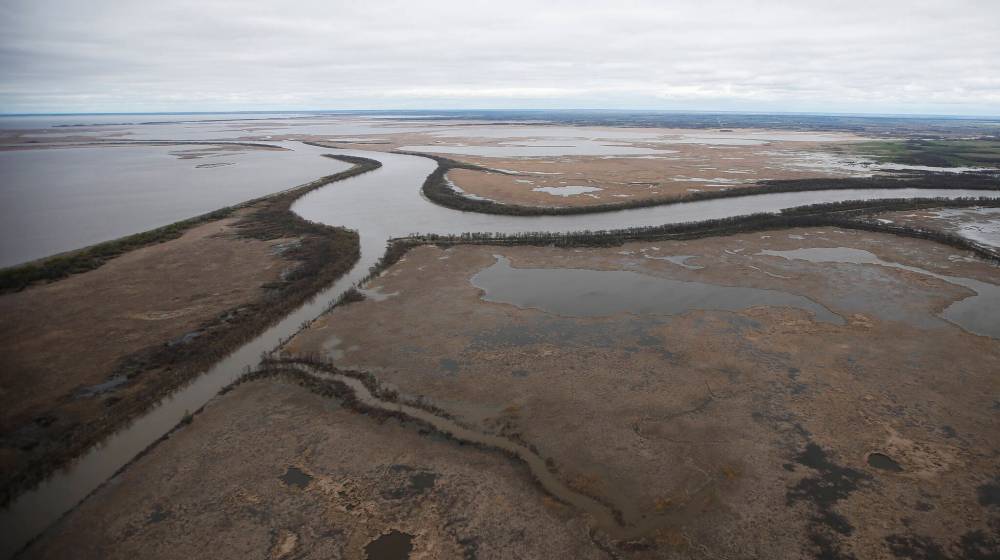
The Canadian Press files
Netley Creek and the Red River enter Lake Winnipeg just north of Winnipeg.
But the agreement offers some stability, at least when compared to similar accords with the United States, from where some of Manitoba’s rivers flow. North Dakota, for example, can petition a joint commission to reduce flow to Manitoba from the Souris River. And along the Red River, there is no formal agreement between the two nations to share water.
“Apportionment on the Red River is challenging due to the fact that there may be very limited or no flow to apportion during severe drought,” according to the province’s drought management strategy.
A Manitoba government spokesperson said the province works with Alberta, Saskatchewan and the federal government through the Prairie Provinces Water Board to manage transboundary water.
“Western provincial officials remain in regular contact during dry periods, to share water management information and updates,” the spokesperson said by email.
The water board, however, has no regulatory authority.
In the case of a dispute between provinces, it will be referred to the Federal Court of Canada.
There is also increased demand on the system as Alberta and Saskatchewan look to expand irrigation, which consumes vast quantities of water. In Alberta, irrigation accounts for approximately 43 per cent of all water allocations. Fossil fuel production has access to 13 per cent.
All of this occurs amid the backdrop of climate change, which Manitoba’s water management strategy warns is “expected to make extreme heat and drought-driven water shortages more frequent and severe.”
Each and every factor could impact hydroelectric generation and the utility’s bottom line.
Drought can lead to competition
Asadzadeh said there has to be more adaptability built into water management on the Prairies, particularly with the increased uncertainty brought by climate change.
“These agreements will protect people, because the more water is used by different sectors, the more competition happens,” he said. “And if (extreme) drought happened, that competition might change its shape from competition to disagreement at some point.”
Asadzadeh said when conflict arises, it’s often the more-vulnerable communities that are most impacted, and consequently, he said there should be more focus placed on Indigenous water rights in times of drought.

Planning ahead for extreme drought is something the water board is at least considering.
A spokesperson said the board has taken part in an extreme drought scenario exercise in 2022, including “how discussions between jurisdictions and other stakeholders can inform actions that might need to be taken should water use need to be prioritized.”
It’s not at all clear where Manitoba Hydro would slot into on that list of priorities.
This story has been co-published with The Narwhal.
drew@thenarwhal.ca
Related Articles
Climate change major driver of surging algae levels in Canada's lakes: study