

Local Muslims, Indigenous people hold interfaith event
Solidarity gathering includes discussions of truth, reconciliation as Orange Shirt Day approaches

Advertisement
Read this article for free:
or
Already have an account? Log in here »
To continue reading, please subscribe:

Digital Subscription
One year of digital access for only $205*
- Enjoy unlimited reading on winnipegfreepress.com
- Read the E-Edition, our digital replica newspaper
- Access News Break, our award-winning app
- Play interactive puzzles
*First annual payment billed as $205.00 + GST for one year. This annual subscription will automatically renew at $233.00 + GST every 52 weeks (10% off the regular annual price of $259.35). Offer available to new and qualified returning subscribers only. Cancel any time.
To continue reading, please subscribe:
Add Free Press access to your Brandon Sun subscription for only an additional
$1 for the first 4 weeks*
- Enjoy unlimited reading on winnipegfreepress.com
- Read the E-Edition, our digital replica newspaper
- Access News Break, our award-winning app
- Play interactive puzzles
*Your next Brandon Sun subscription payment will increase by $1.00 and you will be charged $17.95 plus GST for four weeks. After four weeks, your payment will increase to $24.95 plus GST every four weeks.
Read unlimited articles for free today:
or
Already have an account? Log in here »
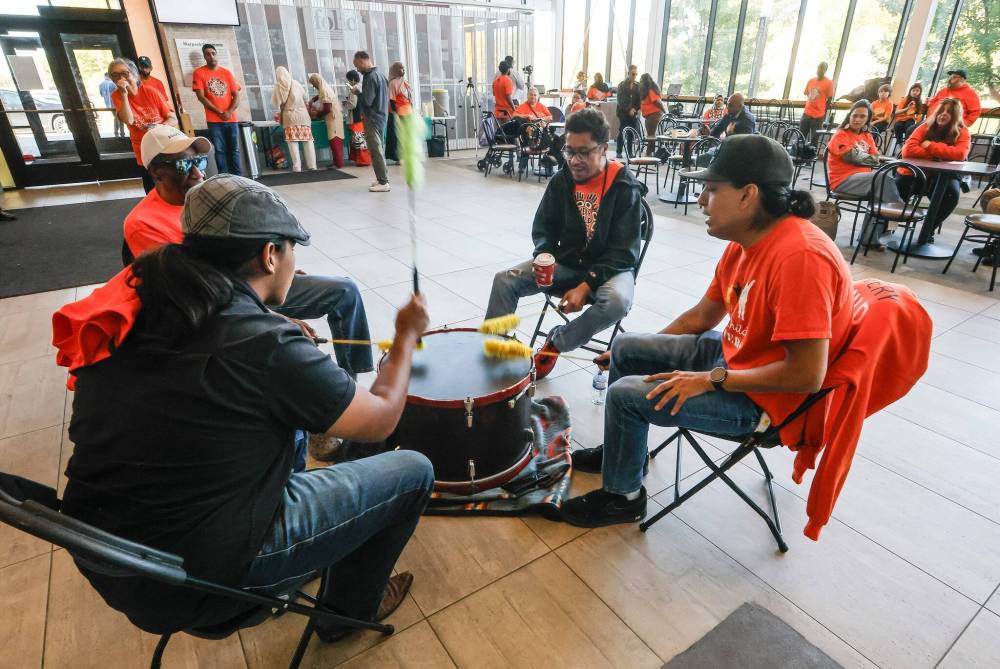
Bannock with wild rice and samosas with halal beef stew were served in equal measure as Indigenous and Muslim Winnipeggers sought common ground at an interfaith event discussing truth and reconciliation Sunday.
The Islamic Social Services Association’s second annual Muslim-Indigenous Solidarity event recognized Orange Shirt Day through conversations with elders, shared prayers and crafting.
Organizer Shahina Siddiqui said many of the people attending the gathering, held at Canadian Mennonite University, share the traumatic impacts of colonialism.
Siddiqui said she herself had attended a Catholic day school in her home country of Pakistan, where she and other students were forced to speak English, and were hurt if they didn’t. Many Muslim-majority countries, she said, have been harmed by colonialism.
“I think the commonalities are there, but it’s about taking the first step and extending our hand,” she said Sunday.
The first gathering last year was inspired in part by the suffering of Palestinian families in Gaza, she said.
“What we are seeing in Gaza, is every child matters, regardless of who they are, where they come from, what colour their skin is,” she said.
“And then I looked into the essence of Orange Shirt Day. It really is to remember and honour and commit that we won’t do this again. And so I thought it was a good time.”
Several Indigenous elders took to the stage to share their own personal experiences with residential schools and racism, and discussed the value of solidarity between marginalized communities.
Among them was David Budd, who acknowledged that at times, he has witnessed fraught relationships between Indigenous Manitobans and newcomers. He said education and compassion is key for building those connections.
“I know it’s hurting, you’re in pain, it’s confusing, it’s frustrating, but you know what? I think we’re all meant to be here,” he said.
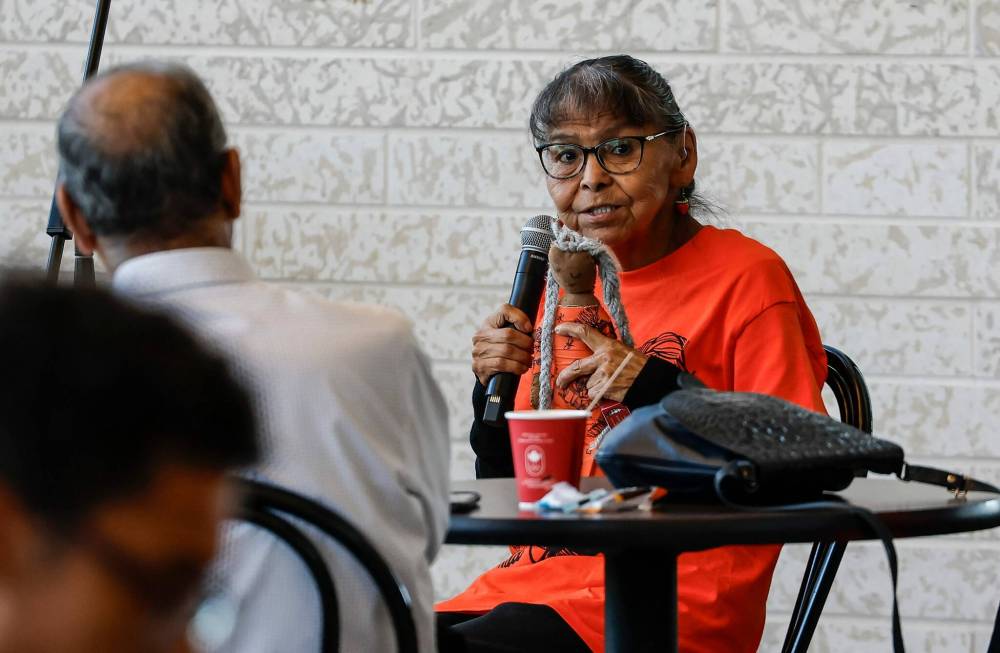

He recalled a story told to him by another elder, who had told him once that all people now have space on Turtle Island. When Budd asked his fellow elder what he meant, the man gestured to the medicine wheel, and said people from all directions of the world had found a home here.
Budd carries that reminder with him.
“Now it’s time to get to know one another,” he said. “Now it’s time to build relationships.”
Orange Shirt Day, known Canada-wide as the National Day for Truth and Reconciliation, is on Wednesday. It was officially established as a federal statutory holiday in 2021 and provincially in 2023.
malak.abas@freepress.mb.ca
Malak Abas is a city reporter at the Free Press. Born and raised in Winnipeg’s North End, she led the campus paper at the University of Manitoba before joining the Free Press in 2020. Read more about Malak.
Every piece of reporting Malak produces is reviewed by an editing team before it is posted online or published in print — part of the Free Press‘s tradition, since 1872, of producing reliable independent journalism. Read more about Free Press’s history and mandate, and learn how our newsroom operates.
Our newsroom depends on a growing audience of readers to power our journalism. If you are not a paid reader, please consider becoming a subscriber.
Our newsroom depends on its audience of readers to power our journalism. Thank you for your support.
Malak Abas is a city reporter at the Free Press. Born and raised in Winnipeg’s North End, she led the campus paper at the University of Manitoba before joining the Free Press in 2020. Read more about Malak.
Every piece of reporting Malak produces is reviewed by an editing team before it is posted online or published in print — part of the Free Press‘s tradition, since 1872, of producing reliable independent journalism. Read more about Free Press’s history and mandate, and learn how our newsroom operates.
Our newsroom depends on a growing audience of readers to power our journalism. If you are not a paid reader, please consider becoming a subscriber.
Our newsroom depends on its audience of readers to power our journalism. Thank you for your support.
Advertisement Advertise With Us
Advertisement Advertise With Us