As octopuses dwindle in Spanish waters, suppliers look to imports and farming despite concerns
Advertisement
Read this article for free:
or
Already have an account? Log in here »
To continue reading, please subscribe:
Digital Subscription
One year of digital access for only $1.44 a week*
- Enjoy unlimited reading on winnipegfreepress.com
- Read the E-Edition, our digital replica newspaper
- Access News Break, our award-winning app
- Play interactive puzzles
*Billed as $5.77 plus GST every four weeks. After 52 weeks, price increases to the regular rate of $19.95 plus GST every four weeks. Offer available to new and qualified returning subscribers only. Cancel any time.
To continue reading, please subscribe:
Add Free Press access to your Brandon Sun subscription for only an additional
$1 for the first 4 weeks*
- Enjoy unlimited reading on winnipegfreepress.com
- Read the E-Edition, our digital replica newspaper
- Access News Break, our award-winning app
- Play interactive puzzles
*Your next Brandon Sun subscription payment will increase by $1.00 and you will be charged $17.95 plus GST for four weeks. After four weeks, your payment will increase to $24.95 plus GST every four weeks.
Read unlimited articles for free today:
or
Already have an account? Log in here »
Hey there, time traveller!
This article was published 12/08/2025 (437 days ago), so information in it may no longer be current.
GALICIA, Spain (AP) — At a humming factory in the Spanish town of O Carballino, workers sling dozens of limp octopuses into a metal cauldron, wincing as strings of slime splatter their aprons. Nearby, others slice tentacles and pack them into vacuum-sealed bags destined for restaurants and retailers across Europe, Asia and the United States — part of a growing global appetite for an animal that’s become increasingly scarce in its native waters.
Though O Carballino proudly calls itself Spain’s octopus capital — complete with a towering bronze octopus statue, streets lined with the pulperias that offer them up to diners and an annual octopus festival that draws tens of thousands — the century-old factory hasn’t sourced a single animal from local waters in 10 years.
“Here in Galicia, octopus has become really, really variable and scarce,” said Carlos Arcos, export manager of Frigorificos Arcos SL. “If you’re industrializing a process like we do, you need to guarantee your customers regularity of supply.”
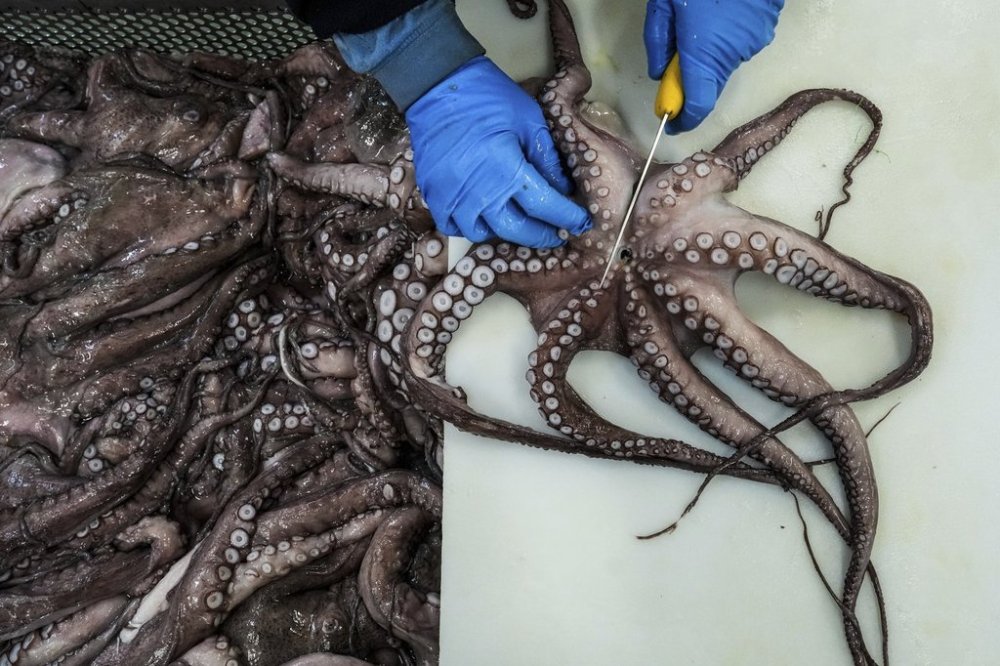
Today, 100% of the company’s octopus comes from Mauritania and Morocco.
While octopus numbers fluctuate naturally from year to year, scientists and fishers say Spain’s long-term trend is downward and surging international demand is only tightening the squeeze. That’s prompted some companies to explore farming the animals in tanks to ensure a long-term supply — a prospect that’s drawn pushback from animal welfare groups.
Pressure forces closure of Spain’s octopus fishery
This summer, that pressure reached a breaking point. Spain’s octopus fishery closed for three months — an unusually long pause meant to give it time to recover.
“The population has only just come back, but once the season opens, we’ll destroy it all in two weeks,” said Juan Martínez, a fisherman of more than four decades. Beside him, hundreds of octopus traps sat idle, stacked along the dock in his home port of Cangas. “This used to be a sustainable industry, but now we’ve broken an entire ecosystem.”
Octopus populations in Galicia also depend heavily on nutrient-rich upwelling — deep ocean water rising to the surface and bringing food for octopuses — said Ángel González, a research professor at the Spanish National Research Council. While upwelling naturally fluctuates, climate change is altering wind patterns, ocean stratification and nutrient delivery, making those cycles less predictable and, in some years, less productive. “When that weakens due to changing oceanographic and atmospheric conditions, numbers drop regardless of fishing.”
In response to growing demand and shrinking wild stocks, some companies in Spain are attempting to farm octopus in captivity — a move they say could ease pressure on the oceans. Grupo Profand is developing a research hatchery in Galicia focused on overcoming the biological challenges of breeding octopus. Meanwhile, seafood giant Nueva Pescanova is pursuing a full-scale industrial farm that would raise up to a million octopuses a year for slaughter.
Grupo Profand did not respond to an interview request. A spokesperson for Nueva Pescanova declined to comment.
Animal welfare groups say octopus shouldn’t be farmed
Animal welfare groups have condemned the proposed project as inhumane, citing plans to kill octopuses by submerging them in ice slurry and to confine the often-cannibalistic animals at high densities. They also warn it would pollute nearby waters with discharged waste, worsen overfishing of wild fish used for feed and inflict suffering on one of the ocean’s most complex creatures.
“Farming wild animals is cruel, but especially with octopuses given their solitary nature and extremely high intelligence,” said Helena Constela, head of communications at Seaspiracy, a group that advocates against industrial fishing. Keeping them confined together in tanks, she said, is “basically torture in slow motion.”
Michael Sealey, senior policy advisor at Oceana Europe, said aquaculture should focus on species with lower environmental costs, such as oysters and mussels, which require no fish feed. “We recognize that aquaculture has a role to play in feeding the world,” said Michael Sealey, senior policy advisor at Oceana Europe. “But we need to prioritize low-impact farming — not systems that rely on feeding wild fish to carnivorous species.”
Widespread concerns have already prompted action in the United States. Washington became the first state to ban octopus farming in 2024, followed by California, which also outlawed the sale of farmed octopus. Lawmakers in more than half a dozen other states have proposed similar bans, and a bipartisan federal bill to prohibit both farming and imports of farmed octopus is under consideration in Congress.
Though no commercial farms currently operate in the U.S., these preemptive measures reflect mounting unease over projects moving ahead in Europe, Asia and parts of Central and South America — unease fueled in part by the 2020 Oscar-winning documentary “My Octopus Teacher,” which showcased the animals’ intelligence and emotional complexity to millions on Netflix.
The arguments in favor of farming
“They have a real brain. They’re able to do things other animals cannot,” said González of the Spanish National Research Council. “But please — don’t cross the line. It’s an animal, it’s an invertebrate. We can’t extrapolate these kinds of things. Personality is linked to persons.”
González, who is working with Grupo Profand on their research hatchery, believes farming could help restore wild stocks by raising juvenile octopuses in captivity for release back into the sea — an approach animal welfare groups argue could pave the way for industrial-scale farming.
Javier Ojeda, national aquaculture representative at APROMAR, Spain’s aquaculture business association, said aquatic animals can play a key role in food security and may be more efficient to raise than livestock. “Octopuses grow extremely fast and efficiently — they’re not fighting gravity and they don’t spend energy heating their bodies,” he said. He acknowledged welfare concerns but argued they should not block scientific progress.
“Farming octopus is something that cannot be stopped,” said Ojeda. “We’ve been eating them for a long time. Now we need to try to find best practices.”
___
Follow Annika Hammerschlag on Instagram @ahammergram.
___
The Associated Press receives support from the Walton Family Foundation for coverage of water and environmental policy. The AP is solely responsible for all content. For all of AP’s environmental coverage, visit https://apnews.com/hub/climate-and-environment
Related Articles
How to use 8 arms? Octopuses tend to explore with their front limbs
Advertisement Advertise With Us
Advertisement Advertise With Us