Arizona, Nevada and Mexico will again get less Colorado River water in 2026

Advertisement

Advertise with us

DENVER (AP) — Arizona, Nevada and Mexico will again live with less water from the Colorado River as drought lingers in the West, federal officials announced Friday.

Read this article for free:


or

Already have an account? Log in here »

To continue reading, please subscribe:

Subscribe and receive a limited-edition Free Press branded hat or tote.

Digital Subscription

One year of digital access for only $205*

  • Enjoy unlimited reading on winnipegfreepress.com
  • Read the E-Edition, our digital replica newspaper
  • Access News Break, our award-winning app
  • Play interactive puzzles

*First annual payment billed as $205.00 + GST for one year. This annual subscription will automatically renew at $233.00 + GST every 52 weeks (10% off the regular annual price of $259.35). Offer available to new and qualified returning subscribers only. Cancel any time.

To continue reading, please subscribe:

Add Free Press access to your Brandon Sun subscription for only an additional

$1 for the first 4 weeks*

  • Enjoy unlimited reading on winnipegfreepress.com
  • Read the E-Edition, our digital replica newspaper
  • Access News Break, our award-winning app
  • Play interactive puzzles
Start now

*Your next Brandon Sun subscription payment will increase by $1.00 and you will be charged $17.95 plus GST for four weeks. After four weeks, your payment will increase to $24.95 plus GST every four weeks.

Hey there, time traveller!
This article was published 15/08/2025 (390 days ago), so information in it may no longer be current.

DENVER (AP) — Arizona, Nevada and Mexico will again live with less water from the Colorado River as drought lingers in the West, federal officials announced Friday.

The Colorado River is a critical lifeline to seven U.S. states, 30 Native American tribes, and two Mexican states. The cuts are based on projections for levels at federal reservoirs — chief among them Lake Powell and Lake Mead — released every August by the U.S. Bureau of Reclamation.

Arizona will again go without 18% of its total Colorado River allocation, while Mexico loses 5%. The reduction for Nevada — which receives far less water than Arizona, California or Mexico — will stay at 7%. California won’t face any cuts because it has senior water rights and is the last to lose in times of shortage.
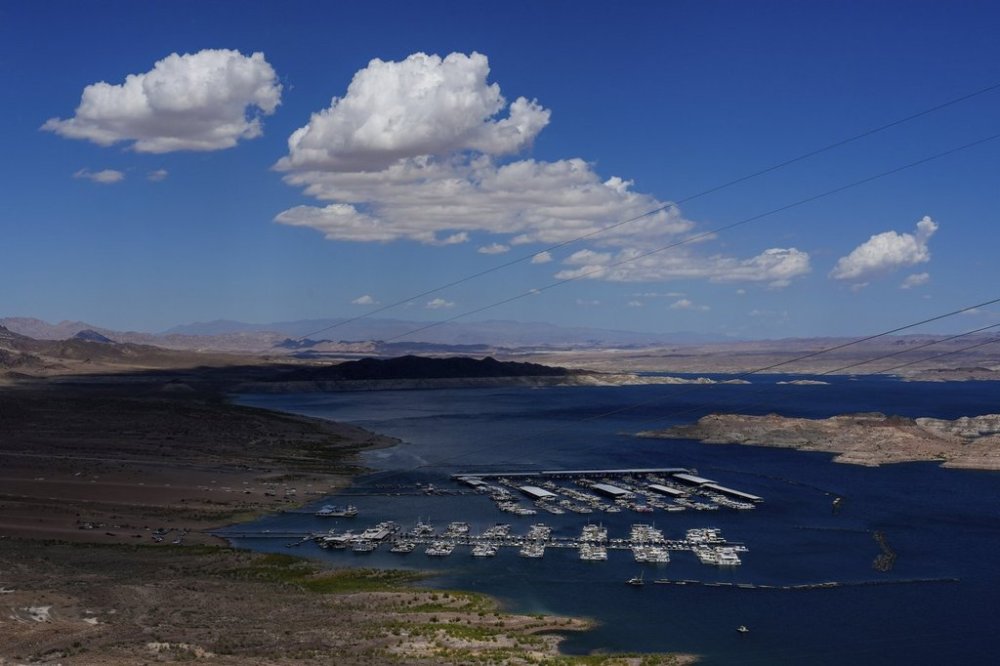
FILE - Lake Mead at Hoover Dam, Thursday, Aug. 22, 2024, near Boulder City, Nev. (AP Photo/Julia Demaree Nikhinson, file)

Decades of overuse and the effects of long-term drought worsened by climate change means there’s far more demand for water than what actually flows through the river. Low reservoir levels at Lake Mead have triggered mandatory cutbacks every year since 2022, with the deepest cuts in 2023, which hit farmers in Arizona the hardest.

Meanwhile, the states are working to reach agreement by next year on new long-term rules to govern the river in dry years. The Trump administration gave a mid-November deadline for states to reach a preliminary agreement, or risk federal intervention. Negotiations have faced delays as states push back against how much water they should each give up.

The original 1922 Colorado River Compact was calculated based on an amount of water that doesn’t exist in today’s climate. That leaves the Upper Basin states of New Mexico, Colorado, Wyoming and Utah to share far less water after the required amount is sent to the to the “Lower Basin” states of Nevada, Arizona and California. Lots of water is also lost to evaporation and leaky infrastructure.

Fairly splitting the river’s water in the era of climate change has been vexing for years, with all of the major users hesitant to give anything up as they anticipate a drier future. There has to be enough water in the reservoirs to reach the tunnels that usher water downstream, and ideally, even more water for hydropower generation. Key infrastructure like the Hoover Dam rely on certain water levels in Lake Mead to generate electricity.

Mandatory cuts and emergency water releases are “reactive,” said John Berggren, a regional policy manager at Western Resource Advocates, a nonprofit focused on climate change.

“If we are going to be able to have a sustainable Colorado River and not just be responding to crisis after crisis, we need large amounts of flexibility built into this new set of guidelines,” he said.

“We can and must do better. Nature isn’t waiting for us,” said Becky Mitchell, Colorado’s commissioner in the Upper Colorado River Commission.

States are considering a so-called natural flow approach to managing the river — where the Lower Basin would receive a certain percentage of the average natural flow from the prior few years.

The Lower Basin states have helped stave off deeper cuts by coming up with voluntary conservation plans.

“Absent all of those measures, the river would be in a very bad place,” said J.B. Hamby, chairman of the Colorado River Board of California and a board member for the Imperial Irrigation District, the largest user of the river’s water. Still, he knows California, like others, will likely have to give up more in the negotiations.

Dozens of conservation projects along for Upper Basin states and tribes are in limbo. President Donald Trump froze yet-to-be-distributed Inflation Reduction Act funds on his first day in office, which included nearly $400 million for those projects. The entire Colorado congressional delegation signed a letter earlier this month urging the release their portion of those funds.

___

This story has been corrected to remove a reference to the third year of cuts in the headline. The cuts announced Friday are set for 2026, which will be the fifth year. ___

Associated Press journalists Amy Taxin in Tustin, California, and Mead Gruver in Fort Collins, Colorado, contributed to this report.

___

The Associated Press receives support from the Walton Family Foundation for coverage of water and environmental policy. The AP is solely responsible for all content. For all of AP’s environmental coverage, visit https://apnews.com/hub/climate-and-environment

Report Error Submit a Tip

More Stories

Slow start but gritty play not enough in Bombers OT loss to Roughriders in Labour Day Classic

Ken Wiebe 7 minute read Preview

Slow start but gritty play not enough in Bombers OT loss to Roughriders in Labour Day Classic

Ken Wiebe 7 minute read Sunday, Sep. 6, 2026

REGINA – Leave it to Brady Oliveira to succinctly describe that fine line between jubilation and the alternate.

In the aftermath of another Labour Day Classic that went down to the wire, Oliveira went through the joy of tying the game with no time left on the clock to the empty feeling that came moments later when the Saskatchewan Roughriders finished off a 32-26 victory on Sunday night before a raucous crowd of 34,352 at Mosaic Stadium.

“It’s terrible,” said Oliveira. “You just kind of feel all of the emotions. I’m pretty pissed right now. We were close, we were right there. We didn’t play our best football and we still gave ourselves a chance, which could be a silver lining.

“I don’t like to look at silver linings because the fact of the matter is we play this game to get positive results. We want to win the game and we didn’t win the game. So, I’m pissed.”

Read
Sunday, Sep. 6, 2026

Manitoba doctor denies working to revive Carberry ER in response to recruitment lawsuit

Erik Pindera 4 minute read Preview

Manitoba doctor denies working to revive Carberry ER in response to recruitment lawsuit

Erik Pindera 4 minute read Sunday, Sep. 6, 2026

A Manitoba doctor has denied he was working as a recruiter after an Ontario doctor accused him of misleading him about a position at the Carberry hospital.

Dr. Klevis Iliriani, who worked at the hospital in Carberry from May to August 2024, filed his statement of claim in Court of King’s Bench earlier this year.

Iliriani, who lives in an Ottawa suburb, has alleged recruiters negligently misrepresented the job at the Carberry hospital and breached the terms of his contract, which resulted in less pay than promised.

His court filing names defendants Dr. Dave Maharajh and Barry Banek as the recruiters.

Read
Sunday, Sep. 6, 2026

Pointing fingers at Tories three years after election tiresome, accomplishes nothing

Tom Brodbeck 5 minute read Preview

Pointing fingers at Tories three years after election tiresome, accomplishes nothing

Tom Brodbeck 5 minute read 1:08 PM CDT

There is a point in every government’s life when blaming the previous government stops being an explanation and starts becoming an excuse.

For Manitoba’s NDP government, that point has arrived.

Justice Minister Matt Wiebe was asked last week about a grievance filed by Crown attorneys over excessive workloads and a government attempt to keep a report documenting those workloads out of an upcoming arbitration hearing.

Wiebe said he couldn’t discuss the arbitration case.

Read
1:08 PM CDT

Woman died while getting wisdom teeth out; case raises questions about transparency of dental association

Nicole Buffie 5 minute read Preview

Woman died while getting wisdom teeth out; case raises questions about transparency of dental association

Nicole Buffie 5 minute read Friday, Sep. 4, 2026

The parents of a 23-year-old southwestern Manitoba woman who died after receiving a local anesthetic during a wisdom tooth extraction say they are in the dark about the investigation into their daughter’s death.

Dulaney and Victoria Blatz say the Manitoba Dental Association has been unwilling to give them information about the probe into their daughter’s death, saying the self-governing regulatory body must be more transparent with the public.

“We have pushed through various channels trying to get information, but it’s nothing but stalling and sidelining,” Victoria said Friday. “This has crashed our world to pieces and we just want answers.”

Virginia Blatz went to Boundary Trails Dental Centre in Morden on Nov. 27, 2024, to have her wisdom teeth removed, but never returned home.

Read
Friday, Sep. 4, 2026

Winkler-based internet provider delivering high-speed service to 30 rural and First Nations Manitoba communities

Nicole Buffie 3 minute read Preview

Winkler-based internet provider delivering high-speed service to 30 rural and First Nations Manitoba communities

Nicole Buffie 3 minute read 7:12 PM CDT

Valley Fiber says it is undertaking one of its largest fibre optic projects and is building infrastructure that will deliver internet to 10,000 homes and businesses in rural and First Nations communities across Manitoba.

“These communities will now have access to the fastest internet network in Manitoba, and it will power their lives and their business,” Ryan Klassen, chief executive officer of the Winkler-based internet provider, said Tuesday from Fisher River Cree Nation.

The province has granted Valley Fiber use of two of its underused cables on the existing Manitoba Hydro fibre optic network for up to 20 years as part of the project, which will connect nearly 30 communities — including Buffalo Point, Hollow Water, Black River and Peguis First Nations, along with Fisher River and Fox Lake Cree Nations — to high-speed internet.

Construction should be finished by 2027.

Read
7:12 PM CDT

Goldeyes open three-game playoff series in Fargo

Grace Anne Paizen 3 minute read Preview

Goldeyes open three-game playoff series in Fargo

Grace Anne Paizen 3 minute read 7:15 PM CDT

The Winnipeg Goldeyes return to post-season action Wednesday night since their trip to the Miles Wolff Cup Final in 2024.

First pitch in Game 1 of the West Division series is scheduled for 6:30 p.m. in Fargo, N.D., against the Fargo-Moorhead RedHawks.

Here’s a breakdown of what to know as the best-of-three series begins at Newman Outdoor Field.

By the numbers

Read
7:15 PM CDT