

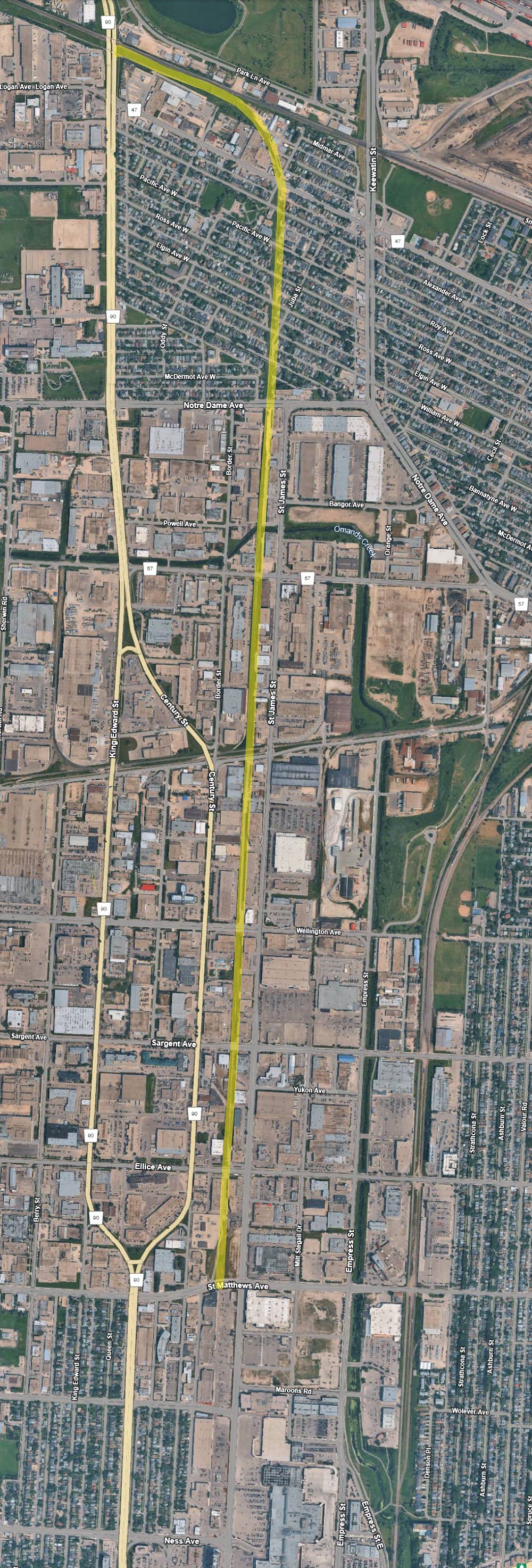
Brooklands active-transportation corridor initial proposal from rail relocation study

Advertisement
Read this article for free:
or
Already have an account? Log in here »
To continue reading, please subscribe:

Digital Subscription
One year of digital access for only $205*
- Enjoy unlimited reading on winnipegfreepress.com
- Read the E-Edition, our digital replica newspaper
- Access News Break, our award-winning app
- Play interactive puzzles
*First annual payment billed as $205.00 + GST for one year. This annual subscription will automatically renew at $233.00 + GST every 52 weeks (10% off the regular annual price of $259.35). Offer available to new and qualified returning subscribers only. Cancel any time.
To continue reading, please subscribe:
Add Free Press access to your Brandon Sun subscription for only an additional
$1 for the first 4 weeks*
- Enjoy unlimited reading on winnipegfreepress.com
- Read the E-Edition, our digital replica newspaper
- Access News Break, our award-winning app
- Play interactive puzzles
*Your next Brandon Sun subscription payment will increase by $1.00 and you will be charged $17.95 plus GST for four weeks. After four weeks, your payment will increase to $24.95 plus GST every four weeks.
Read unlimited articles for free today:
or
Already have an account? Log in here »
Hey there, time traveller!
This article was published 28/08/2025 (385 days ago), so information in it may no longer be current.
A four-kilometre stretch of no longer used tracks in Winnipeg’s Brooklands area is being eyed as a possible pedestrian and cyclist corridor by a railway relocation study led by Lloyd Axworthy.
It is the first proposed redevelopment to move to a design phase and one of the earliest recommendations in the two-year study commissioned by the Manitoba government.
“This is an area where… there is no green space and all the arteries are high traffic,” Axworthy, a former federal Liberal transport minister, told the Free Press Wednesday, noting the existing safety risks for students and others.
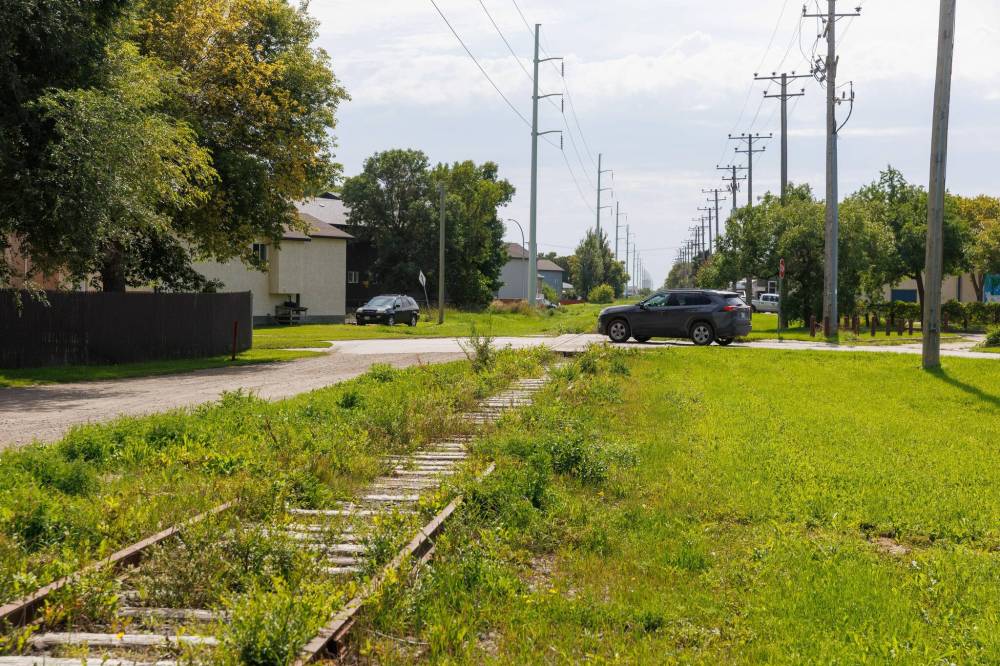
MIKE DEAL / FREE PRESS
A stretch of abandoned rail crosses Pacific Avenue West in Brooklands. The rail group recommends Manitoba commission a design study to transform the rail line into an active transportation corridor.
“I guess right now we’re focusing on what was probably the easiest one to start with, which is a line that’s already been abandoned. I’m not saying it’s a slam-dunk, because there’s a lot of stuff about transferring land and liabilities.”
A contract was expected to be awarded to a design firm Wednesday to help visualize what an active transportation corridor would look like on the Canadian National Railway Co. spur line near Notre Dame Avenue and Keewatin Street.
Premier Wab Kinew and Axworthy announced the rail relocation feasibility study in October 2024 to identify rail yards or lines that could be moved out of the city or decommissioned.
The aims include improving safety, health and transport efficiency, spurring economic development and converting railway land for affordable homes, open spaces, active transportation, public transit or other uses.
Winnipeg is running out of land for development, Axworthy noted.
“How much will it cost?” is usually one of the first questions asked by naysayers or skeptics.
Axworthy said the study team is working with academics to come up with a new algorithm to measure costs and benefits.
“It’s not just, ‘It’s going to cost this much money to move and do remediation,’ it’s also what do you save on health, on eliminating grade crossings and maintenance — which are very expensive — and the safety side of it,” he said. “That’s the trick pony that we have to develop.”
The province initially budgeted $200,000 for the study. Axworthy said the city contributed $25,000 for design work.
Earlier research by a coalition of relocation proponents found 75 per cent of Winnipeggers live within 800 metres of a rail line, with 240 crossings.
Kinew and Axworthy announced the study almost a year ago next to the Canadian Pacific Kansas City Ltd. rail yard that divides central and northern neighbourhoods.
While that yard has been the focus of Winnipeg’s years-long rail relocation debate, the study started small by examining a handful of potential community-based projects, including the one in Brooklands.
“We see them not as stand-alones, but becoming integrated into the (active-transportation) network,” Axworthy said.
He said he started talks with BNSF Railway about possible alternatives to an active yard and line that crosses Corydon, Grant and Taylor avenues and Academy Road in River Heights.
The team is exploring potential options in St. Boniface and Point Douglas, and looking at the possibility of converting a spur line that serves the North End Sewage Treatment Plant.
Some community meetings have already been held. Axworthy said residents raised concerns about pollution and the transport of hazardous goods in urban areas. A wider public forum could be held next year.
“By that time, we’ll have enough evidence — pros and cons, good and bad — so Winnipeggers can come to the Convention Centre and see what the options are,” said Axworthy, a former Winnipeg member of Parliament.
Axworthy was given a tour of the sprawling CPKC yard Wednesday afternoon. The Arlington and Slaw Rebchuk bridges cross the yard, with the former being indefinitely closed since November 2023 due to structural problems.
The study will look at whether larger projects, such as the CPKC site, are feasible. Axworthy said a project of that scale would take many years to complete, but it could be achieved in different ways.
“I don’t think you necessarily are going to have a wholesale sort of transfer. It’s a ‘Duff’s Ditch’ kind of proposition to do it, but I think it can be done,” he said, referring to the Red River Floodway project, spearheaded by former premier Duff Roblin, that had its share of naysayers.
“We’re looking at something that isn’t just in the next five years or 10. We’re talking, how do you get 30 years out? What’s it going to look like?”
He hopes the study will help to eliminate physical barriers, solve inequality issues and, ultimately, reshape Winnipeg. He envisions it as something that could contribute to railway modernization and Winnipeg becoming a transport hub for North America.
“This study should be a catalyst to doing a lot more serious work,” Axworthy said.
Based in Ottawa, he has met with current and former railway executives and politicians at all levels of government in the study’s first year. He’s sensed both enthusiasm and caution during talks.
He plans to soon visit Lac-Mégantic, Que., the site of a deadly rail disaster in 2013.
A final report with recommendations and projected costs is expected to be submitted to the province in October 2026. Axworthy said the study team doesn’t have to wait until then to make recommendations, however.
It is up to the three levels of government to act upon the recommendations, he said. The federal government has a Railway Relocation and Crossing Act.
It remains to be seen if railway companies are willing to part with land in Winnipeg or move operations outside the city, what it would take to do so or where yards or lines would go.
CPKC spokesman Terry Cunha said the company has discussed the “challenges and complexity of rail relocation” with the province multiple times over many years, including through the current study.

He said studies must consider all factors without compromising safety, essential rail service to customers and capacity for future growth, and also capture full costs, which will be significant.
CN Rail has said it will work “collaboratively” with the province.
Each proposed redevelopment project would come with ramifications or consequences, Axworthy noted.
The study’s partners include the University of Manitoba’s Transport Institute. An 18-member advisory board has people with railway experience, urbanists, business leaders, economic experts, Indigenous leaders and social activists.
chris.kitching@freepress.mb.ca
Chris Kitching is a general assignment reporter at the Free Press. He began his newspaper career in 2001, with stops in Winnipeg, Toronto and London, England, along the way. After returning to Winnipeg, he joined the Free Press in 2021, and now covers a little bit of everything for the newspaper. Read more about Chris.
Every piece of reporting Chris produces is reviewed by an editing team before it is posted online or published in print — part of the Free Press‘s tradition, since 1872, of producing reliable independent journalism. Read more about Free Press’s history and mandate, and learn how our newsroom operates.
Our newsroom depends on a growing audience of readers to power our journalism. If you are not a paid reader, please consider becoming a subscriber.
Our newsroom depends on its audience of readers to power our journalism. Thank you for your support.
Chris Kitching is a general assignment reporter at the Free Press. He began his newspaper career in 2001, with stops in Winnipeg, Toronto and London, England, along the way. After returning to Winnipeg, he joined the Free Press in 2021, and now covers a little bit of everything for the newspaper. Read more about Chris.
Every piece of reporting Chris produces is reviewed by an editing team before it is posted online or published in print — part of the Free Press‘s tradition, since 1872, of producing reliable independent journalism. Read more about Free Press’s history and mandate, and learn how our newsroom operates.
Our newsroom depends on a growing audience of readers to power our journalism. If you are not a paid reader, please consider becoming a subscriber.
Our newsroom depends on its audience of readers to power our journalism. Thank you for your support.
Related Articles
The best time for a railyard move is now








Advertisement Advertise With Us
Advertisement Advertise With Us
History
Updated on Thursday, August 28, 2025 11:22 AM CDT: Adds map