Massachusetts cranberry bogs are being given a second life as vibrant wetlands
Advertisement
Read this article for free:
or
Already have an account? Log in here »
To continue reading, please subscribe:

Digital Subscription
One year of digital access for only $205*
- Enjoy unlimited reading on winnipegfreepress.com
- Read the E-Edition, our digital replica newspaper
- Access News Break, our award-winning app
- Play interactive puzzles
*First annual payment billed as $205.00 + GST for one year. This annual subscription will automatically renew at $233.00 + GST every 52 weeks (10% off the regular annual price of $259.35). Offer available to new and qualified returning subscribers only. Cancel any time.
To continue reading, please subscribe:
Add Free Press access to your Brandon Sun subscription for only an additional
$1 for the first 4 weeks*
- Enjoy unlimited reading on winnipegfreepress.com
- Read the E-Edition, our digital replica newspaper
- Access News Break, our award-winning app
- Play interactive puzzles
*Your next Brandon Sun subscription payment will increase by $1.00 and you will be charged $17.95 plus GST for four weeks. After four weeks, your payment will increase to $24.95 plus GST every four weeks.
Read unlimited articles for free today:
or
Already have an account? Log in here »
Hey there, time traveller!
This article was published 28/08/2025 (381 days ago), so information in it may no longer be current.
CARVER, Mass. (AP) — About this time of the year, Jarrod Rhodes should be checking on the vines of cranberries that have grown on his bog for decades in southeastern Massachusetts.
Instead, he is watching a backhoe tear up the cranberry bog, exposing the dark peat underneath that will eventually become a meandering stream through the 32-acre (13-hectare) South Meadow Bogs Restoration site. The goal of the six-to-nine-month-long, $1.1 million project is to convert this bog to a wetland that should see the return of native plants like steeplebush and straw-colored flatsedge along with providing habitat for wildlife like wood frogs, hawks and muskrats.
“These bogs were originally built on top of a wetland, so now we’re putting it back to the way it was,” Rhodes said, adding that this bog was “distressed” which gave his family a choice of spending time and money to rebuild it with new vines and irrigation or take state and federal funding to conserve and restore it.
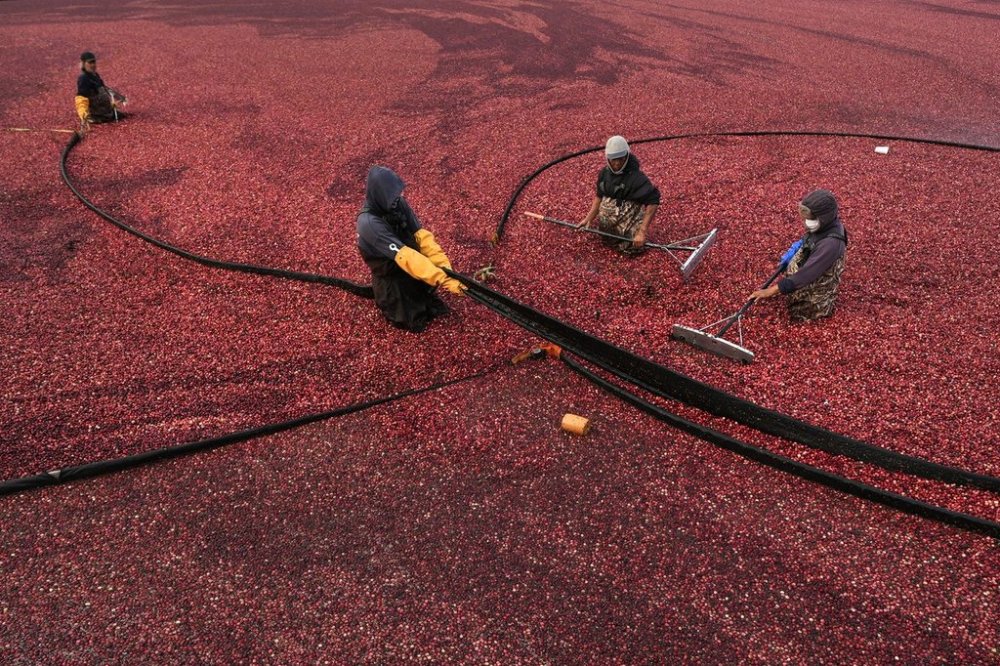
“There were a lot of factors that made this avenue make more sense as opposed to spending the money to rebuild it and waiting five or six years,” said Rhodes, a fourth-generation farmer whose family still has 250 acres (101 hectares) in production.
Nature over housing
This project is part of a growing push by cranberry farmers in Massachusetts to choose conservation over other options to glean extra revenue like converting a bog into solar farms or housing.
The shift comes as the industry is being hit by lower prices for the pinkish crimson berries used in sauce and juice along with the rising cost of producing larger, hybrid varieties. Farmers also are seeing the effects of climate change, which is bringing unpredictable weather like droughts and warmer fall conditions that delay the harvest.
“It’s a tough environment right now economically,” said Brian Wick, the executive director of Massachusetts Cranberries, the state’s growers association. The state started growing cranberries in the 1800s and was country’s top producer until the 1990s. It ceded that title to Wisconsin and now its nearly 300 growers produce about 22% of the nation’s crop.
“We’re starting to see a shift because everyone is in a different place in the industry and what they see as their future,” Wick said. “For some of them, they’re saying I have some bogs. I can’t keep farming them. They’re not going to be economically viable. They could be an environmentally sensitive area where maybe it’s better to have them not being farmed.”
Prime location for bog conversion
Massachusetts is well suited for bog conservation because most sites are built on former wetlands.
The push also comes as federal, state and local funding has increased in recent years for this kind of coastal conservation. Wetlands, which have significantly declined across the United States, provide a home for native plants and wildlife, a filter for pollutants and natural barriers to rising seas, higher tides and stronger storm surges. The restored sites also have proven popular with hikers, bikers and bird watchers.
“A year from now, that river channel will be flowing through a green meadow. You’ll see native plants across this dry landscape behind us. You’ll see wetland trees starting to grow,” said Beth Lambert, the director of the Massachusetts Division of Ecological Restoration, as she visited the South Meadow site. “The real restoration really happens after the construction equipment leaves the site. Mother Nature takes it from there and the site continues to evolve into a wetland for the next five to 10 years.”
The state has converted eight bog sites to wetlands at a cost of more than $27 million and has 12 more planned. Wisconsin and New Jersey have done some bog restoration but on a much smaller scale.
Most conversions can take several years, with construction teams pulling down gates and berms that controlled water flows, filling in drainage ditches and removing several feet of sand used in cranberry farming. They also aim to recreate the unique topography of a wetland — sometimes constructing mounds throughout the site.
“When you look at a natural wetland, you’ll see the surface of that wetland is not flat like a table. It’s hummocky. It has little hills, little tiny valleys,” Lambert said. “It’s that topography, which we call microtopography, that creates a wide diversity of wetland plant species, because each wetland can tolerate a certain amount of water.”
River otters thrive
Among the communities most bullish on bog conservation is Harwich on Cape Cod, where the Harwich Conservation Trust has restored one bog, is in the process of restoring a second by this fall and just bought a third to be turned into wetland — all totaling over 120 acres (49 hectares). Many of the cranberry farmers selling are town residents, who want to ensure their land remains in a natural state.
The Cold Brook Eco-Restoration Project was finished earlier this year and has a stream running through the 66-acre (27-hectare) site for the first time in a century. River otters have turned up and the restoration is proving a boon to egrets and herons. The project also is expected to save Harwich several million dollars in wastewater treatment costs, since wetlands reduce the amounts of nitrogen in the water flowing to the harbor

“While both honoring the cranberry culture and history in town is important, folks are recognizing these eco-restoration transformations are bringing a whole new range of benefits to the community,” said Michael Lach, executive director of the trust.
A 15-minute drive from the South Meadow site sits the first restoration project completed by the state in 2010.
Walking down a rocky hiking trial through a pitch pine forest, Lambert stares out at the Eel River that winds its way through the 40-acre (12-hectare) site. Cattails shake in the wind and a grove of Atlantic white cedar trees, planted as saplings, now stand 20 feet (6 meters) high. A great blue heron flies off as Lambert approaches the water and the fragrant smells of sweet pepper bush fills the air.
Without the state’s intervention, Lambert said the Eel River Preserve would have turned into a pine forest because it was so dry.
“The goal was to have a functioning wetland and that is, in fact, what we got which was incredible,” she said. “We didn’t know that the plants would return naturally on their own. We found that the peat had this incredible seed bank of native plants, which the peat had built up over hundreds of years. Simply exposing that to the sun and having the water moving through it, that created the conditions for the wetland plants to return.”