Construction intensifies at site linked to Israel’s suspected nuclear program, satellite photos show
Advertisement
Read this article for free:
or
Already have an account? Log in here »
To continue reading, please subscribe:

Digital Subscription
One year of digital access for only $205*
- Enjoy unlimited reading on winnipegfreepress.com
- Read the E-Edition, our digital replica newspaper
- Access News Break, our award-winning app
- Play interactive puzzles
*First annual payment billed as $205.00 + GST for one year. This annual subscription will automatically renew at $233.00 + GST every 52 weeks (10% off the regular annual price of $259.35). Offer available to new and qualified returning subscribers only. Cancel any time.
To continue reading, please subscribe:
Add Free Press access to your Brandon Sun subscription for only an additional
$1 for the first 4 weeks*
- Enjoy unlimited reading on winnipegfreepress.com
- Read the E-Edition, our digital replica newspaper
- Access News Break, our award-winning app
- Play interactive puzzles
*Your next Brandon Sun subscription payment will increase by $1.00 and you will be charged $17.95 plus GST for four weeks. After four weeks, your payment will increase to $24.95 plus GST every four weeks.
Read unlimited articles for free today:
or
Already have an account? Log in here »
Hey there, time traveller!
This article was published 02/09/2025 (387 days ago), so information in it may no longer be current.
DUBAI, United Arab Emirates (AP) — Construction work has intensified on a major new structure at a facility key to Israel’s long-suspected atomic weapons program, according to satellite images analyzed by experts. They say it could be a new reactor or a facility to assemble nuclear arms — but secrecy shrouding the program makes it difficult to know for sure.
The work at the Shimon Peres Negev Nuclear Research Center near the city of Dimona will renew questions about Israel’s widely believed status as the Mideast’s only nuclear-armed state.
It could also draw international criticism, especially since it comes after Israel and the United States bombed nuclear sites across Iran in June over their fears that the Islamic Republic could use its enrichment facilities to pursue an atomic weapon. Among the sites attacked was Iran’s heavy water reactor at Arak.
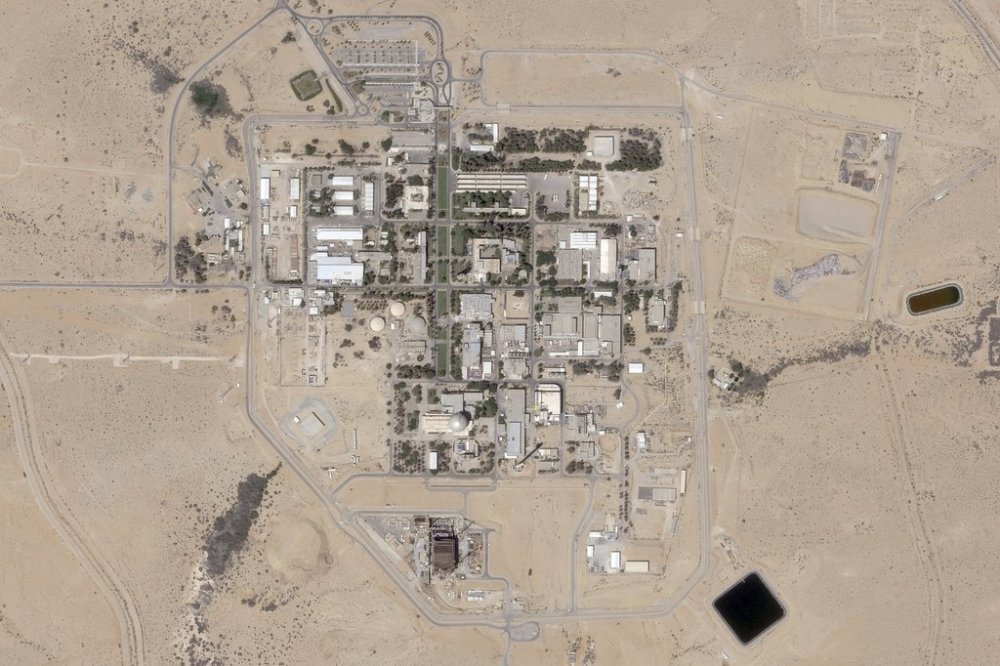
Seven experts who examined the images all said they believed the construction was related to Israel’s long-suspected nuclear weapons program, given its proximity to the reactor at Dimona, where no civilian power plant exists. However, they split on what the new construction could be.
Three said the location and size of the area under construction and the fact that it appeared to have multiple floors meant the most likely explanation for the work was the construction of a new heavy water reactor. Such reactors can produce plutonium and another material key to nuclear weapons.
The other four acknowledged it could be a heavy water reactor but also suggested the work could be related to a new facility for assembling nuclear weapons. They declined to be definitive given the construction was still in an early stage.
“It’s probably a reactor — that judgement is circumstantial but that’s the nature of these things,” said Jeffrey Lewis, an expert at the James Martin Center for Nonproliferation Studies at the Middlebury Institute of International Studies, who based his assessment on the images and Dimona’s history. “It’s very hard to imagine it is anything else.”
Israel does not confirm or deny having atomic weapons, and its government did not respond to requests for comment. The White House, which is Israel’s staunchest ally, also did not respond to requests for comment.
Construction underway for years
The Associated Press first reported on excavations at the facility, some 90 kilometers (55 miles) south of Jerusalem, in 2021. Then, satellite images only showed workers digging a hole some 150 meters (165 yards) long and 60 meters (65 yards) wide near the site’s original heavy water reactor.
Images taken July 5 by Planet Labs PBC show intensified construction at the site of the dig. Thick concrete retaining walls seem to be laid at the site, which appears to have multiple floors underground. Cranes loom overhead.
There’s no containment dome or other features typically associated with a heavy water reactor now visible at the site. However, one could be added later or a reactor could be designed without one.
Dimona’s current heavy water reactor, which came online in the 1960s, has been operating far longer than most reactors of the same era. That suggests it will need to be replaced or retrofitted soon.
“It’s tall, which you would expect, because the reactor core is going to be pretty tall,” Lewis said. “Based on the location, size and general lack of construction there, it’s more likely a reactor than anything.”
Edwin Lyman, a nuclear expert at the Cambridge, Massachusetts-based Union of Concerned Scientists, also said the new construction could be a box-shaped reactor that doesn’t have a visible containment dome, though he acknowledged the lack of transparency made it difficult to be certain.
Israel “doesn’t allow any international inspections or verification of what it’s doing, which forces the public to speculate,” said Lyman.
While details about Dimona remain closely held secrets in Israel, a whistleblower in the 1980s released details and photos of the facility that led experts to conclude that Israel had produced dozens of nuclear warheads.
“If it’s a heavy water reactor, they’re seeking to maintain the capability to produce spent fuel that they then can process to separate plutonium for more nuclear weapons,” said Daryl G. Kimball, the executive director of the Washington-based Arms Control Association. “Or they are building a facility to maintain their arsenal or build additional warheads.”
Israel’s program is thought to rely on byproducts of a heavy water reactor
Israel, like India and Pakistan, is believed to rely on a heavy water reactor to make its nuclear weapons. The reactors can be used for scientific purposes, but plutonium — which causes the nuclear chain reaction needed in an atomic bomb — is a byproduct of the process. Tritium is another byproduct and can be used to boost the explosive yield of warheads.
Given the secrecy of Israel’s program, it remains difficult to estimate just how many nuclear weapons it possesses. The Bulletin of Atomic Scientists in 2022 put the number at around 90 warheads.
Obtaining more tritium to replace decaying material may be the reason for the construction at Dimona, as Lyman noted it decays 5% each year.
“If they’re building a new production reactor,” he said, “it doesn’t necessarily mean they’re looking to expand the plutonium they have, but to manufacture tritium.”
Israel has a policy of nuclear ambiguity
Israel is believed to have begun building the nuclear site in the desert in the late 1950s after facing several wars with its Arab neighbors surrounding its founding in 1948 in the wake of the Holocaust.
Its policy of nuclear ambiguity is thought to have helped deter its enemies.
It is among nine countries confirmed or believed to have atomic weapons and among just four that have never joined the Nuclear Nonproliferation Treaty, a landmark international accord meant to stop the spread of nuclear arms. That means the International Atomic Energy Agency, the United Nations’ nuclear watchdog, has no right to conduct inspections of Dimona.
Asked about the construction, the Vienna-based IAEA reiterated that Israel “is not obligated to provide information about other nuclear facilities in the country” outside of its Soreq research reactor.
___
The Associated Press receives support for nuclear security coverage from the Carnegie Corporation of New York and Outrider Foundation. The AP is solely responsible for all content.
___
Additional AP coverage of the nuclear landscape: https://apnews.com/projects/the-new-nuclear-landscape/