Marsquakes indicate a solid core for the red planet, just like Earth

Advertisement

Advertise with us

CAPE CANAVERAL, Fla. (AP) — Scientists revealed Wednesday that Mars’ innermost core appears to be a solid hunk of metal just like Earth’s.

Read this article for free:


or

Already have an account? Log in here »

To continue reading, please subscribe:

Subscribe and receive a limited-edition Free Press branded hat or tote.

Digital Subscription

One year of digital access for only $205*

  • Enjoy unlimited reading on winnipegfreepress.com
  • Read the E-Edition, our digital replica newspaper
  • Access News Break, our award-winning app
  • Play interactive puzzles

*First annual payment billed as $205.00 + GST for one year. This annual subscription will automatically renew at $233.00 + GST every 52 weeks (10% off the regular annual price of $259.35). Offer available to new and qualified returning subscribers only. Cancel any time.

To continue reading, please subscribe:

Add Free Press access to your Brandon Sun subscription for only an additional

$1 for the first 4 weeks*

  • Enjoy unlimited reading on winnipegfreepress.com
  • Read the E-Edition, our digital replica newspaper
  • Access News Break, our award-winning app
  • Play interactive puzzles
Start now

*Your next Brandon Sun subscription payment will increase by $1.00 and you will be charged $17.95 plus GST for four weeks. After four weeks, your payment will increase to $24.95 plus GST every four weeks.

Hey there, time traveller!
This article was published 03/09/2025 (352 days ago), so information in it may no longer be current.

CAPE CANAVERAL, Fla. (AP) — Scientists revealed Wednesday that Mars’ innermost core appears to be a solid hunk of metal just like Earth’s.

The Chinese-led research team based their findings on seismic readings from NASA’s InSight lander on Mars, which recorded more than 1,300 marsquakes before shutting down in 2022. The spacecraft landed on a broad plain near Mars’ equator in 2018.

Previous studies pointed to liquid at the heart of the red planet. The latest findings indicate the inner core, while small, is indeed solid and surrounded by molten metal — a liquid outer core.
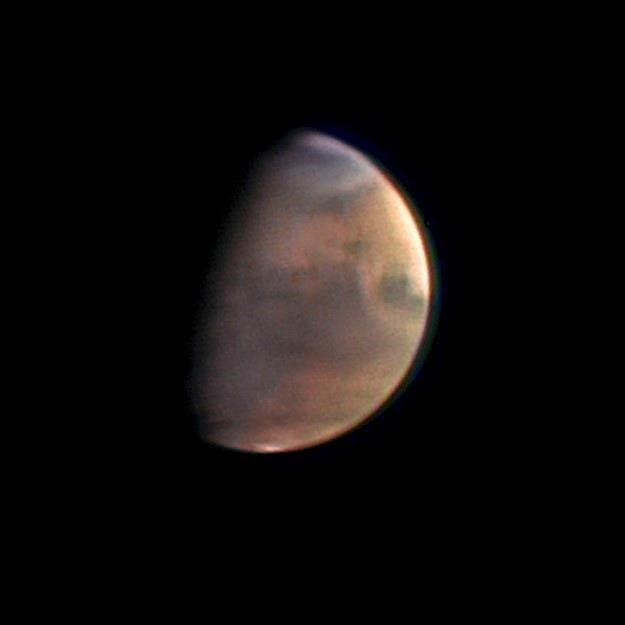
This image provided by the European Space Agency and taken with the ESA's High Resolution Stereo Camera (HRSC) aboard the Mars Express spacecraft shows Mars as the spacecraft approaches the planet from a distance of 5.5 million kilometers.

The Martian inner core extends from the planet’s center out to a radius of approximately 380 miles (613 kilometers), according to the scientists whose findings appeared in the journal Nature.

It’s likely composed of iron and nickel, the same ingredients as Earth’s core, but quite possibly also enriched with lighter elements like oxygen.

Mars’ liquid outer core is bigger, stretching from 380 miles (613 kilometers) to as much as 1,100 miles (1,800 kilometers) from the planet’s center.

Crystallization of Mars’ inner core may have occurred in the past and still be occurring today, one of the lead investigators, Daoyuan Sun of the University of Science and Technology of China, said in an email.

Mars’ core initially would have been entirely liquid. It’s unclear whether the liquid outer core contains any solid material like droplets or whether there might be “a mushy zone” near the boundary between the inner and outer cores, he added.

For their study, Sun and his team relied primarily on 23 marsquakes recorded by InSight, all of them relatively weak. The epicenters were 740 miles to 1,465 miles (1,200 kilometers to 2,360 kilometers) away from the lander.

“Our results suggest that Mars has a solid inner core making up about one-fifth of the planet’s radius — roughly the same proportion as Earth’s inner core. However, this similarity may be just coincidental,” Sun said.

While praising the results, the University of Maryland’s Nicholas Schmerr, who was not involved in the study, said questions regarding Mars’ core are far from settled. With InSight out of action, there will be no new recordings of marsquakes to further reveal the red planet’s insides, he noted.

“There are a lot of details about the exact shape of the inner core and composition of the inner and outer core of Mars that will require a network of InSight like seismometer stations to resolve,” Schmerr said in an email.

More detailed modeling is necessary to develop a clearer picture of how the inner core formed and “what it reveals about the history of Mars’ magnetic field,” said Sun.

At present, Mars lacks a magnetic field, possibly because of the slow crystallization of the planet’s solid core, Schmerr added.

___

The Associated Press Health and Science Department receives support from the Howard Hughes Medical Institute’s Department of Science Education and the Robert Wood Johnson Foundation. The AP is solely responsible for all content.

Report Error Submit a Tip

More Stories

Letters, Aug 21

7 minute read 2:00 AM CDT

911 action essential

The latest revelations about repeated 911 service outages in Manitoba should alarm every Manitoban. When someone dials 911, they should never have to wonder whether their call will actually reach an emergency operator. Lives can depend on those few seconds.

Manitobans need answers — and, more importantly, action.

Bell Canada says its existing systems and contingency plans are designed to protect 911 service, while pointing to the transition to next-generation 911 technology by 2027 as the long-term solution.

Marsquakes indicate a solid core for the red planet, just like Earth

Marcia Dunn, The Associated Press 3 minute read Preview

Marsquakes indicate a solid core for the red planet, just like Earth

Marcia Dunn, The Associated Press 3 minute read Wednesday, Sep. 3, 2025

Previous studies pointed to liquid at the heart of the red planet. But new findings, based on seismic readings from marsquake recordings, indicate Mars' inner core is solid and surrounded by molten metal.

Read
Wednesday, Sep. 3, 2025

Downtown outage caused by construction mishap: Bell MTS

Zoe Pierce 3 minute read Preview

Downtown outage caused by construction mishap: Bell MTS

Zoe Pierce 3 minute read Updated: Yesterday at 4:07 PM CDT

Some customers in downtown Winnipeg are experiencing a Bell MTS service interruption after telecommunications infrastructure was damaged Tuesday.

Bell MTS said on social media that a third-party construction crew accidentally cut a copper cable, causing the outage.

Contractors drilled through multiple underground ducts, causing significant damage to several cables and requiring extensive repairs.

A small number of buildings, mainly concentrated on Fort Street, Garry Street and York Avenue, may be experiencing landline or internet issues because of the damage, said Bell spokesperson Elise von Scheel.

Read
Updated: Yesterday at 4:07 PM CDT

Doctor speaks out, raises alarm over gas plant expansion plans

Rylee Gerrard 4 minute read Preview

Doctor speaks out, raises alarm over gas plant expansion plans

Rylee Gerrard 4 minute read 2:00 AM CDT

BRANDON — A retired doctor is raising red flags on Manitoba Hydro’s proposed gas plant expansion in Brandon and the health-related consequences of climate change.

Dr. Scott Blyth, a former family physician who practised medicine for more than 40 years, said there are health risks associated with long-term exposure to gas.

“A simple answer, the plant should not be built because of the potential health risks,” Blyth said Thursday.

Blyth is a member of the Canadian Association of Physicians for the Environment — a doctor-led organization with 80 members in Manitoba that works on the intersection between health and the environment.

Read
2:00 AM CDT

Man pleads guilty to shotgun slaying

Erik Pindera 5 minute read Preview

Man pleads guilty to shotgun slaying

Erik Pindera 5 minute read Yesterday at 2:01 AM CDT

A Winnipeg drug dealer has pleaded guilty to second-degree murder in a March 2025 killing that saw the body of a 30-year-old man dumped in a garbage bin and dragged to a West End alleyway.

Frederick Francis Mathias Baker, who was 28 upon his arrest early last year, shot Bronson Emery Dale Kequahtooway once in the thigh with a sawed-off shotgun and left him with a fatal wound, Crown prosecutor Matt Armstrong told Court of King’s Bench Justice Brian Bowman on Wednesday.

A split second after Baker shot Kequahtooway in the thigh, the victim was shot in the head with a sawed-off .22 rifle. The man accused of being armed with the rifle, Eric Matthew Morrissette, remains before the court on a second-degree murder charge.

“Either wound would have been fatal on its own,” said Armstrong.

Read
Yesterday at 2:01 AM CDT

Manitoba premier open to lifting U.S. booze ban but hopes Canadians won’t buy it

Ian Bickis, The Canadian Press 3 minute read Preview

Manitoba premier open to lifting U.S. booze ban but hopes Canadians won’t buy it

Ian Bickis, The Canadian Press 3 minute read Updated: Yesterday at 5:13 PM CDT

WINNIPEG - Manitoba's premier says he is reluctantly open to returning U.S. booze to provincial shelves as part of a trade deal, but hopes Canadians won't buy it.

Wab Kinew said Thursday he's still waiting for key details, including what the final tariff rates will be, before making any commitments. 

He said Prime Minister Mark Carney has all but begged the provinces to agree to allow U.S. alcohol sales, as Canada and the United States work to finalize a new trade deal to ward off further punishing tariffs on Canadian goods.

While he hasn't agreed to it yet, Kinew said if the province does agree, he hopes Canadians still buy locally.

Read
Updated: Yesterday at 5:13 PM CDT