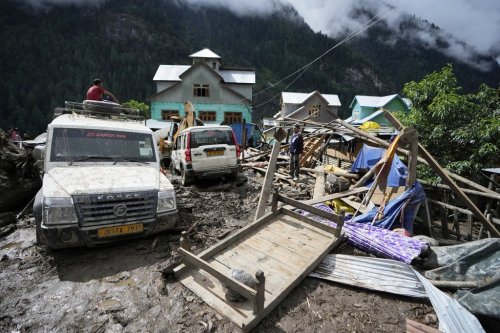
Powerful rain and floods devastate northern India as experts blame climate change
Advertisement
Read this article for free:
or
Already have an account? Log in here »
To continue reading, please subscribe:

Digital Subscription
One year of digital access for only $205*
- Enjoy unlimited reading on winnipegfreepress.com
- Read the E-Edition, our digital replica newspaper
- Access News Break, our award-winning app
- Play interactive puzzles
*First annual payment billed as $205.00 + GST for one year. This annual subscription will automatically renew at $233.00 + GST every 52 weeks (10% off the regular annual price of $259.35). Offer available to new and qualified returning subscribers only. Cancel any time.
To continue reading, please subscribe:
Add Free Press access to your Brandon Sun subscription for only an additional
$1 for the first 4 weeks*
- Enjoy unlimited reading on winnipegfreepress.com
- Read the E-Edition, our digital replica newspaper
- Access News Break, our award-winning app
- Play interactive puzzles
*Your next Brandon Sun subscription payment will increase by $1.00 and you will be charged $17.95 plus GST for four weeks. After four weeks, your payment will increase to $24.95 plus GST every four weeks.
Read unlimited articles for free today:
or
Already have an account? Log in here »
Hey there, time traveller!
This article was published 04/09/2025 (378 days ago), so information in it may no longer be current.
NEW DELHI (AP) — Relentless monsoon rains have unleashed some of the worst flooding and landslides in decades across northern India, killing at least 90 people and displacing hundreds of thousands in recent weeks, government officials said.
India’s Himalayan Mountain states and territories such as Uttarakhand, Himachal Pradesh, Jammu and Kashmir, as well as Punjab state, are among the worst affected. India’s capital city, New Delhi, and nearby regions have been hit by rising rivers and heavy rain. Thousands have been moved to safer ground as city officials said the Yamuna River in the city has breached danger levels.
In Punjab state, which is home to more than 30 million people and one of India’s key agricultural regions, farmers said crops and livestock have been destroyed. State government officials said at least 30 people have died and 300,000 impacted by heavy rains and floods.
Surinder Singh, a farmer in Punjab’s Kapurthala district, said his 10 acres (4 hectares) of farmland has been underwater since Aug. 11 in one of the areas that has been hardest hit by flooding.
“We have lost paddy, maize, and wheat crops worth over 700,000 rupees ($8,400). Children had to be moved to safer villages. The government visits, but we have received little help so far,” he said.
Climate change is likely a key reason for the monsoon’s unpredictability, which has led to the heavy rains in August and these conditions are expected to persist for the next few weeks, according to experts.
The South Asian region, which is among the world’s most densely populated and also among the most vulnerable to climate impacts, will need to better prepare for rain-related disasters as their frequency and intensity increase, experts said.
In neighboring Pakistan, officials said more than 1 million people have been evacuated from flood-prone regions and 2.45 million people have experienced monsoon flooding in recent months.
Indian cities and villages equally affected by rain and floods
Earlier this week, an eight-hour traffic jam paralyzed a highway between New Delhi and the neighboring city, Gurugram, after floodwaters submerged roads. Officials said annual average rainfall levels have already been crossed and residents have moved away from the Yamuna River, which runs through New Delhi.
“We have moved to these tents for now as our homes have been submerged in water. This is just like the 2023 floods,” said Rekha Chaturvedi, 55, of the Nigambodh Ghat area.
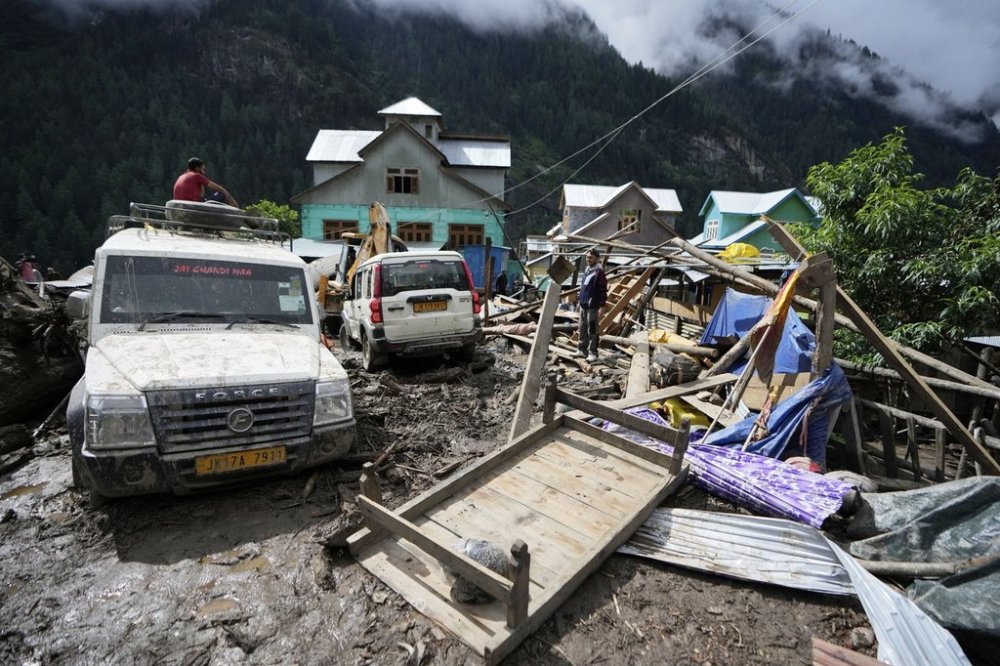
In India’s Himalayan Mountain regions, large-scale destruction has resulted from heavy rains, floods and cloudbursts, which are intense rains occurring over a small area.
Four people were killed and hundreds were left missing after a village in Uttarakhand state was hit by landslides and floods in August. Overflowing glacial lakes in July damaged several hydropower dams and destroyed a key bridge connecting neighboring Nepal to China.
“This is the second time this month our fields have been flooded,” said Fayaz Ahmad, a 70-year-old farmer living on the outskirts of Srinagar in Indian-administered Kashmir. “We saw extreme heat this year, and now water keeps entering our homes and farms after just a few days of rain. Something has changed. It was never like this in my youth.”
Climate change likely strengthening rains
Experts say human-caused climate change is intensifying South Asia’s monsoons, which traditionally run from June to September and again from October to December. The rains, once predictable, now arrive in erratic bursts that dump extreme amounts of water in short periods, followed by dry spells.
“We are living in a warmer world, nearly 1.5 degrees hotter than pre-industrial times,” said Anjal Prakash, author of several United Nations climate reports and professor at Hyderabad-based Indian School of Business. “The intensity and frequency of such extreme rainfall events will only increase. This is the new normal.”
Rapid urbanization, deforestation, and poorly planned infrastructure have worsened flooding, Prakash said.
“Natural drainage systems have been destroyed. Rivers are mismanaged. When intense rainfall coincides with such vulnerabilities, disasters like these become inevitable,” Prakash said.
Akshay Deoras, a meteorologist at the University of Reading, United Kingdom, said rainfall extremes can occur because of local weather conditions or large-scale weather conditions, but climate change is just intensifying them.
“If the rainfall is uniformly distributed, you will not get that much of an impact,” said Deoras, who has tracked Indian weather systems for more than a decade. “But if that rainfall happens, let’s say in a couple of hours or even, for example, the entire month’s rainfall happens in a few days, that is just going to create problems. And that’s exactly what we are seeing.”
Climate experts said smart planning and rebuilding in climate-vulnerable regions must include accounting for multiple risks, installing early warning systems, preparing local communities for disasters and, when needed, relocating infrastructure.
In 2024 alone, there were 167 disasters in Asia, which was the most of any continent, according to the Emergency Events Database maintained by the University of Louvain, Belgium. The storms, floods, heat waves and earthquakes led to losses of over $32 billion, the researchers found.
Countries need to do more to plan for such events in the future, as their frequency will only increase, Deoras said.
“Right now, in India, there is no clear vision as to how things could be handled in the future,” he said.
___
Arasu reported from Bengaluru, India. Dar Yasin in Srinagar, India-administered Kashmir, contributed to this report.
___
Follow Sibi Arasu on X at @sibi123.
___
The Associated Press’ climate and environmental coverage receives financial support from multiple private foundations. AP is solely responsible for all content. Find AP’s standards for working with philanthropies, a list of supporters and funded coverage areas at AP.org.
Related Articles
Death toll from Afghan earthquake jumps to more than 2,200 as aid agencies plead for funds
Advertisement Advertise With Us
Advertisement Advertise With Us