Afro-descendants in Bolivia fight invisibility with dance and memory
Advertisement
Read this article for free:
or
Already have an account? Log in here »
To continue reading, please subscribe:

Digital Subscription
One year of digital access for only $205*
- Enjoy unlimited reading on winnipegfreepress.com
- Read the E-Edition, our digital replica newspaper
- Access News Break, our award-winning app
- Play interactive puzzles
*First annual payment billed as $205.00 + GST for one year. This annual subscription will automatically renew at $233.00 + GST every 52 weeks (10% off the regular annual price of $259.35). Offer available to new and qualified returning subscribers only. Cancel any time.
To continue reading, please subscribe:
Add Free Press access to your Brandon Sun subscription for only an additional
$1 for the first 4 weeks*
- Enjoy unlimited reading on winnipegfreepress.com
- Read the E-Edition, our digital replica newspaper
- Access News Break, our award-winning app
- Play interactive puzzles
*Your next Brandon Sun subscription payment will increase by $1.00 and you will be charged $17.95 plus GST for four weeks. After four weeks, your payment will increase to $24.95 plus GST every four weeks.
Read unlimited articles for free today:
or
Already have an account? Log in here »
Hey there, time traveller!
This article was published 21/09/2025 (384 days ago), so information in it may no longer be current.
YUNGAS, Bolivia (AP) — Cielo Torres had always lived in Bolivia. Yet before moving at age 17 to the remote town of Tocaña — where much of the country’s Afro-descendant community lives — she had rarely encountered people who looked like her.
“Back in Santa Cruz, we were the only Afro,” said Torres, now 25. “But when I saw others like me, I told myself: This is where I want to be. Here I feel comfortable and understood.”
Her sense of belonging echoes the experience of many Afro-Bolivians. Although officially recognized in the constitution since 2009, they remain one of Bolivia’s least visible groups, struggling to feel at home in their own land.
“Many think that we are foreigners and we don’t have any rights,” said Carmen Angola, executive director of the Afro-Bolivian National Council (CONAFRO). “But we were born here.”
More than 11.3 million people live in Bolivia. Around 23,000 identified as Afro in a 2012 census, the first and only time they appeared as a distinct category. Most live in Yungas, a region where roads and communications are scarce but coca leaf plantations abound.
“Our Afro communities depend on coca harvesting or honey production,” said Torres, who runs a beekeeping business with her husband.
“We are people used to walking trails instead of paved roads,” she added. “People who learn from the land.”
Symbolic gestures, scarce change
Official information on the community’s history is hard to come by. “We have been made invisible by the state,” said activist Mónica Rey. “There weren’t any written registers reflecting our reality. We wrote that history down ourselves.”
She said some progress was made in 2007, a year after Evo Morales became Bolivia’s first Indigenous president. “By 2009 we were included in the constitution,” she added. “But we have demanded our inclusion and rights to all the past governments.”
Morales supported CONAFRO’s founding in 2011. That same year, Sept. 23 was established as the National Day of the Afro-Bolivian People and Culture. Still, according to Rey, symbolic recognition is not enough to achieve structural change.
“The idea was that this day would serve to reaffirm our identity and that the state would create public policies for the Afro people,” Rey said. “But it turns out we celebrate among ourselves and the government doesn’t do anything.”
She and Carmen Angola contend that promoting their people’s legacy has proven difficult. Angola has tried to convince local authorities to allow a group of Afro-Bolivians to visit schools and share insights of their community. None have agreed so far.
“They just say they’re going to address discrimination, history and racism,” Angola said. “But the people who created the curricula aren’t Black. Their history is not ours.”
From the mines to the ‘haciendas’
CONAFRO joined efforts with another organization to gather testimonies documenting the Afro-Bolivian community’s long-lost past. A comprehensive document was released in 2013.
“We got our history back,” Rey said. “Our experiences, our elders’ tales, our culture, have been retrieved and documented.”
The Afro-Bolivian people descend from the Africans enslaved in the Americas during the European conquest between the 16th and 17th centuries.
Mostly born in Congo and Angola, they were initially taken to Potosí, a colonial mining city located about 340 miles (550 kilometers) southeast of La Paz.
The high altitude — 13,700 feet (4,175 meters) above sea level — and the extreme weather quickly took a toll. Later on, exposure to mercury and other substances in mining led to severe illnesses — from tooth loss, respiratory disease and death.
Two centuries later, the ancestors of the current Afro-Bolivian population were forcibly relocated to Yungas. There they settled and started working in large estates known as ‘haciendas,’ where coca leaf, coffee and sugar cane were grown.
“The Afro people were dying and that was inconvenient because they were considered investments,” said sociologist Óscar Mattaz. “So people started buying them and taking them away.”
Now Tocaña and neighboring towns are considered the cultural heart of Afro-Bolivians.
A king with no crown
In Mururata lives Julio Pinedo, a symbolic leader regarded as the king of the Afro-Bolivians.
Bolivia’s Black community has recognized kings for centuries. Pinedo’s role carries no political weight within the government, but he is considered a guardian of his people’s rights. Local authorities acknowledge his title and even attended his coronation in 1992.
“The king was a symbolic means to show there’s royalty in the community,” Mattaz said. “He was very influential, worked hard and was respected.”
His position hardly made a difference in his lifestyle. Pinedo, now 83, resides in the same humble home he has always lived. He now relies on his son’s coca harvest for income.
Pinedo welcomes visitors. But engaging in conversation is hard due to his age. According to his wife, Angélica Larrea, his royal ancestry dates back 500 years.
“I remember his coronation,” she said. “People came from other communities. They danced and there was a procession. A priest came and we celebrated Mass.”
A handful of Afro-Bolivians have tried to decipher what their ancestors’ spirituality was. Yet the community remains overwhelmingly Catholic.
Close to Pinedo’s home, the sole parish of Mururata has no resident priest. Nonetheless, a group of devoted women are welcomed to read the Bible each Sunday.
Isabel Rey — a distant relative of Mónica — said her ancestors were Catholics. And even without a priest to rely on, the catechist in charge of the church has kept the community’s faith strong.
“She will soon celebrate 40 years sharing the Lord’s word,” Rey said. “I help her, because she can’t keep up the work alone.”
A dance of struggle and love
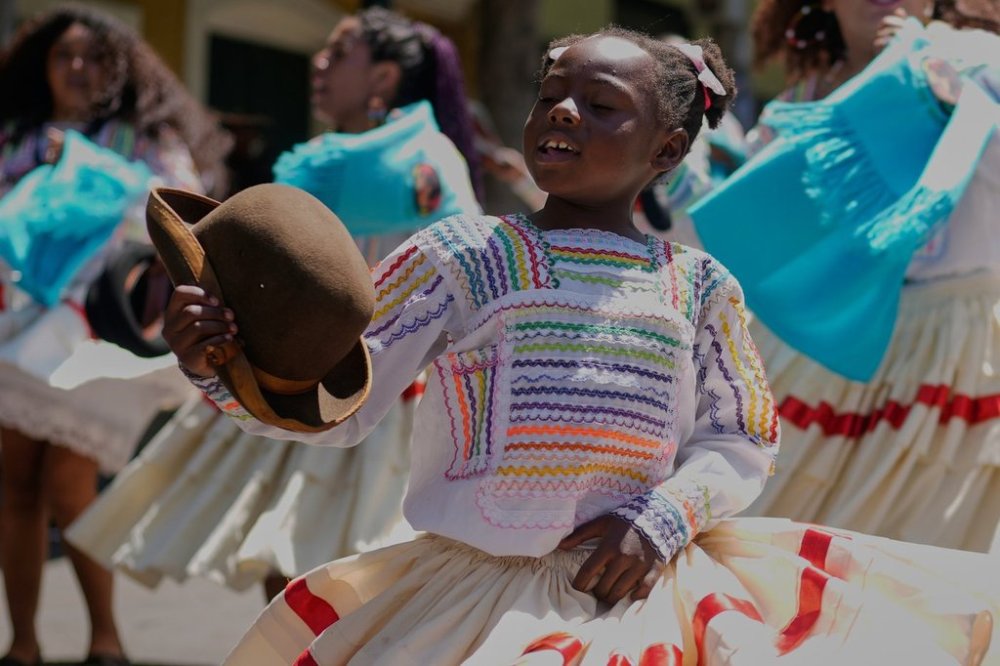
There might not be an Afro-Bolivian spirituality, but the community’s soul remains bonded through the “saya,” a traditional dance performed with drums and chants.
“Our demands were born through this music,” Rey said. “The saya has become our instrument to gain visibility. We protest with drums and songs.”
Torres recalled dancing saya before moving to Tocaña. Yet her feelings while performing it changed.
“Here it’s danced from the heart,” she said. “I learned how to sing and listen. It’s no ordinary music because we tell our history through it.”
She said each detail in their garments bears meaning. The white symbolizes peace and the red honors the blood shed by their ancestors. Men wear black hats to remember how their predecessors worked endlessly under the sun. And the women’s braids depict the roads they dreamed of to escape.
“It may seem like fashion, but it’s not,” Torres said. “It’s our culture.”
For more than a decade now, she has learned new moves and saya songs. She became fluent in her community’s language — a variation of Spanish that is not officially recognized — and is proud of her identity.

“I used to feel embarrassed for dancing saya,” Torres said. “But when I saw people dancing here, I told myself: ‘This is what I am. I am Black.’”
Committed to raising her daughter to also be proud of her ancestry, she constantly praises her skin color, hair and moves.
“She already dances saya,” Torres said. “I tell her: ‘You are Black. My Black little girl.’”
____
Associated Press religion coverage receives support through the AP’s collaboration with The Conversation US, with funding from Lilly Endowment Inc. The AP is solely responsible for this content.
The Free Press acknowledges the financial support it receives from members of the city’s faith community, which makes our coverage of religion possible.