Fears of massive battery fires spark local opposition to energy storage projects
Advertisement
Read this article for free:
or
Already have an account? Log in here »
To continue reading, please subscribe:

Digital Subscription
One year of digital access for only $205*
- Enjoy unlimited reading on winnipegfreepress.com
- Read the E-Edition, our digital replica newspaper
- Access News Break, our award-winning app
- Play interactive puzzles
*First annual payment billed as $205.00 + GST for one year. This annual subscription will automatically renew at $233.00 + GST every 52 weeks (10% off the regular annual price of $259.35). Offer available to new and qualified returning subscribers only. Cancel any time.
To continue reading, please subscribe:
Add Free Press access to your Brandon Sun subscription for only an additional
$1 for the first 4 weeks*
- Enjoy unlimited reading on winnipegfreepress.com
- Read the E-Edition, our digital replica newspaper
- Access News Break, our award-winning app
- Play interactive puzzles
*Your next Brandon Sun subscription payment will increase by $1.00 and you will be charged $17.95 plus GST for four weeks. After four weeks, your payment will increase to $24.95 plus GST every four weeks.
Read unlimited articles for free today:
or
Already have an account? Log in here »
Hey there, time traveller!
This article was published 04/10/2025 (372 days ago), so information in it may no longer be current.
More and more, big arrays of lithium-ion batteries are being hooked up to electrical grids around the U.S. to store power that can be discharged in times of high demand.
But as more energy storage is added, residents in some places are pushing back due to fears that the systems will go up in flames, as a massive facility in California did earlier this year.
Proponents maintain that state-of-the-art battery energy storage systems are safe, but more localities are enacting moratoriums.
“We’re not guinea pigs for anybody … we are not going to experiment, we’re not going to take risk,” said Michael McGinty, the mayor of Island Park, New York, which passed a moratorium in July after a storage system was proposed near the village line.
At least a few dozen localities around the United States have moved to temporarily block development of big battery systems in recent years.
Long Island, where the power grid could get a boost in the next few years as offshore wind farms come online, has been a hotbed of activism, even drawing attention recently from the Trump administration. Opponents there got a boost in August when Environmental Protection Agency Administrator Lee Zeldin visited New York to complain that the state was rushing approvals of sites in order to meet “delusional” green power goals — a claim state officials deny.
Battery growth spurt
Battery energy storage systems that suck up cheap power during periods of low demand, then discharge it at a profit during periods of high demand, are considered critical with the rise of intermittent energy sources such as wind and solar.
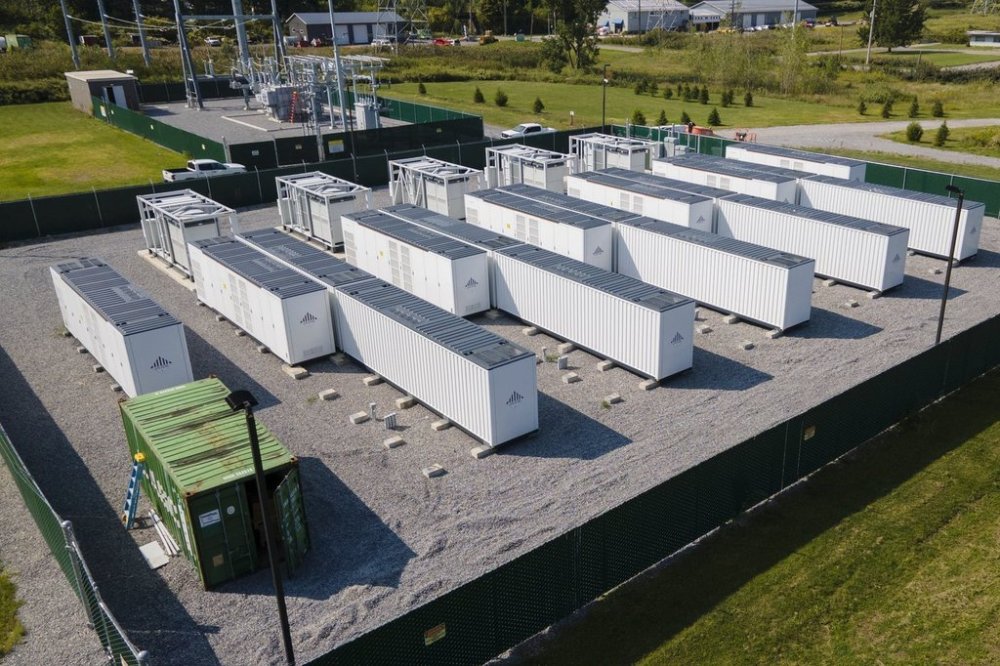
Known by the acronym BESS, the systems can make grids more reliable and have been credited with reducing blackouts. A large battery system might consist of rows of shipping containers in a fenced lot, with the containers holding hundreds of thousands of cells.
China and the United States lead the world in rapidly adding battery storage energy systems. However, Saudi Arabia, South Africa, Australia, Netherlands, Chile, Canada and the U.K. have commissioned or started construction on large projects since 2024, too, according to research from BloombergNEF.
In the U.S., California and Texas have been leaders in battery storage. But other states are moving quickly, often with privately developed systems. While the Trump administration has been unsupportive or even hostile to renewable energy, key tax credits for energy storage projects were maintained in the recently approved federal budget for qualified projects that begin construction in the next eight years.
Developers added 4,908 megawatts of battery storage capacity in the second quarter of 2025, with Arizona, California and Texas accounting for about three-quarters of that new capacity, according to a report from American Clean Power Association, an industry group. That’s enough to power nearly 1.7 million households.
New York has an ambitious goal to add 6,000 megawatts of energy storage by 2030, half of it large-scale systems.
Lithium-ion fire worries
Opposition to the storage systems usually focuses on the possibility of thermal runaway, a chain reaction of uncontrolled heating that can lead to fire or an explosion. Opponents point to past fires and ask: What if that happens in my neighborhood?
A battery storage system in Moss Landing, California caught fire in January, sending plumes of toxic smoke into the atmosphere and forcing the evacuation of about 1,500 people..
Experts in the field say battery systems have become safer over the years. Ofodike Ezekoye, a combustion expert and professor of mechanical engineering at The University of Texas at Austin, notes that failures are relatively infrequent, but also that no engineered system is 100% foolproof.
“This is a relatively immature technology that is maturing quickly, so I think that there are a lot of really thoughtful researchers and other stakeholders who are trying to improve the overall safety of these systems,” Ezekoye said.
Battery storage proponents say a facility like Moss Landing, where batteries were stored indoors, would not be allowed in New York, which has adopted fire codes that require modular enclosure design with required minimum spacing to keep fires from spreading.
Blocking battery systems
People who live near proposed sites are not always assured.
In Washington state, the city of Maple Valley approved a six-month moratorium in July as a way “to protect us until we know more,” said city manager Laura Philpot.
Voters in Halstead, Kansas, which has a moratorium, will be asked this Election Day whether they want to prohibit larger battery storage systems inside the city limits, according to Mayor Dennis Travis. He hopes the city can one day host a safely designed storage system, and said local opponents wrongly fixate on the California fire.
The number of localities passing moratoriums began rising in 2023 and 2024, mirroring trends in battery storage deployment, with a notable cluster in New York, according to a presentation last year by the Pacific Northwest National Laboratory.
Winnie Sokolowski is among area residents against a proposed 250-megawatt lithium-ion storage system in the Town of Ulster, New York, contending it is too close to schools and homes.
“They’re banking on nothing happening, but I don’t think you can place it where they’re proposing and assume nothing’s going to happen,” Sokolowski said. “It’s just too risky if it does.”
The developer, Terra-Gen, said the design will keep a fire from spreading and that the system “poses no credible, scientific-based threat to neighbors, the public or the environment.”
New York State Energy Research and Development Authority President Doreen Harris said she’s confident the state has the right safety rules in place, and that scaling up the use of battery storage systems will “strengthen and modernize our grid.”
She noted there also were local concerns in the early stages of siting solar farms, which have since proven their benefits.
___
Associated Press writer Jennifer McDermott in Providence, Rhode Island, contributed to this report.