Canada’s first non-beating heart transplant could lead to shorter wait lists: UHN

Advertisement

Advertise with us

TORONTO - A Toronto hospital says it transplanted a heart that stopped beating last month in a Canadian first that has the potential to substantially shorten the long wait for a donor.

Read this article for free:


or

Already have an account? Log in here »

To continue reading, please subscribe:

Subscribe and receive a limited-edition Free Press branded hat or tote.

Digital Subscription

One year of digital access for only $205*

  • Enjoy unlimited reading on winnipegfreepress.com
  • Read the E-Edition, our digital replica newspaper
  • Access News Break, our award-winning app
  • Play interactive puzzles

*First annual payment billed as $205.00 + GST for one year. This annual subscription will automatically renew at $233.00 + GST every 52 weeks (10% off the regular annual price of $259.35). Offer available to new and qualified returning subscribers only. Cancel any time.

To continue reading, please subscribe:

Add Free Press access to your Brandon Sun subscription for only an additional

$1 for the first 4 weeks*

  • Enjoy unlimited reading on winnipegfreepress.com
  • Read the E-Edition, our digital replica newspaper
  • Access News Break, our award-winning app
  • Play interactive puzzles
Start now

*Your next Brandon Sun subscription payment will increase by $1.00 and you will be charged $17.95 plus GST for four weeks. After four weeks, your payment will increase to $24.95 plus GST every four weeks.

Hey there, time traveller!
This article was published 11/10/2025 (351 days ago), so information in it may no longer be current.

TORONTO – A Toronto hospital says it transplanted a heart that stopped beating last month in a Canadian first that has the potential to substantially shorten the long wait for a donor.

University Health Network says the procedure could grow the national donor pool by 30 per cent if the practice is expanded across the country.

That’s the case in some parts of Europe and Australia, where the practice was adopted a decade ago.
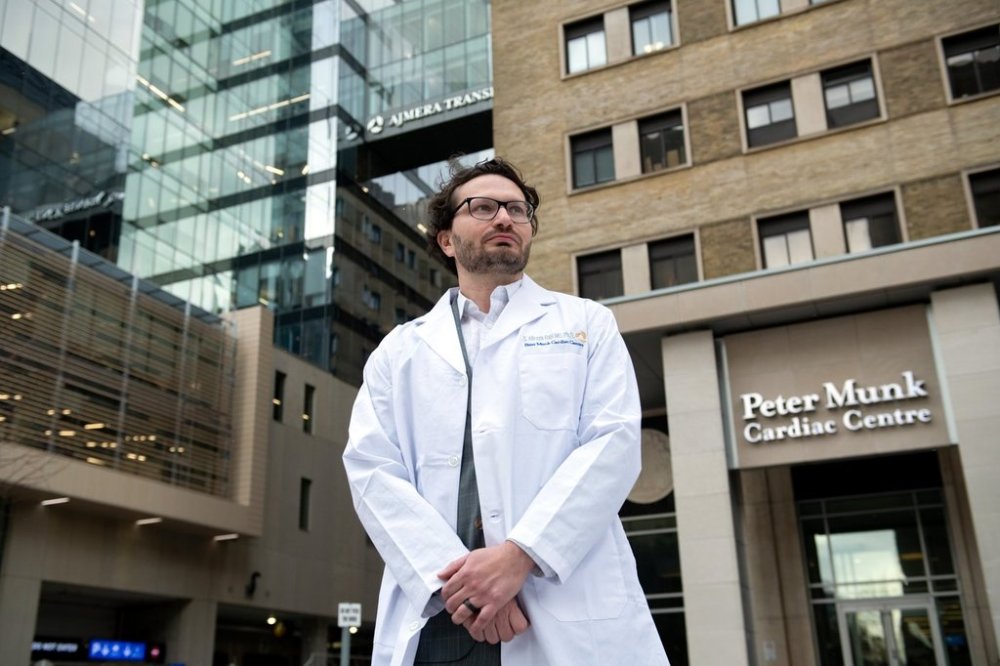
Dr. Seyed Alireza Rabi, shown in this undated handout photo, led a multidisciplinary team at University Health Network, in Toronto, that performed the first Canadian death by circulatory criteria (DCC) heart transplant in September 2025. THE CANADIAN PRESS/Handout - UHN Foundation (Mandatory Credit)

Dr. Seyed Alireza Rabi led the September surgery in Toronto after having been part of one of the first transplants with a non-beating heart in the United States in 2019.

He was recruited from Massachusetts General Hospital, where he performed heart transplants of this nature upward of 50 times, but Rabi said he still finds it a miracle every time a donor’s heart starts beating inside another person.

Here’s how it works:

Typically, heart transplants are performed when a donor is considered brain dead but their heart is still beating. The surgeon removes the donor heart, cools it and puts it in a special preservative solution. It can be out of the body for about four hours if it’s on ice, and even longer with temperature-controlling technology.

The process is similar with the transplant performed at UHN last month – called a donation after death by circulatory criteria (DCC) heart transplant – but the donor’s condition is different.

The patient has basic brain function, such as very limited reflexes, but there is no prospect of neurological recovery. If the family decides to take their loved one off of life support, they would be considered a candidate, only approached by a transplant team after that decision has been made so as not to influence it.

Once the donor dies, Rabi said his team has one hour to transfer the heart from donor to recipient. Beyond that hour, it would no longer be considered viable.

His surgical team quickly wheels the donor into the operating room, cuts open their chest and removes their heart. They flush it in a protective solution and control the organ’s temperature. During that window, the heart is still warm, even though it’s no longer receiving oxygen or nutrients from the body.

Rabi then shifts to the other side of the operating room and attaches the donor heart to a lung and heart machine that’s already connected to the recipient. Blood and oxygen flow into the heart and it starts beating, even before it’s sewn into the body.

But before that happens, Rabi said there is a brief period of nerve-racking uncertainty as he waits for the heart to wake up in a new body.

“Here is a heart that you’re taking out of a person. It stops beating, it’s cold, it’s at four to 10 degrees Celsius. You’re bringing it back, you’re putting it in, sewing it into a new person. It’s exposed to a whole new environment, a new blood flow. And now, you’re hoping that it will start beating again, and not just beating, but beating to a point where it can support another person,” Rabi said.

The hospital said the recipient in this case is recovering well.

Here’s why it’s needed:

UHN’s surgeon-in-chief Dr. Thomas Forbes said there are currently more than 175 people on the wait list for heart transplants in Canada.

“What this innovation provides is basically an increase in the number of hearts that are available for donation … unfortunately, there is a shortage of organs to save these patients with end-stage heart failure.”

Quebec researchers found the average wait time for a heart transplant in the province was 342 days in 2022, and as many as one in four adults on the waiting list in Canada either die or become ineligible because their health deteriorates.

Data from the Canadian Institute for Health Information shows 13 people died while waiting for a heart transplant in 2024.

Over the next year, Forbes said UHN is hoping to perform 10 to 15 additional heart transplants with this method.

“We want to monitor, obviously very closely, the outcomes and the benefit for the patients, the importance of appropriate patient selection, both on the donor and the recipient side. And I think year over year there will be slow growth.”

This report by The Canadian Press was first published Oct. 11, 2025.

Canadian Press health coverage receives support through a partnership with the Canadian Medical Association. CP is solely responsible for this content.


Report Error Submit a Tip

More Stories

Jets’ brass warming up to El Nino?

Mike McIntyre 7 minute read Preview

Jets’ brass warming up to El Nino?

Mike McIntyre 7 minute read Friday, Sep. 25, 2026

Decisions, decisions.

The Winnipeg Jets held their final dress rehearsal Friday night before the curtain rises next week on the new NHL season.

Unlike their first three exhibitions, this one in Denver featured competitive lineups that looked an awful lot like what we’ll see when the games start counting, with plenty of star power and veteran presence on both sides.

So what are we to make of the Jets’ 5-2 loss to the mighty Colorado Avalanche, who captured the Presidents’ Trophy last year and are once again a legitimate Stanley Cup contender?

Read
Friday, Sep. 25, 2026

‘In Normandy, we remember’

Aaron Epp 4 minute read Preview

‘In Normandy, we remember’

Aaron Epp 4 minute read Yesterday at 6:23 PM CDT

Travelling nearly 7,000 km from his home in France to Winnipeg gave Gabriel Zaranski a new perspective on warfare.

“It’s very different to speak about war in school (than) to speak with real people who (have fought) in a war,” he said. “We can feel the emotion when they speak … The testimony has more impact when it’s real soldiers.”

Zaranski is one of 14 Grade 12 students from Bayeux, a town in France’s Normandy region, in Winnipeg this week for a learning tour.

The students, who attend Lycée Arcisse de Caumont high school, met on Saturday with veterans from the Queen’s Own Cameron Highlanders of Canada, a local military regiment, to discuss their studies and the regiment’s role in the Second World War.

Read
Yesterday at 6:23 PM CDT

Special teams woes hurt Bombers in loss to Argos

Ken Wiebe 7 minute read Preview

Special teams woes hurt Bombers in loss to Argos

Ken Wiebe 7 minute read Yesterday at 8:06 PM CDT

They’ve been the most consistent of the three phases in the Winnipeg Blue Bombers arsenal this season.

A port in the proverbial storm, throughout this topsy-turvy campaign of ups-and-downs, the special-teams units have been supplying strength to a group that is still searching for consistency with only four games left in the regular season.

That’s what made this momentary lapse so costly in a 30-28 loss to the Toronto Argonauts on Friday at Princess Auto Stadium.

“We didn’t keep up our end of the bargain. And that hurts our football team, hurts our chances of winning games,” said Blue Bombers special teams ace Tanner Cadwallader. “And if we want to win close games. we’ve got to be a whole lot better than that. And we will. We’re going to come in (on Saturday for the film session) and go through it with a fine-tooth comb and just work a little bit harder.”

Read
Yesterday at 8:06 PM CDT

Flammable gas culprit of 2024 Transcona home explosion: police

Malak Abas 2 minute read Preview

Flammable gas culprit of 2024 Transcona home explosion: police

Malak Abas 2 minute read Friday, Sep. 25, 2026

Flammable gas is believed to be the cause of a 2024 house explosion in Transcona that damaged neighbouring homes and displaced residents.

“As a result of the investigation and upon Crown review, the explosion is believed to be an isolated incident,” Winnipeg Police Service Const. Dani McKinnon said in an email Friday afternoon.

“There are no public safety concerns connected to this incident, and no criminal charges have been laid.”

The sudden blast happened in a bungalow on Camrose Bay on June 26, 2024. It levelled the home and caused significant damage to 22 other houses. At the time, it was described as “catastrophic” by the fire chief at the scene.

Read
Friday, Sep. 25, 2026

Husband of rival sex club owner accused in attempted bathhouse bombing

Morgan Modjeski 4 minute read Preview

Husband of rival sex club owner accused in attempted bathhouse bombing

Morgan Modjeski 4 minute read Thursday, Sep. 24, 2026

A Winnipeg bathhouse owner says he was shocked to learn the man accused of planting a pipe bomb outside his business is married to the owner of a competing sex and lifestyle club.

Christopher Gregoire, who recently took ownership of AQ Sauna, said a live pipe bomb was found by a “heroic patron” outside the club, formerly known as Aquarius Bath House, in the early morning hours of Sept. 11.

On Thursday, the Winnipeg Police Service announced Erik Lymen Olson, 59, was facing multiple charges in the incident. Olson is the husband of Adonis Men’s Spa owner Doug Pomanski.

“This is wild,” Gregoire said after learning of the charges.

Read
Thursday, Sep. 24, 2026

Blue Bombers whiff on their opportunities to put game away

Taylor Allen 7 minute read Preview

Blue Bombers whiff on their opportunities to put game away

Taylor Allen 7 minute read Friday, Sep. 25, 2026

In theory, Bryce Perkins has a simple job.

When it’s third and short, the Winnipeg Blue Bombers trot out the short-yardage quarterback, and all he has to do is plunge forward for a yard or two to make everyone on his sideline happy.

But on Friday night against the visiting Toronto Argonauts, he went above and beyond his job description.

The Bombers, down 24-21 with six minutes left, faced a third-and-one from their own end when Perkins found a hole and burst through it for a 76-yard touchdown to put the home team in front 28-24 late.

Read
Friday, Sep. 25, 2026