Industrial carbon price a focus Carney’s climate strategy consultations: sources

Advertisement

Advertise with us

OTTAWA - Environment advocates say the federal government's consultations ahead of the release of its climate competitiveness strategy next week have focused in part on making industrial carbon pricing a cornerstone of the new plan.

Read this article for free:


or

Already have an account? Log in here »

To continue reading, please subscribe:

Subscribe and receive a limited-edition Free Press branded hat or tote.

Digital Subscription

One year of digital access for only $205*

  • Enjoy unlimited reading on winnipegfreepress.com
  • Read the E-Edition, our digital replica newspaper
  • Access News Break, our award-winning app
  • Play interactive puzzles

*First annual payment billed as $205.00 + GST for one year. This annual subscription will automatically renew at $233.00 + GST every 52 weeks (10% off the regular annual price of $259.35). Offer available to new and qualified returning subscribers only. Cancel any time.

To continue reading, please subscribe:

Add Free Press access to your Brandon Sun subscription for only an additional

$1 for the first 4 weeks*

  • Enjoy unlimited reading on winnipegfreepress.com
  • Read the E-Edition, our digital replica newspaper
  • Access News Break, our award-winning app
  • Play interactive puzzles
Start now

*Your next Brandon Sun subscription payment will increase by $1.00 and you will be charged $17.95 plus GST for four weeks. After four weeks, your payment will increase to $24.95 plus GST every four weeks.

Hey there, time traveller!
This article was published 28/10/2025 (349 days ago), so information in it may no longer be current.

OTTAWA – Environment advocates say the federal government’s consultations ahead of the release of its climate competitiveness strategy next week have focused in part on making industrial carbon pricing a cornerstone of the new plan.

Two senior officials at national environmental advocacy groups who met with the federal ministers developing the plan in recent weeks say the emphasis on industrial carbon pricing in their discussions — and Prime Minister Mark Carney’s commitment to it during the election — makes them confident the government is planning major changes to the policy.

They asked not to be named due to the private nature of the meetings with the government. Both told The Canadian Press Carney has given the strategy a great deal of personal attention.
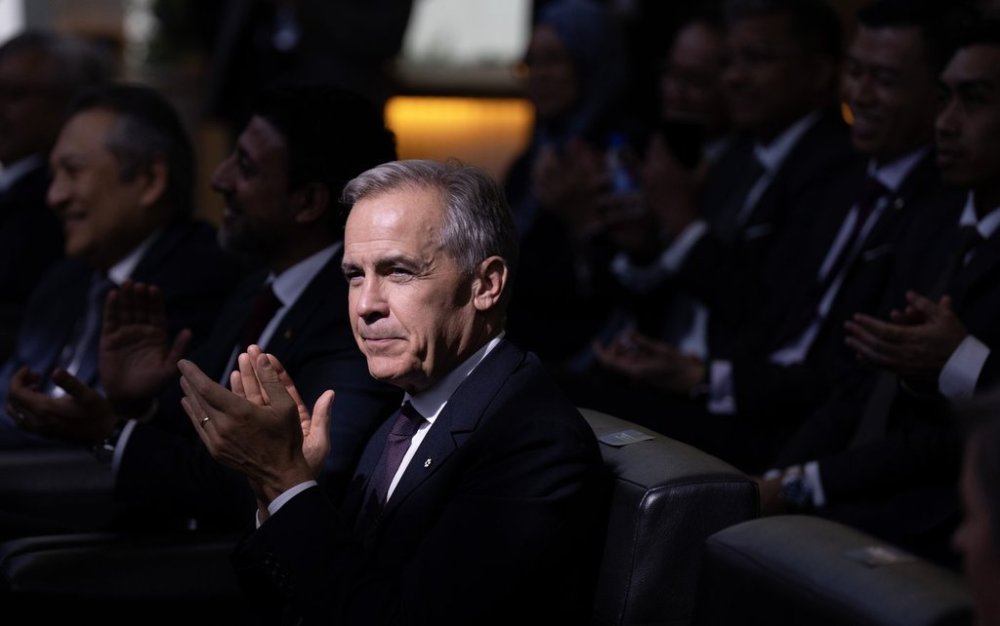
Prime Minister Mark Carney as he watches a signing ceremony at the CAE training facility in Kuala Lumpur, Monday, Oct. 27, 2025. THE CANADIAN PRESS/Adrian Wyld

The prime minister has promised a climate competitiveness strategy for weeks. In a speech on Oct. 22, he said the policy will be part of the federal budget on Nov. 4.

Speaking to The Canadian Press on Tuesday, Environment Minister Julie Dabrusin declined to share details of the climate competitiveness strategy since it’s in the federal budget.

Dabrusin did say her consultations with environmental groups and industry leaders have highlighted the importance of an industrial carbon policy that gives investors certainty while driving down emissions.

“At a high level, I can say that industrial carbon pricing is an important part of how do we fight climate change, and at the same time how do we build a future economy,” she said.

The climate competitiveness strategy is expected to mark a shift in Canada’s approach to climate policy.

Carney has said his approach prioritizes results over emissions targets and places an emphasis on the economy. He and his ministers have dodged questions recently on whether the government is still committed to its emission reduction targets.

Several recent reports have said Canada is nowhere near being on track to meet its 2030 goal under the Paris climate pact, which commits Canada to cutting emissions to at least 40 per cent below 2005 levels. That goal is not legally binding.

During the Liberal leadership race, Carney campaigned on a promise to eliminate the consumer carbon price while strengthening and expanding the levy paid by big industrial emitters like oilsands producers, fossil fuel power generators and manufacturing plants.

His first official act as prime minister in March was to end the consumer levy. He has yet to do anything with the industrial price.

The federal government introduced the two streams six years ago, with consumers and smaller businesses and non-profits paying the per tonne cost on all fossil fuel purchases, and big emitters paying it on a portion of their actual emissions.

A report from the Canadian Climate Institute in 2024 found consumer carbon pricing had a much smaller impact on emissions than the price applied to big industrial emitters. The pricing system for industry accounted for about 80 per cent of total emissions cuts from carbon pricing overall.

One of the sources who spoke to The Canadian Press said the government is concerned about the public’s perception of industrial carbon pricing in a new climate strategy, given the lack of public support for the consumer carbon price.

Dabrusin wouldn’t say whether she’s worried about how Canadians perceive industrial carbon pricing.

“Canadians see that climate change and the extreme weather events are impacting their communities in real time right now,” she said.

“So I think that my job is how do I actually build a path forward that’s unifying for Canadians. And that’s what they want to see. So I’m actually hopeful.”

The other source said it’s hard to imagine the government moving forward with a strategy to sell energy to countries with carbon pricing policies without taking meaningful action on its industrial price policy. Carney has said he wants to double the amount of non-U.S. exports over the next decade.

Most provinces and territories have their own industrial carbon pricing systems, which need federal approval based on Ottawa’s standard. If a province or territory doesn’t meet Ottawa’s minimum system requirements, the federal government can impose its system instead.

Both Alberta and Saskatchewan have challenged the federal government on the issue.

Alberta proposed changes to its industrial carbon pricing program last month that would allow companies to avoid paying provincial fees for emissions by investing in their own emissions reduction projects instead.

It also proposed allowing smaller companies that don’t meet the program’s minimum emissions threshold to opt out of the carbon pricing system for 2025.

Saskatchewan paused its industrial carbon price program altogether on April 1. The federal government hasn’t indicated it plans on triggering the federal backstop on either province.

Alberta Premier Danielle Smith said three weeks ago she was open to adjusting aspects of Alberta’s industrial carbon pricing program as the province talks to Ottawa about building a new pipeline to the B.C. coast.

Pressed on whether Ottawa has held back on triggering the federal backstop on either province because changes to the government’s own policy are coming, Dabrusin would only say the government talking with all provinces.

“What we’re doing is having lots of active conversations with all of the provinces on how do we get to where we need to go,” she said.

“Right now, it’s all about having conversations. If we’re going to have a unifying path forward, it’s about making sure that we’re talking and working with provinces and territories on all of our policies.”

This report by The Canadian Press was first published Oct. 28, 2025.

Report Error Submit a Tip

More Stories

A Life's Story: Writer built bridges with genuine curiosity, compassion for diversity of religious practices

Janine LeGal 6 minute read Preview

A Life's Story: Writer built bridges with genuine curiosity, compassion for diversity of religious practices

Janine LeGal 6 minute read Saturday, Oct. 10, 2026

Brenda Suderman knew how to make people feel comfortable. For a journalist, that character trait is a real strength, and it made people trust and appreciate her.

Whether covering musicals, worship spaces, the effects of pandemic shutdowns, death rituals and practices of different traditions, the discovery of the burial of 2,284 infants in unmarked graves, or any other of the countless topics she wrote about in her four- decade career, Suderman did it with genuine interest and care.

Born and raised in Winkler, Suderman grew up on a farm. Much of her childhood was spent in gardens and sugar beet fields.

Baptized at 16, she became a member of the Winkler Bergthaler Mennonite Church. The restrictions against women at the time contributed to planting the seeds of Suderman’s feminist perspective.

Read
Saturday, Oct. 10, 2026

Manitoba e-scooter legislation changes set to impose speed limit, age restrictions, sidewalk ban

Matthew Frank 5 minute read Preview

Manitoba e-scooter legislation changes set to impose speed limit, age restrictions, sidewalk ban

Matthew Frank 5 minute read Updated: Yesterday at 5:14 PM CDT

People riding e-scooters and other personal electric vehicles in Manitoba will have to strap on a helmet, stay off sidewalks and follow new age limits once new provincial rules for the devices take effect next year.

The vehicles, which also include electric skateboards, hoverboards and unicycles, will fall under The Highway Traffic Act starting in 2027, according to the province’s website. E-bikes are excluded from the new rules, according to the province’s frequently-asked-questions page.

All riders must be at least 16 years old and wear properly fitting helmets — that goes for passengers, too, the province said.

The proposed new legislation sets a speed limit of 25 km/h and would prohibit personal electric vehicles from sidewalks unless signs specifically allow sidewalk use. Riders would be using shared paths or roads with speed limits of 50 km/hr or less. They won’t be allowed to operate the vehicles under the influence of alcohol or drugs and they must use hand signals and obey traffic signs.

Read
Updated: Yesterday at 5:14 PM CDT

Person killed in workplace accident at Fairmont construction site

Morgan Modjeski 3 minute read Preview

Person killed in workplace accident at Fairmont construction site

Morgan Modjeski 3 minute read Friday, Oct. 9, 2026

Emergency responders were on scene and Manitoba Workplace Safety and Health is investigating after a worker died following an incident at a Winnipeg construction site Thursday.

Little information about the worker killed was provided, but the fatal incident happened at the Fairmont Winnipeg, located at 2 Lombard Place, with police responding around 5 p.m.

The hotel is currently closed and is an active construction site. The person killed has not been identified by name.

Information from a provincial spokesperson said the deceased was working for Kepsco Construction when they were fatally injured after a “portion of an overhead canopy collapsed during asbestos abatement work.”

Read
Friday, Oct. 9, 2026

Collaros turns back the clock in crucial win over Stamps

Taylor Allen 7 minute read Preview

Collaros turns back the clock in crucial win over Stamps

Taylor Allen 7 minute read Yesterday at 7:14 PM CDT

It was around this time seven years ago that the Winnipeg Blue Bombers officially became Zach Collaros’s team.

Making his first start in blue and gold after being acquired via trade, Collaros ran backwards to escape a collapsing pocket before rolling to his right and firing a perfect pass to Darvin Adams in the back corner of the south end zone during a home game against the Calgary Stampeders.

The play marked the beginning of the Collaros era in Winnipeg.

And a similar play Saturday night, once again against the Stampeders, served as a reminder that the 38-year-old pivot isn’t done just yet.

Read
Yesterday at 7:14 PM CDT

Eagles’ Jeremiah Trotter Jr. gets ejected in London 21 years after his father was tossed from a game

The Associated Press 2 minute read Preview

Eagles’ Jeremiah Trotter Jr. gets ejected in London 21 years after his father was tossed from a game

The Associated Press 2 minute read Updated: Yesterday at 4:00 PM CDT

LONDON (AP) — Philadelphia linebacker Jeremiah Trotter Jr.'s ejection from Sunday's 19-17 loss to the Jacksonville Jaguars in London came 21 years after his father was also tossed from an NFL game.

Bryan Thomas Jr. of the Jaguars also was ejected after a scrum at midfield at Tottenham Hotspur Stadium that followed the opening kickoff.

Trotter’s father, Jeremiah Trotter, was tossed in 2005 with Philadelphia after a pre-game scuffle in a meeting with Atlanta.

Jacksonville rookie Josh Cameron returned the kickoff 90 yards for a would-be touchdown, but it was called back because of offsetting penalties that included a hold by Branson Combs of the Jaguars.

Read
Updated: Yesterday at 4:00 PM CDT

Hurricane Simon pounds resorts and vulnerable towns along Mexico’s Pacific coast

Fernando Llano And Martin Silva, The Associated Press 5 minute read Preview

Hurricane Simon pounds resorts and vulnerable towns along Mexico’s Pacific coast

Fernando Llano And Martin Silva, The Associated Press 5 minute read Updated: 2:38 AM CDT

PUERTO VALLARTA, Mexico (AP) — Hurricane Simon pounded Mexico’s Pacific coast as a Category 3 storm on Sunday, its eye remaining just offshore as its most powerful winds and rain slammed people living between the Sierra Madre and the ocean.

The hurricane's center swirled parallel to the coast, closing in on the Puerto Vallarta area, where its most damaging winds and rain were expected to hit around midnight and continue through Monday morning. Its maximum sustained winds weakened late Sunday to 115 mph (185 kph), according to the U.S. National Hurricane Center in Miami, but it was still expected to remain a dangerous hurricane.

That’s not good news for people in and around Puerto Vallarta, a popular tourist destination in the state of Jalisco. Just inland and uphill from the resort areas, many Mexicans live in communities where housing might not stand up to the storm.

By late Sunday, Simon's eye was moving northwest about 45 miles (75 kilometers) south of Cabo Corrientes at about 5 mph (7 kph). A senior hurricane center specialist, Philippe Papin, said this westernmost tip of mainland Mexico is the area most likely to get a direct hit from the system. Cabo Corrientes is at the southern tip of Bahia de Banderas, the wide bay where Puerto Vallarta looks out to the Pacific.

Read
Updated: 2:38 AM CDT