Takeaways from AP report on how Border Patrol monitors US drivers for ‘suspicious’ travel
Advertisement
Read this article for free:
or
Already have an account? Log in here »
To continue reading, please subscribe:

Digital Subscription
One year of digital access for only $205*
- Enjoy unlimited reading on winnipegfreepress.com
- Read the E-Edition, our digital replica newspaper
- Access News Break, our award-winning app
- Play interactive puzzles
*First annual payment billed as $205.00 + GST for one year. This annual subscription will automatically renew at $233.00 + GST every 52 weeks (10% off the regular annual price of $259.35). Offer available to new and qualified returning subscribers only. Cancel any time.
To continue reading, please subscribe:
Add Free Press access to your Brandon Sun subscription for only an additional
$1 for the first 4 weeks*
- Enjoy unlimited reading on winnipegfreepress.com
- Read the E-Edition, our digital replica newspaper
- Access News Break, our award-winning app
- Play interactive puzzles
*Your next Brandon Sun subscription payment will increase by $1.00 and you will be charged $17.95 plus GST for four weeks. After four weeks, your payment will increase to $24.95 plus GST every four weeks.
Read unlimited articles for free today:
or
Already have an account? Log in here »
Hey there, time traveller!
This article was published 19/11/2025 (325 days ago), so information in it may no longer be current.
The U.S. Border Patrol is monitoring millions of American drivers nationwide in a secretive program to identify and detain people whose travel patterns it deems suspicious, The Associated Press has found.
Here are Takeaways from the AP’s investigation:
What did the AP investigation find?
The Border Patrol’s predictive intelligence program has resulted in people being stopped, searched and in some cases arrested. A network of cameras scans and records vehicle license plate information, and an algorithm flags vehicles deemed suspicious based on where they came from, where they were going and which route they took. Federal agents in turn may then flag local law enforcement.
Suddenly, drivers find themselves pulled over — often for reasons cited such as speeding, no turn signals or even a dangling air freshener blocking the view. They are then aggressively questioned and searched, with no inkling that the roads they drove put them on law enforcement’s radar.
The AP’s investigation, the first to reveal details of how the program on America’s roads, is based on interviews with eight former government officials with direct knowledge of the program who spoke on the condition of anonymity because they weren’t authorized to speak to the media, as well as dozens of federal, state and local officials, attorneys and privacy experts. The AP also reviewed thousands of pages of court and government documents, state grant and law enforcement data, and arrest reports.
What does the government say?
Border Patrol’s parent agency, U.S. Customs and Border Protection, said they use license plate readers to help identify threats and disrupt criminal networks and are “governed by a stringent, multi-layered policy framework, as well as federal law and constitutional protections, to ensure the technology is applied responsibly and for clearly defined security purposes.”
“For national security reasons, we do not detail the specific operational applications,” the agency said. While the U.S. Border Patrol primarily operates within 100 miles (161 kilometers) of the border, it is legally allowed “to operate anywhere in the United States,” the agency added.
What is the history of the program?
Once limited to policing the nation’s boundaries, the Border Patrol’s surveillance system stretches into the country’s interior and monitors ordinary Americans’ daily actions and connections for anomalies instead of simply targeting wanted suspects. Started about a decade ago to fight illegal border-related activities and the trafficking of both drugs and people, it has expanded over the past five years.
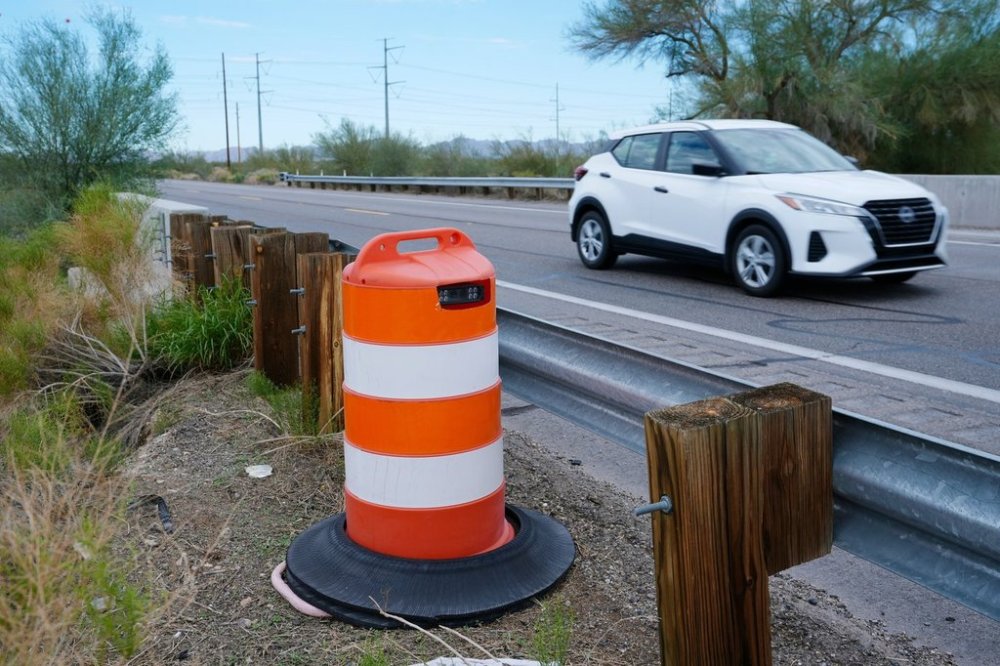
Border Patrol has for years hidden details of its license plate reader program, trying to keep any mention of the program out of court documents and police reports, according to two people familiar with the program. Readers are often disguised along highways in traffic safety equipment like drums and barrels.
The Border Patrol has defined its own criteria for which drivers’ behavior should be deemed suspicious or tied to drug or human trafficking, stopping people for anything from driving on backcountry roads, being in a rental car or making short trips to the border region. The agency’s network of cameras now extends along the southern border in Texas, Arizona and California, and also monitors drivers traveling near the U.S.-Canada border.
The Border Patrol has recently grown even more powerful through collaborations with other agencies, drawing information from license plate readers nationwide run by the Drug Enforcement Administration, private companies and, increasingly, local law enforcement programs funded through federal grants. Texas law enforcement agencies have asked Border Patrol to use facial recognition to identify drivers, documents show.
This active role beyond the borders is part of the quiet transformation of its parent agency, U.S. Customs and Border Protection, into something more akin to a domestic intelligence operation. Under the Trump administration’s heightened immigration enforcement efforts, CBP is now poised to get more than $2.7 billion to build out border surveillance systems such as the license plate reader program by layering in artificial intelligence and other emerging technologies.
What do critics say?
While collecting license plates from cars on public roads has generally been upheld by courts, some legal scholars see the growth of large digital surveillance networks such as Border Patrol’s as raising constitutional questions.
Courts have started to recognize that “large-scale surveillance technology that’s capturing everyone and everywhere at every time” might be unconstitutional under the Fourth Amendment, said Andrew Ferguson, a law professor at George Washington University.
Nicole Ozer, the executive director of the Center for Constitutional Democracy at UC Law San Francisco, expressed alarm when told of AP’s findings.
“They are collecting mass amounts of information about who people are, where they go, what they do, and who they know,” she said. “These surveillance systems do not make communities safer.”
—-
Tau reported from Washington, Laredo, San Antonio, Kingsville and Victoria, Texas. Burke reported from San Francisco. AP writers Aaron Kessler in Washington, Jim Vertuno in San Antonio, AP video producer Serginho Roosblad in Bisbee, Arizona, and AP photographers Ross D. Franklin in Phoenix and David Goldman in Houston contributed reporting. Ismael M. Belkoura in Washington also contributed.
—-
Contact AP’s global investigative team at Investigative@ap.org or https://www.ap.org/tips/.
Related Articles
Border Patrol is monitoring US drivers and detaining those with 'suspicious' travel patterns
Advertisement Advertise With Us
Advertisement Advertise With Us