Concerns raised about AI-powered toys and creativity, development as holiday shopping peaks
Advertisement
Read this article for free:
or
Already have an account? Log in here »
To continue reading, please subscribe:
Digital Subscription
One year of digital access for only $1.44 a week*
- Enjoy unlimited reading on winnipegfreepress.com
- Read the E-Edition, our digital replica newspaper
- Access News Break, our award-winning app
- Play interactive puzzles
*Billed as $5.77 plus GST every four weeks. After 52 weeks, price increases to the regular rate of $19.95 plus GST every four weeks. Offer available to new and qualified returning subscribers only. Cancel any time.
To continue reading, please subscribe:
Add Free Press access to your Brandon Sun subscription for only an additional
$1 for the first 4 weeks*
- Enjoy unlimited reading on winnipegfreepress.com
- Read the E-Edition, our digital replica newspaper
- Access News Break, our award-winning app
- Play interactive puzzles
*Your next Brandon Sun subscription payment will increase by $1.00 and you will be charged $17.95 plus GST for four weeks. After four weeks, your payment will increase to $24.95 plus GST every four weeks.
Read unlimited articles for free today:
or
Already have an account? Log in here »
Hey there, time traveller!
This article was published 26/11/2025 (331 days ago), so information in it may no longer be current.
TORONTO – As parents hunt for gifts that will wow their kids this holiday season, Canadian child development and psychology experts say they should be wary of AI-powered toys because of possible harms, ranging from privacy and security violations to interference with children’s creativity and development.
“Early childhood is a time where the developing brain is a little sponge. It’s taking everything in and it is so malleable,” said Dr. Nicole Racine, an Ottawa child psychologist and scientist at the CHEO Research Institute.
“I think about what kind of inputs do I want my kids to be having? And to be honest, it’s not the inputs of an AI algorithm,” said Racine, who also has two young children.
Her comments follow an advisory for parents issued last week from Fairplay, a U.S.-based organization aiming to protect children from potential technology harms. It was endorsed by dozens of experts, including child advocacy groups, pediatricians, educators and psychologists.
The advisory defines AI toys as “chatbots embedded in everyday children’s toys, like plushies, dolls, action figures or kids’ robots and use artificial intelligence technology designed to communicate like a trusted friend and mimic human characteristics and emotions.”
The AI component is usually prominently advertised so they’re not difficult for parents to spot, said Rachel Franz, director of Fairplay’s Young Children Thrive Offline Program, in an interview. Checking to see if the toy needs to be connected to WiFi is another element to look for, she said.
The toys are cute and marketed as educational and interactive companions that encourage children’s creativity. But child development experts caution that the opposite may be true.
They can curb a child’s imagination because with a regular toy, the child makes up both sides of the conversation, Fairplay says.
In addition, AI chatbots tend to agree with the user, eliminating the experience of navigating conflict and building relationships, experts say.
“How is that child (going to) learn to manage disagreements? ‘Oh, I want to play like this. No, but I want to play that.’ That’s an essential and such a basic function of childhood,” said psychiatrist Dr. Daniela Lobo, medical lead of the problem gambling and technology use treatment service at the Centre for Addiction and Mental Health in Toronto.
Lobo praised Fairplay’s advisory, noting that AI development has far outpaced safety research and is “unregulated.”
“We need to start thinking about, ‘OK, is there proof of safety for us to be using this for children?’ Children’s brains develop super quick, right? So what are we exposing our children to?”
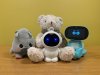
Fairplay lists several examples, including Curio Interactive’s Gabbo, Grem and Grok characters — plush wide-eyed stuffies of a robot, an alien and a rocket ship that kids can ask questions and talk with — as well as Roybi’s robot, which can teach children languages, math and science.
In emailed statements, both Curio Interactive and Roybi said they take child safety and data protection very seriously and comply with the U.S. Children’s Online Privacy Protection Act (COPPA).
“We do not record or store any sensitive data. We never record audio or video. Each child’s profile is created as an anonymous ID with no identifiable personal information attached,” Roybi said.
“Our learning content is developed and approved by certified teachers. It is structured rather than open-ended to ensure the highest ethical use of AI and to provide a safe, guided learning experience for children.”
Their statements also emphasized that parents and caregivers can control their children’s AI experiences.
“We encourage parents to monitor conversations, track insights, and choose the controls that work best for their family on the Curio: Interactive Toys app,” Curio said.
But Racine said that’s not necessarily realistic for parents.
“I think we can say that this is a toy that you should use with your child or you should sit with them and do it,” she said.
“The problem is how that actually plays out in the home and what actually ends up happening.”
On Wednesday afternoon, the Canadian Paediatric Society published a statement on its website saying child health and development experts don’t recommend AI toys for children.

“The best toys encourage activity, imaginative play, or help with developing motor skills,” the society said.
“Many pediatricians are seeing increased rates of developmental, language, and social-emotional delays in young children. And they are concerned that AI toys could worsen this trend by confusing a child’s early understanding of positive relationships — especially in very young hands.”
Fairplay’s advisory also cautioned parents that AI toys can “invade family privacy by collecting a lot of sensitive data.”
“(Kids) often confide in their favourite toys, giving toymakers and third parties access to intimate and private details, including a child’s deeply personal thoughts, emotions, fears and desires,” it says.
Franz said it’s unfair in the absence of adequate regulation to place the onus on parents to figure out how much privacy they may be compromising.
“Trudging through a privacy policy for the average family is extremely difficult,” she said.
Elizabeth Cawley, chief clinical officer of PlaySpace — an online platform for therapists to use play as part of their sessions with children — said she thinks of AI toys the same way she thinks about smartphones and the internet.
“Kids should not just have open access to something that is unregulated and has very little safeguards around it,” she said.
Cawley said given the right regulations and parental supervision, AI could be useful for learning and making play more accessible for some kids — but having a responsible adult “in the loop” is critical.
PlaySpace has its own AI storybook building system where therapists can create customized content for their young patients, but it’s always reviewed by a licensed clinician, she said.
In an emailed statement, the Canadian Toy Association urged parents and caregivers to “shop only from reputable toymakers, brands, and retailers who prioritize children’s safety above all else.”
The office of Evan Solomon, federal minister of artificial intelligence and digital innovation, said in a statement that it is “monitoring how AI is being built into consumer products, including those designed for children.”
“We recognize the concerns being raised by experts,” said press secretary Sofia Ouslis, noting that “Health Canada is responsible for the safety of consumer products, including toys.”
The Canadian Press reached out to Health Canada for comment, but it was not able to provide a response before deadline.
This report by The Canadian Press was first published Nov. 26, 2025.
Canadian Press health coverage receives support through a partnership with the Canadian Medical Association. CP is solely responsible for this content.
Related Articles
There’s no holiday from tariffs for Manitoba retailers


Advertisement Advertise With Us
Advertisement Advertise With Us