

Bulgaria’s government withdraws controversial budget after major protests
Advertisement
Read this article for free:
or
Already have an account? Log in here »
To continue reading, please subscribe:
Monthly Digital Subscription
$1 per week for 24 weeks*
- Enjoy unlimited reading on winnipegfreepress.com
- Read the E-Edition, our digital replica newspaper
- Access News Break, our award-winning app
- Play interactive puzzles
*Billed as $4.00 plus GST every four weeks. After 24 weeks, price increases to the regular rate of $19.95 plus GST every four weeks. Offer available to new and qualified returning subscribers only. Cancel any time.
Monthly Digital Subscription
$4.99/week*
- Enjoy unlimited reading on winnipegfreepress.com
- Read the E-Edition, our digital replica newspaper
- Access News Break, our award-winning app
- Play interactive puzzles
*Billed as $19.95 plus GST every four weeks. Cancel any time.
To continue reading, please subscribe:
Add Free Press access to your Brandon Sun subscription for only an additional
$1 for the first 4 weeks*
*Your next subscription payment will increase by $1.00 and you will be charged $16.99 plus GST for four weeks. After four weeks, your payment will increase to $23.99 plus GST every four weeks.
Read unlimited articles for free today:
or
Already have an account? Log in here »
SOFIA, Bulgaria (AP) — Bulgaria’s government said Tuesday it is withdrawing a controversial budget proposal after an evening demonstration drew tens of thousands of peaceful participants that was later marred by clashes between a much smaller group of masked men and police.
Opposition and business groups have warned that plans for higher taxes, increased social security contributions and spending increases could hurt investment and expand the shadow economy as the country prepares to join the eurozone at the start of next year.
The center-right government of Prime Minister Rosen Zhelyazkov first promised to withdraw the draft for thorough revision after protests last week, but later backtracked, sparking protests in the capital, Sofia, and other major cities on Monday night. Organizers said that 50,000 people rallied in Sofia.
Protesters, many of them young Bulgarians, called for the government to revise the draft budget or step down.
“We will not allow ourselves to be lied to; we will not allow ourselves to be robbed,” people chanted at the protest in Sofia.
Banners included slogans like: “Young Bulgaria without the Mafia.”
Bulgarian President Rumen Radev, an opponent of the government who hails from the political left, weighed in on the side of the protesters in a televised address to the nation on Tuesday evening. He said changes were needed that “will lead to the rule of law and the restoration of statehood.”
“The government is disgraced. Resignation is urgent. Early elections are the only way forward,” Radev said.
He urged Bulgarians “not to miss the opportunity to change Bulgaria,” while also calling for “unity, will and wisdom to preserve peace from provocations.”
Earlier in the day, Prime Minister Zhelyazkov listed several changes that will be made, including a review of the investment program, and did not rule out the possibility of entering 2026 with an extended budget from this year.
“We will do what is necessary to ensure that the budget is consensual,” Zhelyazkov said after a government meeting.
He said that the government is ready for compromises but would not bow to demands to step down.
Mario Bikarski, senior Eastern and Central Europe analyst at the risk intelligence company Verisk Maplecroft, predicted that redoing the budget “will be rocky with increased scrutiny from unions, business groups and the public.”
“There is broad consensus about the need for fiscal prudence,” he added in emailed comments. “However, repeated attempts to increase taxes are likely to inflame social tensions further.”
Organizers had urged demonstrators to keep Monday’s protest peaceful, warning that provocations were possible and calling on anyone witnessing such acts to record them.
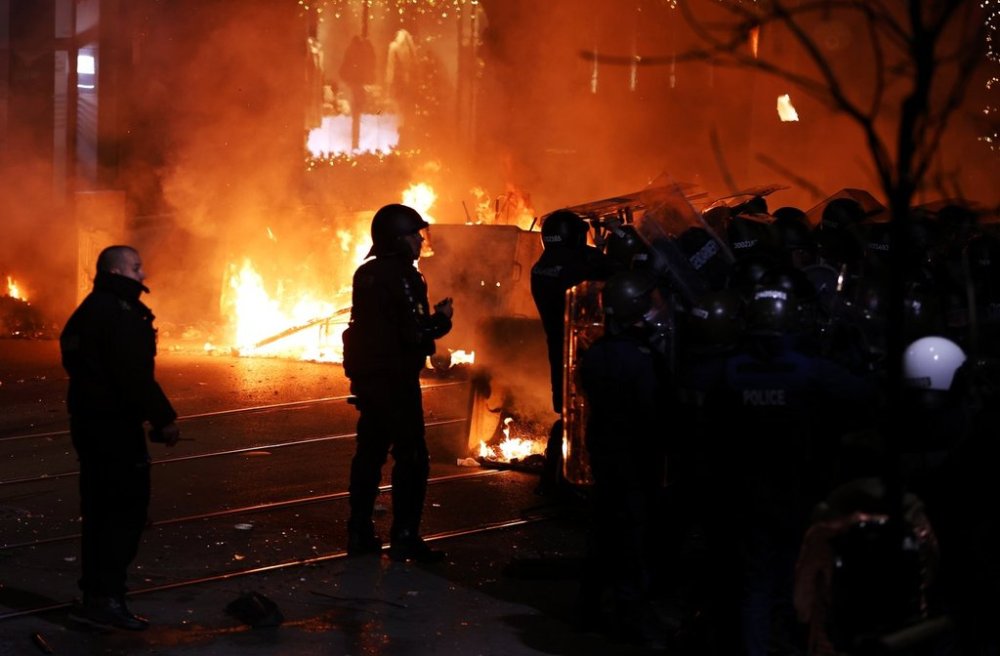
Tensions escalated as small groups of protesters moved to the offices of the main ruling parties and started throwing plastic and glass bottles, firecrackers and stones at the buildings and police officers guarding them.
Clashes erupted between police officers and young people dressed in black hoodies and masks, while garbage containers were burned and police vehicles were vandalized. Police in full riot gear pepper-sprayed protesters.
Emergency services reported that several injured people were taken to hospitals, while many were examined and provided with assistance on the spot.
“The protest proceeded peacefully, quietly, and calmly, and I congratulate the citizens for that,” Sofia police chief, Lyubomir Nikolov, told reporters on Tuesday. He explained that the escalation was caused by individuals who had been organized in advance and added that a total of 71 people has been detained.

The leader of the opposition We Continue the Change party, Assen Vassilev, told reporters on Tuesday that it plans to submit a no-confidence motion in Parliament “if the government does not resign this week.”
“This government does not have the moral right to govern the country any longer,” he added.
Even if the budget is redone, public concerns about large-scale corruption will keep the government unpopular, particularly with the younger urban electorate.
Bikarski, the analyst, argues that increased public pressure could cause the collapse of the fragile governing coalition and lead to another early election, which would be the eighth since 2021. And that would not bode well for investor confidence.
“Such a scenario would risk negating some of the operational advantages that businesses were hoping to enjoy from joining the euro area,” he added.