

City needs province to step in with enforceable vacant building law

Advertisement
Read this article for free:
or
Already have an account? Log in here »
To continue reading, please subscribe:

Digital Subscription
One year of digital access for only $205*
- Enjoy unlimited reading on winnipegfreepress.com
- Read the E-Edition, our digital replica newspaper
- Access News Break, our award-winning app
- Play interactive puzzles
*First annual payment billed as $205.00 + GST for one year. This annual subscription will automatically renew at $233.00 + GST every 52 weeks (10% off the regular annual price of $259.35). Offer available to new and qualified returning subscribers only. Cancel any time.
To continue reading, please subscribe:
Add Free Press access to your Brandon Sun subscription for only an additional
$1 for the first 4 weeks*
- Enjoy unlimited reading on winnipegfreepress.com
- Read the E-Edition, our digital replica newspaper
- Access News Break, our award-winning app
- Play interactive puzzles
*Your next Brandon Sun subscription payment will increase by $1.00 and you will be charged $17.95 plus GST for four weeks. After four weeks, your payment will increase to $24.95 plus GST every four weeks.
Read unlimited articles for free today:
or
Already have an account? Log in here »
Hey there, time traveller!
This article was published 02/12/2025 (292 days ago), so information in it may no longer be current.
The City of Winnipeg’s long-awaited review of how to tackle vacant and derelict homes landed last week. On the surface, it looks ambitious.
After years of soaring vacancy numbers, persistent fires, and entire blocks deteriorating in neighbourhoods such as William Whyte, city officials are finally proposing a more muscular approach.
There are dozens of recommendations, partnerships with Manitoba Housing, tweaks to tax-sale timelines, and a renewed push to use the city’s little-used power to take title of properties from non-compliant owners without compensation.
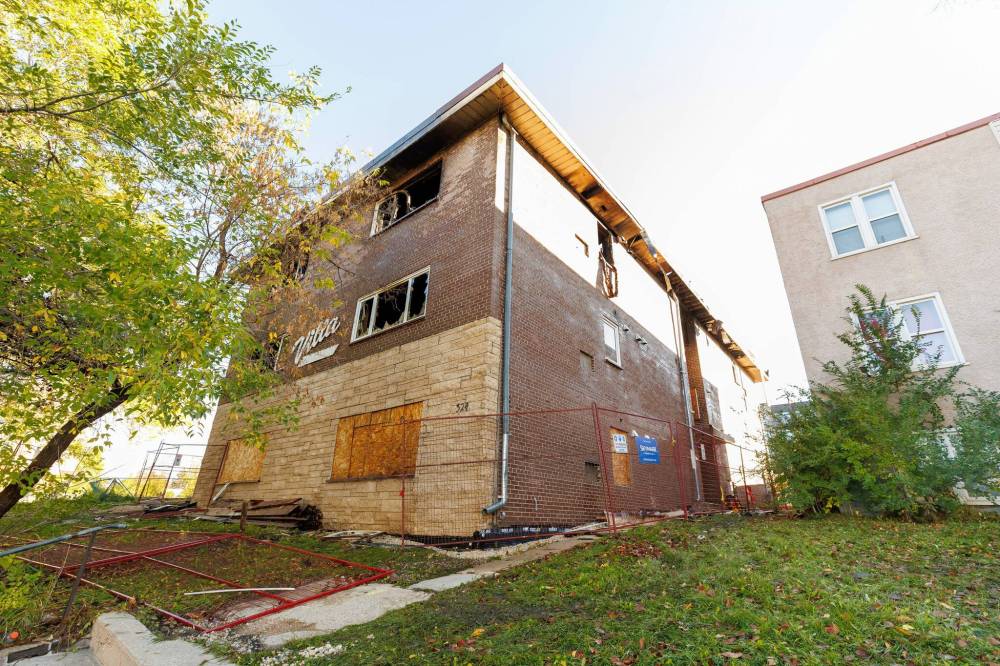
MIKE DEAL / FREE PRESS FILES
Winnipeg has hundreds of properties that have been vacant for years. A fire broke out at this vacant apartment building at Enfield Crescent and Marion Street in the fall.
It’s a step in the right direction. But it’s not enough.
The core problem isn’t complicated. Winnipeg has hundreds of properties that have been vacant for years. Some sit empty because owners lack the means to fix them.
But many are owned by investors who know exactly what they’re doing: they comply with the minimum bylaw requirements, pay their taxes and vacant-building fees, keep the property boarded up just enough to avoid triggering enforcement and then sit on it for five, 10, even 15 years.
They may be banking on future land values, waiting for the right moment to cash out or simply treating the property as a tax writeoff.
And under current law — both municipal and provincial — there’s not much the city can do about it.
The report confirms what community groups and fire officials have been shouting for years. Vacant buildings are magnets for crime, arson, trespassing and dumping. They erode safety, depress property values, strain emergency services and destabilize entire neighbourhoods.
Yet despite the severity of the problem, the city’s tools remain almost entirely reactive. Officials can’t prohibit vacancies outright. They can’t force an owner to rent or sell. They can’t cap how long a building can sit empty.
And the “taking title without compensation” process — while powerful on paper — applies only when a property owner has already been convicted of violating the vacant-building bylaw. Even then, owners are given multiple chances to comply with bylaw regulations, even after a conviction, to avoid losing their properties.
It’s a threat that works on the most negligent landlords, but the chronic ones who follow the rules just enough to avoid having their properties taken by the city? They sail right through.
Even the empty-building fee — which would be restructured so it escalates from one per cent to five per cent of assessed value over five years — won’t deter the worst offenders. Many of them already treat the fee as the cost of doing business between speculative cycles.
And as the report makes clear, the city legally can’t pass a bylaw prohibiting long-term vacancy. That’s a provincial limitation.
Which brings us to the real issue: nothing changes unless the province changes the law.
Winnipeg needs a far more robust legislative framework, one that empowers municipalities to impose a hard cap on how long a home can remain vacant. Five years. Seven years. Pick a number, but make it enforceable.
The city’s own data shows the scale of deterioration. Vacant buildings under enforcement have surged 45 per cent in less than four years, from 543 in 2021 to 788 today. Many of the hardest-hit neighbourhoods are also the poorest — the very places where capital has been fleeing for decades.
The economic abandonment of these communities is well-known. What’s changed is how rapidly the consequences are accelerating.
The city’s five major interventions — partnerships to build more affordable housing, better use of title-taking powers, reducing tax-sale timelines, escalating vacant-building fees and formalizing programs to accept distressed properties — all make sense. Each will improve conditions at the margins.
But none of these measures address the small but influential group of chronic slum landlords who keep properties vacant indefinitely, legally and with virtually no consequences.
That’s the real crisis.
When an owner can keep a house boarded up for a decade and still remain “in compliance,” the system is broken. When taxpayers shell out millions in fire-response costs because a handful of negligent owners let their buildings become neighbourhood tinderboxes, the system is broken.

So yes, the city’s report is well-researched, thorough and thoughtful. But it stops short of the only reform that will truly turn the tide: provincial legislation giving Winnipeg the power to compel action when a property sits empty for too long.
Not encourage. Not incentivize. Compel.
A five- or seven-year maximum vacancy period is the only realistic way to disrupt the cycle of abandonment. Without that, every other measure is just nibbling at the edges.
The city has finally put forward a plan. But unless the province steps up and gives municipalities real power to deal with long-term vacancy, we’ll be having this exact same conversation five years from now — with even more burned-out shells, more fire calls, more boarded-up windows and more neighbourhoods paying the price for political hesitation.
tom.brodbeck@freepress.mb.ca
Tom Brodbeck is an award-winning author and columnist with over 30 years experience in print media. He joined the Free Press in 2019. Born and raised in Montreal, Tom graduated from the University of Manitoba in 1993 with a Bachelor of Arts degree in economics and commerce. Read more about Tom.
Tom provides commentary and analysis on political and related issues at the municipal, provincial and federal level. His columns are built on research and coverage of local events. The Free Press’s editing team reviews Tom’s columns before they are posted online or published in print – part of the Free Press’s tradition, since 1872, of producing reliable independent journalism. Read more about Free Press’s history and mandate, and learn how our newsroom operates.
Our newsroom depends on a growing audience of readers to power our journalism. If you are not a paid reader, please consider becoming a subscriber.
Our newsroom depends on its audience of readers to power our journalism. Thank you for your support.
Tom Brodbeck is an award-winning author and columnist with over 30 years experience in print media. He joined the Free Press in 2019. Born and raised in Montreal, Tom graduated from the University of Manitoba in 1993 with a Bachelor of Arts degree in economics and commerce. Read more about Tom.
Tom provides commentary and analysis on political and related issues at the municipal, provincial and federal level. His columns are built on research and coverage of local events. The Free Press’s editing team reviews Tom’s columns before they are posted online or published in print – part of the Free Press’s tradition, since 1872, of producing reliable independent journalism. Read more about Free Press’s history and mandate, and learn how our newsroom operates.
Our newsroom depends on a growing audience of readers to power our journalism. If you are not a paid reader, please consider becoming a subscriber.
Our newsroom depends on its audience of readers to power our journalism. Thank you for your support.
Related Articles
City seizing derelict homes sooner would be game changer: William Whyte resident


Advertisement Advertise With Us
Advertisement Advertise With Us